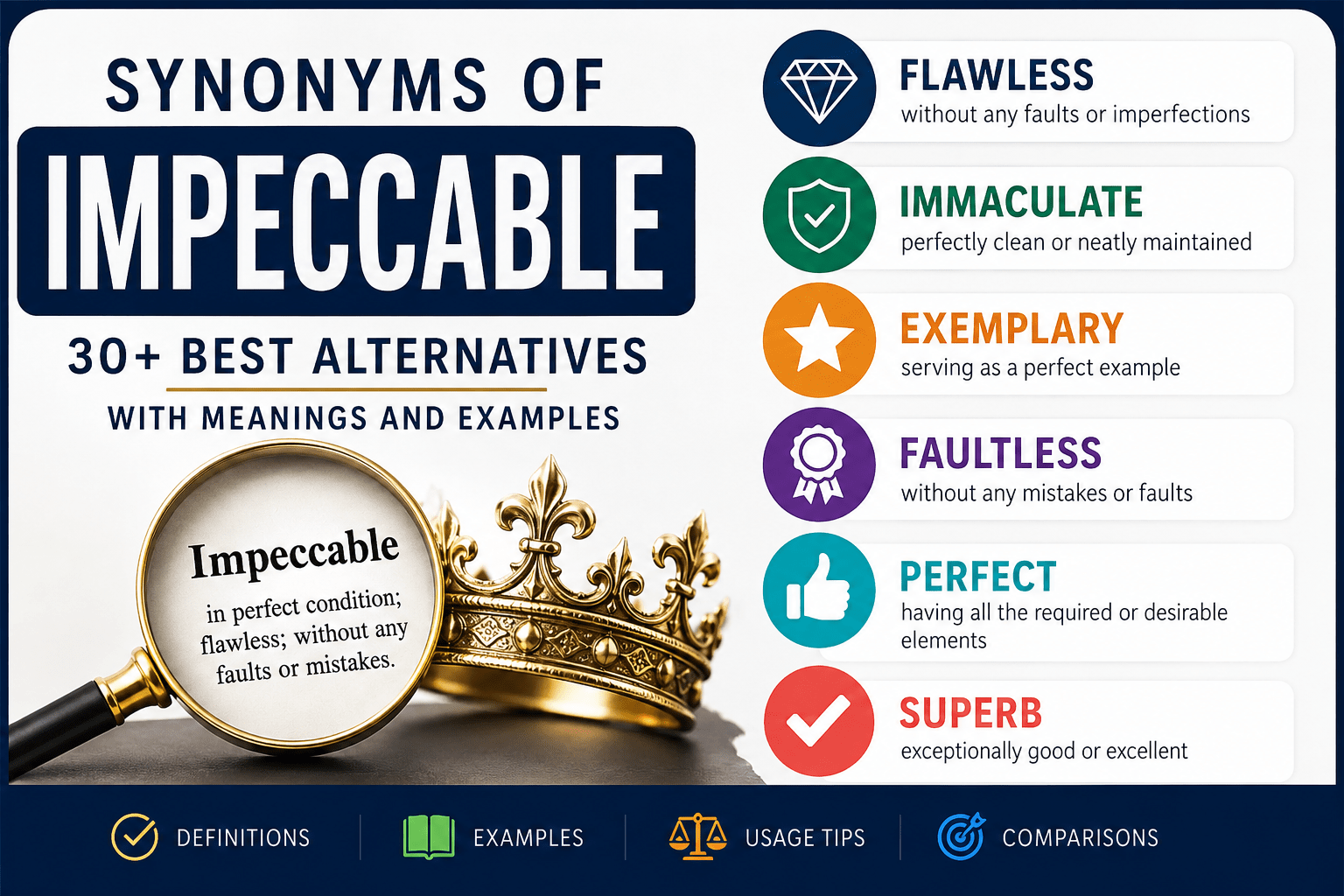
Finding the right synonym for impeccable depends on what you are describing. The word usually means completely free from faults, mistakes, or criticism. Common alternatives include flawless, faultless, perfect, immaculate, unblemished, irreproachable, and excellent, but they are not interchangeable in every sentence. Cambridge defines impeccable as perfect or without problems or bad parts, while Merriam-Webster emphasizes being free from fault or blame.
This guide explains the closest synonyms, their differences, natural contexts, and how to choose the best word.
Quick Answer: What Are the Best Synonyms of Impeccable?
The closest synonyms of impeccable are flawless, faultless, perfect, immaculate, unblemished, irreproachable, and excellent. The best choice depends on context: flawless emphasizes the absence of defects, faultless emphasizes the absence of mistakes, immaculate often emphasizes spotless condition or exceptional neatness, and irreproachable emphasizes being beyond criticism or blame. Cambridge and Merriam-Webster both list several of these words among the established synonyms of impeccable.
Core Synonyms of Impeccable
| Word | Relationship | Meaning | Best Context |
| Flawless | Direct synonym | Without any flaw or defect | Performance, appearance, work |
| Faultless | Direct synonym | Without mistakes or faults | Performance, judgment, behavior |
| Perfect | Very close synonym | Complete and without defects | General use |
| Immaculate | Near synonym | Extremely clean, neat, or free from flaws | Appearance, condition, writing |
| Unblemished | Near synonym | Without marks, damage, or negative history | Reputation, record, appearance |
| Irreproachable | Near synonym | Impossible to criticize or blame | Conduct, character, reputation |
| Excellent | Contextual alternative | Extremely good | Work, service, performance |
| Superb | Contextual alternative | Exceptionally good | Quality, performance, service |
| Ideal | Contextual alternative | Best or most suitable | Conditions, solutions, situations |
| Exemplary | Contextual alternative | Worthy of imitation | Behavior, conduct, performance |
| Polished | Contextual alternative | Refined and highly developed | Writing, presentation, performance |
| Unassailable | Contextual alternative | Impossible to challenge or attack | Arguments, evidence, reputation |
| Blameless | Near synonym | Free from guilt or fault | Conduct, responsibility |
| Unimpeachable | Near synonym | Beyond doubt or criticism | Credentials, integrity, evidence |
| Seamless | Contextual alternative | Smooth and without noticeable problems | Processes, experiences, transitions |
Not every word above has exactly the same meaning as impeccable. The distinctions matter.
What Does Impeccable Mean?
Impeccable is an adjective meaning free from faults, mistakes, defects, or blame. It is commonly used for things such as manners, taste, credentials, service, timing, language, performance, and reputation. Cambridge gives examples such as impeccable taste, impeccable manners, and impeccable credentials.
Merriam-Webster also notes a historical sense meaning incapable of sinning, but modern everyday English overwhelmingly uses impeccable in the sense of flawless or faultless.
Examples:
- She has impeccable manners.
- His timing was impeccable.
- The hotel is known for its impeccable service.
- She has an impeccable reputation.
- His English is impeccable.
1. Flawless
Flawless is probably the closest general-purpose synonym for impeccable. It means having no flaws, imperfections, or defects.
Best for: appearance, performance, work, execution, and results.
Example:
The team delivered a flawless performance.
Impeccable vs flawless
These words overlap heavily, but flawless often focuses more directly on the absence of imperfections or defects. Impeccable can carry a stronger sense of being beyond criticism, particularly when describing conduct, manners, judgment, or service.
- Flawless execution — emphasizes no mistakes or defects.
- Impeccable judgment — emphasizes exceptionally sound judgment.
2. Faultless
Faultless means free from faults or mistakes. It is especially natural when discussing performance, behavior, reasoning, or execution.
Example:
The pianist gave a faultless performance.
Best choice when: you want to emphasize that nothing went wrong.
Faultless is listed by Cambridge and Merriam-Webster among the established synonyms of impeccable.
3. Perfect
Perfect is broader and more common than impeccable. It can mean complete, ideal, or entirely without faults.
Example:
She gave the perfect answer.
Impeccable vs perfect
Perfect is more flexible and everyday. Impeccable often sounds more polished and evaluative.
Compare:
- perfect timing — ordinary and natural.
- impeccable timing — more formal and strongly complimentary.
If you want the safest everyday alternative, perfect is often appropriate. If you want a more sophisticated compliment, impeccable may be better.
4. Immaculate
Immaculate can mean completely clean or spotless, but it can also mean free from flaws or imperfections. Cambridge includes it among the synonyms of impeccable.
Examples:
- The car was in immaculate condition.
- She wore an immaculate suit.
- He writes in immaculate prose.
Impeccable vs immaculate
Use immaculate when cleanliness, neatness, condition, or visual perfection is important.
Use impeccable when the emphasis is more broadly on excellence or freedom from criticism.
- Immaculate appearance → exceptionally neat or spotless.
- Impeccable manners → beyond criticism.
- Immaculate condition → extremely well maintained.
5. Unblemished
Unblemished means without marks, damage, defects, or a negative stain on one’s reputation or record.
Examples:
- She has an unblemished record.
- The candidate has an unblemished reputation.
- The painting remains unblemished.
This word is particularly useful for records, reputations, histories, and physical surfaces. Cambridge specifically identifies unblemished and untarnished as related alternatives in appropriate contexts.
6. Irreproachable
Irreproachable means impossible or difficult to criticize or blame.
Example:
His professional conduct was irreproachable.
This is more formal than excellent and is especially useful for behavior, conduct, character, and professional standards.
Choose irreproachable when: the important idea is that nobody can reasonably find fault with someone’s conduct.
7. Excellent
Excellent means extremely good or of very high quality.
Example:
The restaurant provides excellent service.
Unlike impeccable, excellent does not necessarily mean absolutely free of faults.
That distinction is important:
Excellent = extremely good.
Impeccable = so good that faults or criticism are essentially absent.
For casual or professional communication, excellent is often more natural and less formal.
8. Superb
Superb means exceptionally good or impressive.
Example:
The chef prepared a superb meal.
It works especially well for:
- food
- performances
- service
- craftsmanship
- artistic work
Unlike impeccable, superb emphasizes exceptional quality rather than specifically being free from faults.
9. Ideal
Ideal means the best or most suitable for a particular purpose.
Example:
This location is ideal for a family vacation.
Ideal is not a universal synonym for impeccable. It works when the intended meaning is perfectly suited, not simply without flaws.
Compare:
- Impeccable service → service without faults.
- Ideal service location → a location that is especially suitable.
10. Exemplary
Exemplary means serving as a model that others should imitate.
Example:
Her leadership was exemplary.
It is particularly useful for:
- behavior
- leadership
- conduct
- professional performance
- standards
Exemplary differs from impeccable because it adds the idea of being a model for others.
11. Polished
Polished describes something refined, well-developed, sophisticated, or skillfully presented.
Examples:
- She delivered a polished presentation.
- His writing is polished and professional.
It is a good contextual alternative when impeccable refers to refinement or quality of presentation.
However, polished does not necessarily mean completely faultless.
12. Unassailable
Unassailable means impossible to attack, challenge, or successfully criticize.
Example:
The researcher presented an unassailable argument.
This is best for:
- arguments
- evidence
- reasoning
- positions
- reputations
It is not a general substitute for impeccable.
13. Blameless
Blameless means not responsible for wrongdoing or fault.
Example:
The investigation concluded that she was blameless.
This word is especially appropriate for responsibility and wrongdoing, rather than general excellence.
14. Unimpeachable
Unimpeachable means beyond doubt, criticism, or suspicion.
Examples:
- He has unimpeachable credentials.
- The evidence came from an unimpeachable source.
It is especially useful in formal contexts involving credibility, integrity, evidence, or reputation.
15. Seamless
Seamless means smooth and without noticeable interruptions, problems, or awkward transitions.
Example:
The company provided a seamless customer experience.
It can replace impeccable in certain contexts involving service or processes, but it is not a direct synonym. The focus changes from faultlessness to smoothness.
Synonyms of Impeccable by Context
For People
When describing someone’s character, behavior, or conduct, consider:
- irreproachable
- exemplary
- blameless
- faultless
- unimpeachable
Example:
Her conduct throughout the investigation was irreproachable.
For Work and Performance
The strongest choices include:
- flawless
- faultless
- excellent
- superb
- exemplary
- polished
Example:
The production team delivered a flawless performance.
For Service
Natural choices include:
- excellent
- exceptional
- superb
- faultless
- outstanding
- flawless
Example:
The hotel is famous for its impeccable service.
For a slightly less formal tone:
The hotel is famous for its excellent service.
For Appearance and Condition
Consider:
- immaculate
- flawless
- perfect
- pristine
- unblemished
Example:
The vintage car was in immaculate condition.
For Reputation or Record
The strongest contextual choices are:
- unblemished
- untarnished
- unimpeachable
- irreproachable
- unassailable
Example:
She has an unblemished professional record.
For Writing and Language
Natural alternatives include:
- flawless
- faultless
- polished
- perfect
- excellent
Example:
His report was flawless and required no revisions.
Which Word Should I Use?
Choose flawless when:
You mean there are no defects, mistakes, or imperfections.
Choose faultless when:
You want to emphasize that there were no mistakes or faults.
Choose immaculate when:
The focus is cleanliness, neatness, condition, or visual perfection.
Choose perfect when:
You want the most common and flexible alternative.
Choose irreproachable when:
Someone’s conduct or behavior is beyond criticism.
Choose unblemished when:
You are talking about a record, reputation, history, or physical surface without marks.
Choose exemplary when:
Something is so good that it provides a model for others.
Choose excellent when:
You simply want to say something is extremely good without implying absolute perfection.
Choose unimpeachable when:
The focus is credibility, integrity, evidence, or something that cannot reasonably be challenged.
Impeccable vs. Flawless
Both words describe something without faults or defects.
Impeccable is often broader and can describe qualities such as manners, taste, judgment, service, credentials, and reputation.
Flawless focuses more directly on the absence of flaws or imperfections.
Examples:
She has impeccable manners.
The dancer gave a flawless performance.
Both are natural, but the second sentence places stronger emphasis on execution without mistakes.
Impeccable vs. Faultless
Faultless specifically emphasizes the absence of faults or mistakes.
His faultless performance impressed the judges.
Impeccable can communicate the same idea but also works naturally with qualities such as taste, manners, credentials, and service.
Her impeccable taste was obvious.
A useful rule:
faultless → no mistakes or faults
impeccable → no faults and beyond criticism
Impeccable vs. Immaculate
These words overlap, but they often emphasize different things.
Immaculate commonly suggests spotless cleanliness, excellent condition, or exceptional neatness.
Impeccable more often emphasizes faultlessness or an absence of criticism.
The apartment was immaculate.
His manners were impeccable.
Both can describe writing:
She writes in immaculate prose.
She writes with impeccable grammar.
Cambridge lists immaculate as a synonym of impeccable while also illustrating its use with writing and appearance.
Impeccable vs. Perfect
Perfect is the more common everyday word.
Impeccable sounds more formal, polished, and evaluative.
Compare:
You have perfect manners.
You have impeccable manners.
The second sounds like a more deliberate and sophisticated compliment.
However, perfect has meanings that impeccable does not. For example, something can be the perfect choice because it is ideally suited to a situation. In that context, impeccable would not necessarily work.
Common Mistakes When Choosing a Synonym
Mistake 1: Treating every positive adjective as an exact synonym
Words such as excellent, superb, and outstanding indicate very high quality, but they do not necessarily mean completely free from faults.
Mistake 2: Using immaculate only to mean excellent
Immaculate often carries a strong sense of cleanliness, neatness, or pristine condition.
Mistake 3: Using ideal as a universal replacement
Ideal means best or most suitable for a particular purpose. It does not simply mean flawless.
Mistake 4: Using exemplary for physical perfection
Exemplary normally introduces the idea of being a model worth imitating. It is therefore much more natural for conduct, leadership, or performance than for physical appearance.
Mistake 5: Choosing a word without considering collocation
A synonym may be grammatically correct but still sound unnatural with a particular noun.
For example:
Impeccable manners ✓
Flawless manners possible but less idiomatic
Flawless performance ✓
Impeccable performance ✓
The best synonym is not always the closest dictionary definition; it is the word that naturally fits the context.
Common Collocations With Impeccable
Some especially useful phrases include:
- impeccable manners
- impeccable taste
- impeccable service
- impeccable credentials
- impeccable reputation
- impeccable timing
- impeccable judgment
- impeccable English
- impeccable grammar
- impeccable record
- impeccable performance
- impeccable style
- impeccable standards
- impeccable conduct
- impeccable presentation
These phrases are useful because they show where impeccable sounds natural in real English.
Antonyms of Impeccable
The opposite of impeccable is something containing faults, defects, or grounds for criticism.
Useful antonyms include:
- flawed
- faulty
- defective
- imperfect
- blemished
- tarnished
- blameworthy
- deficient
- culpable
The best antonym depends on context.
For example, an impeccable reputation can become a tarnished reputation, while impeccable work may be described as flawed work when errors appear. Similarly, impeccable conduct is the opposite of blameworthy conduct.
Cambridge lists several of these contrasting terms, including flawed, faulty, tarnished, and blameworthy.
Pronunciation of Impeccable
US: /ɪmˈpek.ə.bəl/
UK: /ɪmˈpek.ə.bəl/
The stress falls on the second syllable:
im-PEK-uh-buhl
Cambridge gives the same core pronunciation for both American and British English.
Etymology of Impeccable
Impeccable ultimately comes from the Latin impeccabilis, formed from in- meaning “not” and peccare, meaning “to sin.”
Its earlier English sense was connected with being incapable of sinning. Modern English most commonly uses the word to mean flawless, faultless, or free from blame. Merriam-Webster records English use from the 16th century and identifies 1531 as its first known use.
FAQ About Synonyms of Impeccable
What is the closest synonym for impeccable?
Flawless is one of the closest general synonyms for impeccable. Faultless and perfect are also very close. The best choice depends on context: flawless often emphasizes the absence of defects, while faultless emphasizes the absence of mistakes.
What is a formal synonym for impeccable?
Irreproachable and unimpeachable are useful formal alternatives in specific contexts. Irreproachable is especially suitable for conduct or behavior, while unimpeachable often describes credibility, evidence, credentials, or integrity.
Is flawless the same as impeccable?
They are very close, but not identical in every context. Flawless emphasizes the absence of flaws or imperfections, whereas impeccable can also suggest that something is beyond criticism. Both can describe excellent performance, work, or appearance.
What is a synonym for impeccable service?
Depending on the intended meaning, good alternatives include excellent service, exceptional service, superb service, flawless service, and faultless service. Excellent is more general and natural in everyday business writing, while impeccable is a stronger, more polished compliment.
What is another word for impeccable manners?
Good alternatives include faultless manners, exemplary manners, irreproachable manners, and perfect manners. Exemplary is especially useful when you want to emphasize that the person’s behavior is a model for others.
What is a synonym for an impeccable reputation?
Useful alternatives include unblemished reputation, untarnished reputation, unimpeachable reputation, and irreproachable reputation. Unblemished and untarnished are especially natural when emphasizing a clean record or absence of scandal.
Is immaculate a synonym for impeccable?
Yes, in some contexts. Both can describe something without flaws, but immaculate often emphasizes cleanliness, neatness, or pristine condition. Impeccable is broader and commonly describes manners, service, judgment, taste, credentials, and reputation.
Is excellent stronger than impeccable?
Usually, no. Excellent means extremely good, while impeccable normally suggests that there are no faults or grounds for criticism. However, strength depends on context and the speaker’s intended meaning.
Conclusion
The best synonym for impeccable depends on what you are describing. Flawless is an excellent general alternative, faultless emphasizes the absence of mistakes, immaculate suits cleanliness and condition, unblemished works well for records and reputations, and irreproachable emphasizes conduct beyond criticism. Perfect is the most flexible everyday option, while excellent is a natural but slightly broader alternative.
The key is not to choose the most sophisticated-looking word. Choose the synonym whose meaning, tone, and collocation fit the sentence most naturally.

Daniel Carter is a professional content strategist and language enthusiast. He focuses on semantic SEO, keyword research, and creating structured vocabulary content that ranks well on search engines while remaining user-friendly.