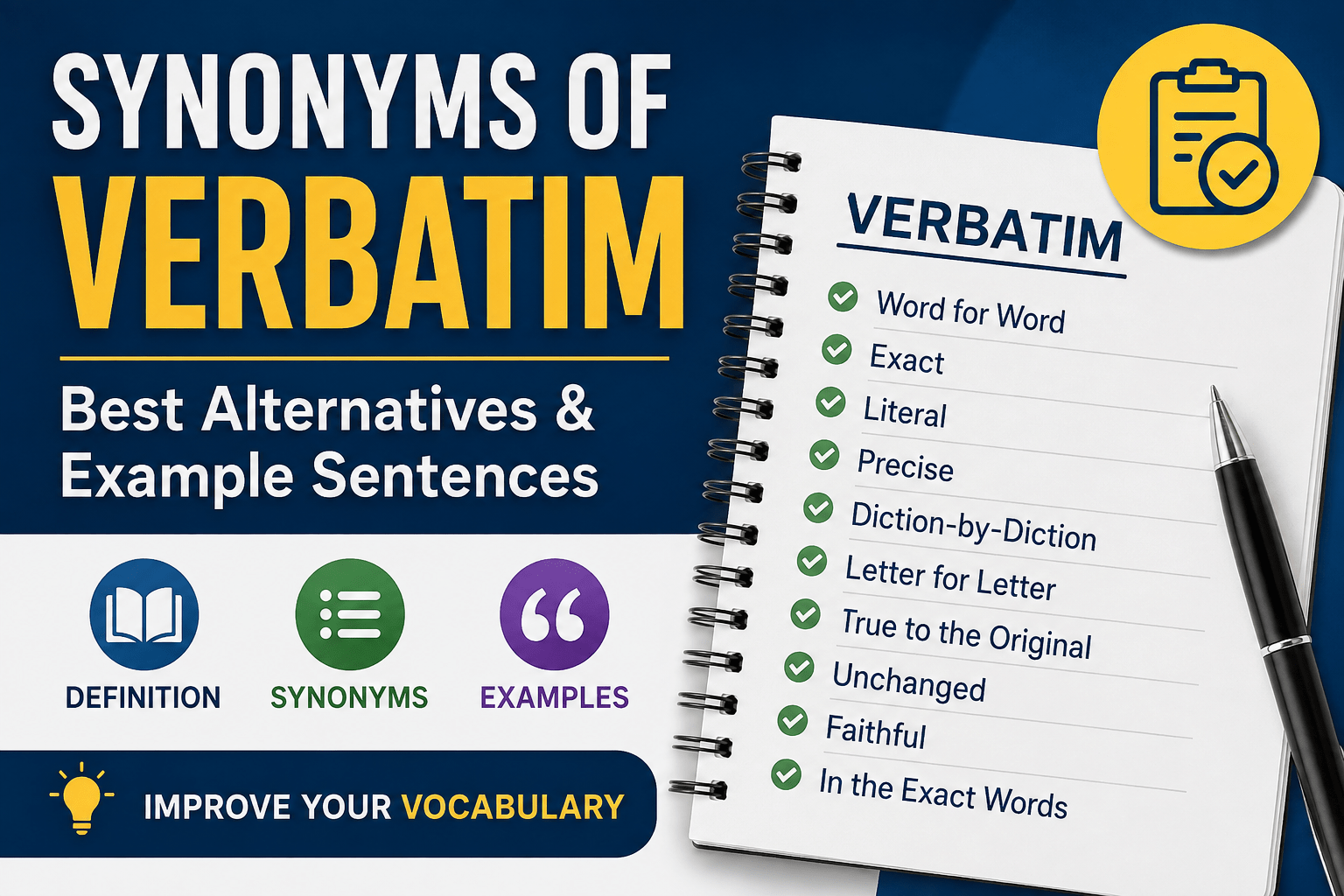
If you are looking for synonyms of verbatim, the closest choices are word for word, exactly, precisely, literally, faithfully, and to the letter. However, these alternatives are not interchangeable in every sentence. Verbatim specifically emphasizes reproducing the same words used in the original speech or writing, so the best replacement depends on the context.
This guide explains the closest synonyms, shows where each one works naturally, and helps you choose the right alternative for conversations, reports, quotations, transcripts, and formal writing.
Quick Answer: What Are the Best Synonyms of Verbatim?
The closest synonyms of verbatim are:
- Word for word — using exactly the same words.
- Exactly — with no difference, especially when emphasizing exact reproduction.
- Precisely — exactly and accurately.
- Literally — in the exact or direct sense, although it is not always a true substitute for verbatim.
- Faithfully — reproducing something accurately and without significant alteration.
- To the letter — following or reproducing something exactly.
- Accurately — correctly representing the original, although accuracy does not necessarily mean identical wording.
- Directly — useful in contexts involving direct quotation or reproduction, but not a universal synonym.
- Identically — exactly the same, especially when comparing versions.
- Line for line — reproducing written material in the same sequence and wording.
The safest everyday replacement is usually word for word because it preserves the central meaning of verbatim. Oxford explicitly lists word for word as a synonym of verbatim.
What Does Verbatim Mean?
Verbatim means using exactly the same words that were originally spoken or written. It can function as both an adjective and an adverb.
For example:
- Adverb: She repeated the instructions verbatim.
- Adjective: The journalist published a verbatim transcript.
Cambridge defines the word as using exactly the same words originally used, while Oxford describes it as meaning “exactly as spoken or written.”
Merriam-Webster traces verbatim to Medieval Latin verbatim, from Latin verbum, meaning “word.” The word has been used in English since the 15th century.
Pronunciation
- US: /vərˈbeɪtəm/
- UK: /vɜːˈbeɪtɪm/
Core Synonyms of Verbatim
| Word or phrase | Relationship | Best meaning | Formality | Best context |
|---|---|---|---|---|
| Word for word | Direct synonym | Exactly the same words | Neutral | Speech, writing, quotations |
| Exactly | Near synonym | Without alteration or difference | Neutral | General conversation and writing |
| Precisely | Near synonym | Exactly and accurately | Neutral/Formal | Reports, explanations |
| Literally | Contextual alternative | In the exact/direct sense | Neutral | Meaning, translation, quotations |
| Faithfully | Near synonym | Accurately reproducing the original | Neutral/Formal | Reports, adaptations |
| To the letter | Contextual alternative | Exactly according to instructions or wording | Neutral | Instructions, rules |
| Accurately | Near synonym | Correctly representing the original | Neutral/Formal | Reports and records |
| Identically | Contextual alternative | Exactly the same | Formal | Copies, versions, comparisons |
| Directly | Contextual alternative | Taken or quoted directly | Neutral | Quotations and sources |
| Line for line | Contextual alternative | Matching each line | Neutral/Formal | Written texts |
Collins lists exactly, to the letter, word for word, closely, precisely, and faithfully among the relevant alternatives for verbatim. Merriam-Webster likewise lists directly, accurately, exactly, word for word, and precisely.
1. Word for Word
Word for word is the closest and most straightforward alternative to verbatim.
It means that the same words are reproduced in the same wording.
Example:
The witness repeated the conversation word for word.
You can usually replace verbatim with word for word:
She repeated the statement verbatim.
She repeated the statement word for word.
Best for:
- conversations
- quotations
- transcripts
- speeches
- written passages
Choose “word for word” when you want the clearest everyday expression.
2. Exactly
Exactly emphasizes complete agreement or lack of difference. It can replace verbatim when the context makes clear that the issue is the original wording.
Example:
He repeated exactly what the manager had said.
However, exactly is broader than verbatim. Something can be exactly correct without containing exactly the same words.
For example:
She gave me the exact location.
Here, verbatim would not work.
Best for:
- exact statements
- details
- descriptions
- measurements
- wording
Choose “exactly” when exactness matters more generally, not specifically the preservation of original wording.
3. Precisely
Precisely is similar to exactly, but it can sound slightly more formal or deliberate.
Example:
Please tell me precisely what the witness said.
It works particularly well in professional, academic, and formal contexts.
However, like exactly, it does not inherently mean that the same words were reproduced.
Best for:
- formal writing
- professional communication
- detailed explanations
- exact quotations
4. Literally
Literally can overlap with verbatim, especially when something is reproduced in its direct or exact wording.
For example:
The article quoted the politician literally.
But literally has broader meanings and is often used to contrast figurative and non-figurative language. Therefore, it is not always a safe replacement for verbatim.
Compare:
She repeated his words verbatim.
This specifically means she used the same words.
She literally repeated his words.
This can suggest exact repetition, but the emphasis is different.
Best for:
- direct wording
- literal meaning
- translations
- contrasts with figurative language
Do not automatically replace verbatim with literally.
5. Faithfully
Faithfully emphasizes accurate reproduction of an original source.
Example:
The translator faithfully reproduced the meaning of the original text.
This does not necessarily mean that every word remained identical.
That distinction is important.
A translation can be faithful to the original while changing its wording completely.
Best for:
- translations
- adaptations
- reproductions
- summaries
- representations of original material
Choose “faithfully” when accuracy to the original matters, even if the exact wording changes.
6. To the Letter
To the letter means exactly or strictly according to something.
Example:
The technician followed the instructions to the letter.
It is especially natural with instructions, rules, orders, and requirements.
It is not normally the best replacement when you simply mean that someone repeated a sentence exactly.
Natural:
She followed the instructions to the letter.
Less natural:
She repeated his speech to the letter.
In the second sentence, verbatim or word for word is usually better.
7. Accurately
Accurately means correctly or without significant error.
Example:
The transcript accurately recorded the interview.
But an accurate transcript is not necessarily a verbatim transcript unless it preserves the original words.
This makes accurately a useful near-synonym rather than a perfect substitute.
Key distinction:
Verbatim = same words.
Accurately = correct representation.
That distinction is particularly important in academic and professional writing.
8. Identically
Identically means in exactly the same way or form.
Example:
The two documents were reproduced identically.
It can sometimes replace verbatim when comparing copies or versions, but it is less natural for spoken quotations.
Best for:
- copies
- duplicate documents
- matching versions
- identical wording
9. Directly
Directly can work when the meaning is “taken or quoted directly from the original.”
Example:
The report directly quoted the researcher.
But directly does not necessarily mean every word was reproduced.
For that reason, it is a contextual alternative rather than a direct synonym.
10. Line for Line
Line for line is useful when comparing or reproducing written material line by line.
Example:
The editor compared the revised document with the original line for line.
It emphasizes correspondence between individual lines rather than simply the fact that something was quoted.
Verbatim vs. Word for Word
These two expressions are extremely close.
| Feature | Verbatim | Word for word |
| Same original words | Yes | Yes |
| Common in everyday English | Moderate | Very common |
| Formal writing | Excellent | Good |
| Transcripts | Excellent | Excellent |
| Quotations | Excellent | Excellent |
| Meaning | Exact original wording | Exact original wording |
Which should you choose?
Use verbatim when you want a concise, formal term:
The interview was transcribed verbatim.
Use word for word when you want a more conversational expression:
She remembered the conversation word for word.
Oxford directly connects verbatim with word for word.
Verbatim vs. Exactly
These words overlap, but they are not identical.
Verbatim specifically concerns the original words.
Exactly has a much wider meaning.
Compare:
He repeated the instructions verbatim.
This means he used the same words.
He repeated the instructions exactly.
This can mean the same thing, but it can also mean that he reproduced the instructions accurately in another way.
Simple rule
Use “verbatim” when wording is the focus.
Use “exactly” when exactness in general is the focus.
Verbatim vs. Literally
This is another common source of confusion.
Verbatim means reproducing the same words.
Literally usually means according to the exact or non-figurative meaning of a word or statement.
Compare:
The reporter quoted the statement verbatim.
The reporter used the original wording.
The statement was literally true.
The statement was true in its direct, non-figurative sense.
Therefore, these words should not normally be treated as interchangeable.
Verbatim vs. Accurately
This distinction is especially useful for students and professional writers.
The secretary recorded the meeting verbatim.
Every original word was recorded.
The secretary recorded the meeting accurately.
The record correctly represents what happened, but it does not necessarily reproduce every word.
Remember:
Verbatim focuses on wording.
Accurately focuses on correctness.
Verbatim vs. Faithfully
These words are also close but differ in emphasis.
The translator reproduced the passage faithfully.
The translation stays true to the original.
The translator reproduced the passage verbatim.
This would imply that the exact original words were reproduced, which normally would not make sense for a translation into another language.
Therefore, faithfully is often better for translations and adaptations.
Common Collocations With Verbatim
Some combinations with verbatim are especially natural:
- verbatim transcript
- verbatim quotation
- verbatim report
- verbatim account
- quote verbatim
- repeat verbatim
- record verbatim
- transcribe verbatim
- reproduce verbatim
- copy verbatim
Oxford specifically lists collocations such as quotation, quote, and record with verbatim.
Examples
The interview was transcribed verbatim.
The lawyer quoted the witness verbatim.
The researcher included a verbatim quotation from the interview.
The assistant recorded the instructions verbatim.
Which Word Should You Use?
Choose verbatim when:
You mean the original words were reproduced exactly.
The interview was transcribed verbatim.
Choose word for word when:
You want a clear, natural everyday expression.
I remember the conversation word for word.
Choose exactly when:
You mean there was no difference generally.
That is exactly what happened.
Choose precisely when:
You want a slightly more formal expression of exactness.
Please explain precisely what you saw.
Choose faithfully when:
The reproduction remains true to the original but may use different wording.
The adaptation faithfully reflects the original story.
Choose to the letter when:
Someone follows instructions or rules exactly.
She followed the safety procedure to the letter.
Choose accurately when:
The emphasis is on correctness rather than identical wording.
The report accurately describes the findings.
Common Mistakes With Verbatim Synonyms
Mistake 1: Treating “accurately” as identical to “verbatim”
An accurate account does not necessarily use the original wording.
Better distinction:
Verbatim = exact wording
Accurate = correct information
Mistake 2: Using “literally” for every instance of “verbatim”
Although dictionaries list literally among related alternatives, its meaning is broader.
Mistake 3: Using “to the letter” for ordinary quotations
“To the letter” is most natural when someone follows instructions, rules, or requirements.
Mistake 4: Assuming “faithfully” means identical wording
A faithful translation can change the wording while preserving the original meaning.
Mistake 5: Calling every related word a direct synonym
Words such as directly, accurately, precisely, literally, and faithfully overlap with verbatim in particular contexts, but they do not all carry its precise “same words” meaning.
Antonyms of Verbatim
The opposite of verbatim is not always a single word. Depending on context, useful opposites include:
- loosely
- freely
- approximately
- inexactly
- inaccurately
- paraphrased
- summarized
For example:
The speaker’s comments were not quoted verbatim; they were paraphrased.
This is a particularly useful contrast because a paraphrase preserves the meaning while changing the original wording.
Merriam-Webster lists several opposing concepts, including loosely, inaccurately, inexactly, and imprecisely.
Frequently Asked Questions
What is the closest synonym for verbatim?
The closest synonym is word for word because both mean using exactly the same words as the original. Exactly and precisely can also work in some contexts, but they have broader meanings.
What is another way to say “verbatim”?
You can say word for word, exactly, precisely, or, in suitable contexts, to the letter or faithfully. The best choice depends on whether you mean identical wording, general exactness, or faithful reproduction.
Is “word for word” the same as “verbatim”?
Yes, when both refer to reproducing exactly the same words. Word for word is generally more conversational, while verbatim is especially common in formal writing, transcripts, reports, and academic contexts.
Is “literally” a synonym for “verbatim”?
Sometimes, but not always. Literally has a broader meaning and often concerns whether something is expressed in its direct or non-figurative sense. Verbatim specifically focuses on using the original words.
Is “exactly” a synonym for “verbatim”?
Exactly can substitute for verbatim when the context clearly concerns exact wording. However, exactly is much broader and can describe measurements, locations, times, quantities, or facts that have nothing to do with wording.
What is the difference between verbatim and paraphrase?
A verbatim quotation uses the original words, whereas a paraphrase expresses the original meaning using different words.
Verbatim: She repeated his statement word for word.
Paraphrase: She explained what he meant in her own words.
What is a formal synonym for verbatim?
Verbatim itself is already appropriate for formal and professional writing. Word for word is also accurate, while precisely may work when the context emphasizes exactness rather than identical wording.
Can “faithfully” replace “verbatim”?
Only in suitable contexts. Faithfully means accurately or truly representing an original, but it does not necessarily mean that every original word is retained. It is therefore a near-synonym rather than a universal replacement.
Conclusion
The best synonyms of verbatim are not equally interchangeable. Word for word is the closest everyday alternative because it preserves the core idea of using exactly the same words. Exactly and precisely are broader alternatives, while faithfully, accurately, literally, and to the letter work in particular contexts.
The easiest rule to remember is:
Use “verbatim” or “word for word” when the exact original wording matters. Use “accurately” or “faithfully” when the emphasis is on preserving information or meaning rather than every individual word.
That distinction helps you choose a synonym that is not merely related to verbatim, but genuinely appropriate for the sentence.

Daniel Carter is a professional content strategist and language enthusiast. He focuses on semantic SEO, keyword research, and creating structured vocabulary content that ranks well on search engines while remaining user-friendly.