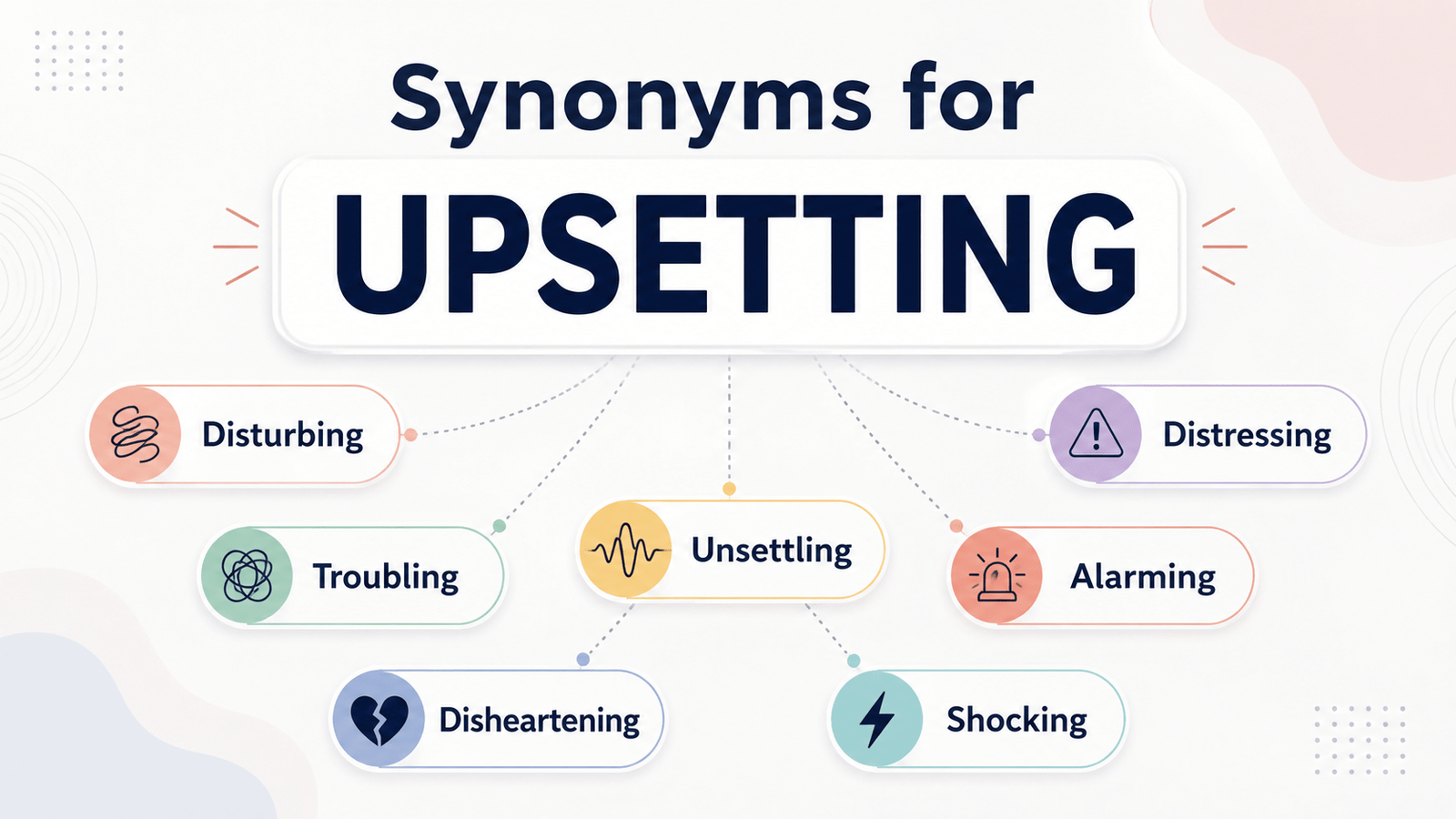
Finding the right synonym for upsetting depends on what kind of emotional reaction you want to describe. Words such as disturbing, distressing, troubling, unsettling, disquieting, alarming, disheartening, and dismaying overlap with upsetting, but they are not interchangeable in every situation. Some emphasize sadness, others worry, fear, shock, or a loss of confidence.
This guide explains the most useful alternatives to upsetting, how their meanings differ, and when a native English speaker would naturally choose one over another.
Quick Answer: What Are the Best Synonyms for Upsetting?
The closest and most useful synonyms for upsetting include disturbing, distressing, troubling, unsettling, disquieting, dismaying, disheartening, alarming, and shocking. The best choice depends on the reaction you want to emphasize. Distressing strongly suggests emotional pain, alarming emphasizes fear or concern, while unsettling suggests that something makes you feel uneasy or uncomfortable.
Cambridge defines upsetting as something that makes someone feel worried, unhappy, or angry, while Merriam-Webster describes it as mentally or emotionally troubling or disturbing.
Best Synonyms for Upsetting at a Glance
| Word | Relationship | Main emphasis | Strength | Best context |
|---|---|---|---|---|
| Disturbing | Direct/near synonym | Concern or emotional disturbance | Strong | News, images, behavior |
| Distressing | Near synonym | Emotional pain or suffering | Strong | Experiences, situations |
| Troubling | Near synonym | Concern or uneasiness | Moderate | Problems, developments |
| Unsettling | Near synonym | Unease or discomfort | Moderate | Behavior, events, situations |
| Disquieting | Near synonym | Persistent uneasiness | Moderate–strong | Formal writing, news |
| Dismaying | Near synonym | Disappointment or loss of confidence | Strong | Results, developments |
| Disheartening | Near synonym | Loss of hope or enthusiasm | Strong | Failures, setbacks |
| Alarming | Contextual alternative | Fear or serious concern | Strong | Warnings, statistics, events |
| Shocking | Contextual alternative | Surprise and emotional impact | Strong | News, revelations |
| Frightening | Contextual alternative | Fear | Strong | Threats, danger |
| Worrisome | Contextual alternative | Worry | Moderate | Problems, risks |
| Perturbing | Near synonym | Deep mental disturbance | Strong | Formal writing |
| Disconcerting | Near synonym | Confusion or loss of confidence | Moderate | Unexpected situations |
| Discomfiting | Contextual alternative | Embarrassment or discomfort | Moderate | Social situations |
| Discouraging | Contextual alternative | Reduced motivation | Moderate | Results, setbacks |
| Demoralizing | Contextual alternative | Loss of confidence or morale | Strong | Work, teams, failures |
| Horrifying | Contextual alternative | Extreme fear or revulsion | Very strong | Graphic or terrible events |
| Terrifying | Contextual alternative | Intense fear | Very strong | Immediate danger |
| Dreadful | Contextual alternative | Very unpleasant or bad | Strong | Experiences, situations |
| Dire | Related/contextual | Serious or urgent danger | Strong | Circumstances, warnings |
| Dispiriting | Contextual alternative | Loss of enthusiasm | Moderate–strong | Setbacks, news |
| Nagging | Contextual alternative | Persistent irritation or worry | Mild–moderate | Concerns, doubts |
| Unnerving | Contextual alternative | Nervousness or loss of confidence | Strong | Experiences, behavior |
| Haunting | Contextual alternative | Lingering emotional effect | Strong | Memories, images |
| Painful | Contextual alternative | Emotional hurt | Moderate–strong | Memories, conversations |
Merriam-Webster’s current thesaurus groups words such as disturbing, unsettling, troubling, frightening, and distressing among the closest alternatives to upsetting. It also lists more context-dependent words such as alarming, shocking, disheartening, and demoralizing.
What Does “Upsetting” Mean?
Upsetting is an adjective used for something that causes a person to feel worried, unhappy, angry, or emotionally disturbed.
Examples:
- The news was upsetting.
- It was an upsetting experience.
- She found the images extremely upsetting.
The word is broad. That is why it can describe many different emotional reactions without specifying exactly what the person felt.
For example, an upsetting event might make someone:
- sad
- worried
- angry
- frightened
- distressed
- uncomfortable
- disappointed
This broad meaning is the key to choosing a more precise synonym.
1. Disturbing
Disturbing is one of the closest alternatives to upsetting. It suggests that something causes significant emotional discomfort, concern, or unease.
Example:
The documentary contained some disturbing images.
Choose disturbing when the subject itself feels troubling, unsettling, or psychologically uncomfortable.
Best for: images, news, behavior, events, stories, evidence.
2. Distressing
Distressing emphasizes emotional pain, suffering, or anguish.
The family received some distressing news.
Compared with upsetting, distressing often sounds more emotionally serious.
Choose it when: the experience causes considerable sadness, pain, or emotional suffering.
3. Troubling
Troubling emphasizes concern rather than intense emotional pain.
The investigation revealed some troubling information.
It is particularly useful when something makes you think that there is a problem that needs attention.
Best for: developments, statistics, behavior, evidence, trends, reports.
4. Unsettling
Unsettling describes something that makes you feel uneasy, uncomfortable, or less secure.
There was something unsettling about his sudden change in behavior.
It does not necessarily mean that something is extremely sad or frightening. The emphasis is on unease.
5. Disquieting
Disquieting is a more formal alternative to unsettling or troubling.
The report contained several disquieting findings.
It works particularly well in formal, academic, journalistic, and professional writing.
6. Dismaying
Dismaying emphasizes disappointment, concern, or a loss of confidence.
The team’s latest results were dismaying.
Use it when something produces a reaction similar to:
“This is worse than I expected, and it is discouraging.”
7. Disheartening
Disheartening focuses on the loss of hope, enthusiasm, or confidence.
The repeated failures were disheartening.
This is a particularly good choice for setbacks and disappointing results.
Upsetting: emotionally disturbing.
Disheartening: makes you lose hope or motivation.
8. Alarming
Alarming is best when something causes fear, concern, or a sense of possible danger.
The sudden increase in cases is alarming.
Calling something alarming usually communicates more urgency than simply calling it upsetting.
9. Shocking
Shocking emphasizes surprise and the strength of the emotional reaction.
The announcement was shocking.
Something can be shocking without being deeply sad, although shocking events are often upsetting too.
Use it when: the unexpected nature of an event is important.
10. Frightening
Frightening specifically emphasizes fear.
The experience was frightening and upsetting.
This example shows why the words are not always exact substitutes. Something may be upsetting without being frightening.
11. Worrisome
Worrisome means causing worry or concern.
The company’s declining sales are worrisome.
It is generally less emotionally intense than distressing or horrifying.
12. Perturbing
Perturbing describes something that deeply disturbs or troubles the mind.
The evidence raised some perturbing questions.
It is more formal and less common in everyday American conversation than upsetting or disturbing.
13. Disconcerting
Disconcerting suggests that something causes confusion, discomfort, uncertainty, or a loss of confidence.
His sudden change in attitude was disconcerting.
It is especially useful when the problem is not simply sadness but a feeling that something is strange or difficult to understand.
14. Discomfiting
Discomfiting means making someone feel uncomfortable, embarrassed, or uneasy.
Her direct question was discomfiting.
This is usually a better choice for awkward social situations than for serious tragedies.
15. Discouraging
Discouraging describes something that reduces hope, motivation, or enthusiasm.
The lack of progress was discouraging.
It works well for failures, setbacks, disappointing results, and difficult circumstances.
Which Synonym Should You Use?
The best synonym depends on what kind of emotional response you want to emphasize.
Choose “disturbing” when:
Something causes strong discomfort, concern, or emotional disturbance.
The video contained disturbing footage.
Choose “distressing” when:
The emphasis is on emotional pain or suffering.
The patient received distressing news.
Choose “troubling” when:
Something creates concern about a problem.
The report revealed troubling statistics.
Choose “unsettling” when:
Something makes you feel uneasy or uncomfortable.
There was something unsettling about the situation.
Choose “alarming” when:
Something creates fear or serious concern.
The latest figures are alarming.
Choose “disheartening” when:
Something causes you to lose hope or confidence.
The repeated rejection was disheartening.
Choose “shocking” when:
The unexpected nature of the event is central.
The revelation was shocking.
Upsetting vs. Disturbing
These words overlap considerably, but they are not identical.
Upsetting is broader and can describe something that makes you sad, worried, or angry.
Disturbing often suggests that something is deeply troubling, uncomfortable, or psychologically unsettling.
Compare:
The cancellation was upsetting.
The footage was disturbing.
The first sentence mainly describes an emotional reaction. The second suggests that the content itself was troubling or disturbing.
Upsetting vs. Distressing
Distressing is usually stronger when the focus is emotional suffering.
The argument was upsetting.
The family’s situation was distressing.
The second sentence suggests deeper emotional hardship.
Upsetting vs. Troubling
Troubling tends to emphasize concern about a situation or development.
The news was upsetting.
The news was troubling.
The first emphasizes emotional impact. The second can emphasize the fact that the news indicates a problem.
Upsetting vs. Unsettling
Unsettling focuses on unease.
The experience was upsetting.
The experience was unsettling.
The first could mean sadness, anger, or worry. The second more specifically suggests discomfort or uncertainty.
Upsetting vs. Alarming
Alarming is more strongly associated with danger, fear, or urgency.
The report was upsetting.
The report was alarming.
The second suggests that the information is serious enough to cause concern about what may happen.
Natural Collocations With “Upsetting”
Some common combinations include:
- upsetting news
- upsetting experience
- upsetting situation
- upsetting event
- upsetting images
- upsetting story
- upsetting conversation
- upsetting behavior
- upsetting decision
- upsetting incident
- upsetting discovery
- upsetting memory
- upsetting message
The best replacement depends on the noun.
“Upsetting news”
Possible alternatives:
- distressing news — emphasizes emotional pain
- troubling news — emphasizes concern
- alarming news — emphasizes danger or urgency
- shocking news — emphasizes surprise
“Upsetting images”
Possible alternatives:
- disturbing images
- distressing images
- shocking images
- horrifying images
Disturbing images is often the most natural choice when the images themselves are uncomfortable or troubling.
“Upsetting experience”
Possible alternatives:
- distressing experience
- traumatic experience — much stronger and more specific
- painful experience
- unsettling experience
- frightening experience
Be careful with traumatic: it should not automatically be used as a stronger synonym for every upsetting event.
Common Mistakes With Synonyms for Upsetting
1. Treating “frightening” as an exact synonym
Something can be upsetting without causing fear.
A disappointing breakup may be upsetting but not frightening.
2. Using “alarming” for ordinary sadness
The canceled dinner was alarming.
This sounds unnatural unless the cancellation signals a serious problem.
3. Using “distressing” for every minor inconvenience
Distressing often carries greater emotional weight than upsetting.
4. Assuming “shocking” means “sad”
Shocking primarily emphasizes surprise or a powerful reaction. It does not necessarily mean sadness.
5. Using “disheartening” when fear is the main emotion
Disheartening concerns reduced hope or confidence, not primarily fear.
Words That Are Related but Not Always Synonyms
Some words are semantically connected to upsetting but should not automatically replace it.
Sad
Sad describes an emotional state rather than necessarily describing something that causes the reaction.
The movie was upsetting.
She was sad.
Angry
Angry identifies one possible emotional response to something upsetting.
Painful
Painful can describe emotional hurt, but it is not interchangeable with upsetting in every context.
Traumatic
Traumatic is substantially stronger and has a more specific meaning. It should not be used simply as an intensified synonym for ordinary upsetting.
Strongest Synonyms for Upsetting
There is no universal “strongest” synonym because intensity depends on context.
For emotional pain:
upsetting → distressing → devastating
For fear:
upsetting → alarming → frightening → terrifying
For psychological discomfort:
upsetting → unsettling → disturbing → horrifying
For loss of hope:
upsetting → discouraging → disheartening → demoralizing
These are approximate semantic progressions, not fixed intensity scales.
FAQ: Synonyms for Upsetting
What is the closest synonym for upsetting?
Disturbing is one of the closest general synonyms for upsetting. Other close alternatives include distressing, troubling, and unsettling. The best choice depends on whether you want to emphasize emotional pain, concern, or unease. Merriam-Webster specifically lists disturbing, unsettling, troubling, and distressing among its synonyms for upsetting.
What is a formal word for upsetting?
Disquieting, perturbing, and distressing can work as more formal alternatives, depending on the context. Disquieting is especially useful in formal writing when something causes unease or concern.
What is another word for an upsetting experience?
Depending on the situation, you could say distressing experience, painful experience, disturbing experience, unsettling experience, or frightening experience. Distressing is a strong choice when the experience caused substantial emotional pain.
Is “disturbing” stronger than “upsetting”?
Often, yes, but not in every context. Disturbing commonly suggests significant discomfort or concern, whereas upsetting is broader and can describe anything that makes someone unhappy, worried, or angry.
What is a synonym for upsetting news?
Depending on the meaning, useful alternatives include distressing news, troubling news, alarming news, shocking news, and dismaying news. Use alarming when the news suggests danger, shocking when surprise is central, and distressing when emotional pain is the focus.
What is a synonym for something very upsetting?
For a particularly strong emotional effect, consider distressing, disturbing, horrifying, devastating, or heartbreaking, depending on the situation. Avoid using the strongest word automatically; the replacement should accurately describe the actual emotional effect.
What is the difference between upsetting and unsettling?
Upsetting broadly means causing unhappiness, worry, or anger. Unsettling more specifically suggests making someone feel uneasy, uncomfortable, or uncertain.
Can “sad” replace “upsetting”?
Not always. Sad generally describes a person’s emotional state, while upsetting commonly describes something that causes an emotional reaction. For example, “The news was upsetting” describes the effect of the news, whereas “She was sad” describes her emotional state.
Conclusion
The best synonym for upsetting depends on the emotion or effect you want to emphasize. Disturbing is a strong general alternative, distressing emphasizes emotional pain, troubling focuses on concern, unsettling expresses unease, alarming highlights danger or urgency, and disheartening suggests a loss of hope or confidence.
Rather than choosing the most dramatic word, choose the word that describes the situation most precisely. That distinction turns a basic synonym list into more effective vocabulary.