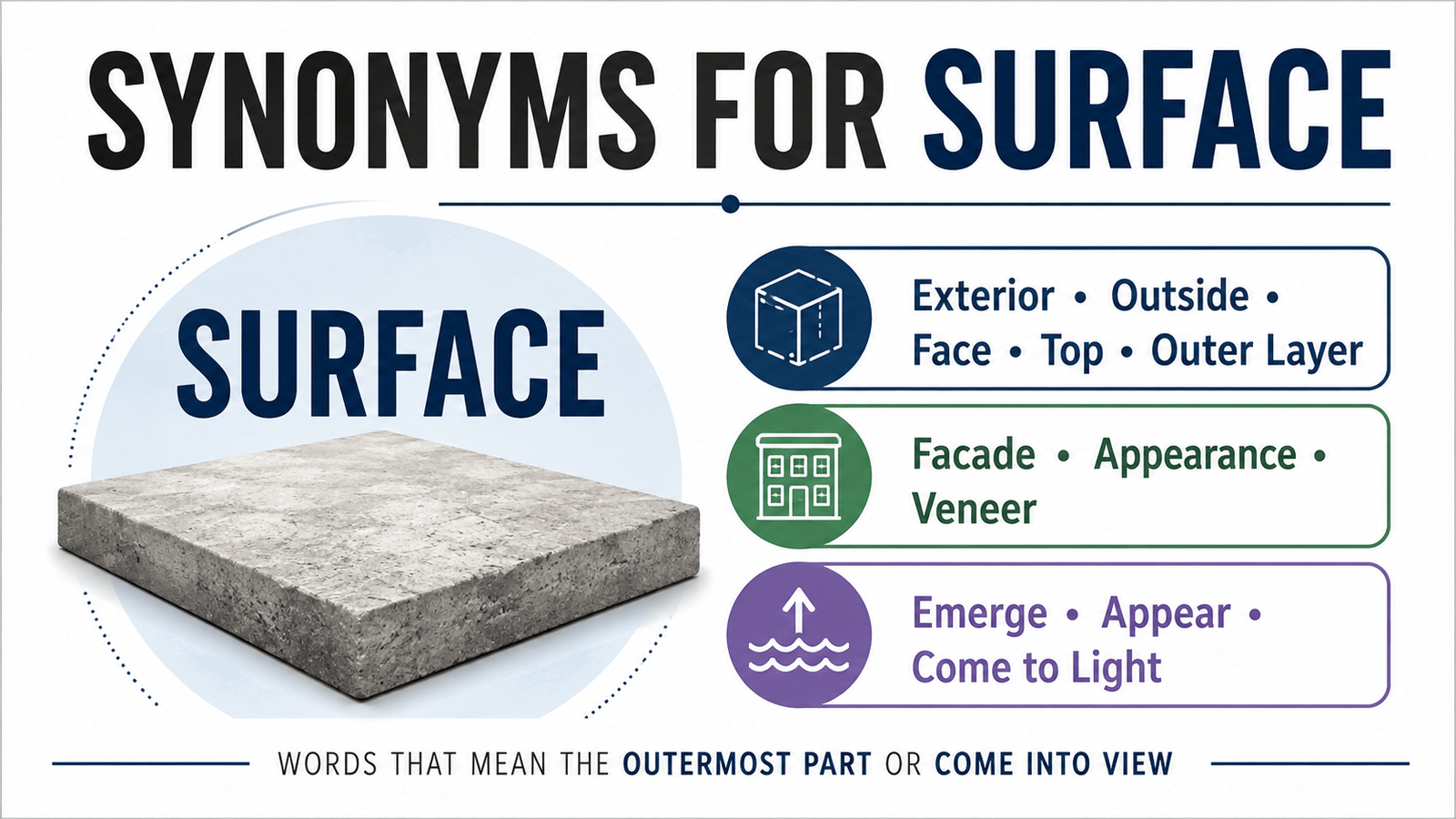
If you’re looking for synonyms for surface, the best choice depends on what surface means in your sentence. For the outside of an object, useful alternatives include exterior, outside, face, top, outer layer, and skin. When surface means an outward appearance, facade, appearance, semblance, or veneer may work better. As a verb meaning “to appear or become known,” alternatives include emerge, appear, arise, and come to light.
The important point is that these words are not interchangeable in every sentence. Choosing the right synonym requires considering meaning, context, grammar, and tone.
Quick Answer: What Are the Best Synonyms for Surface?
The closest synonyms for surface as a noun are exterior, outside, face, top, outer layer, and skin. For the figurative meaning of outward appearance, consider facade, appearance, veneer, semblance, or outward aspect. As a verb meaning “to become known,” the strongest alternatives are emerge, appear, arise, and come to light.
Best Synonyms for Surface
Physical Surface Synonyms
| Word | Relationship | Meaning | Best Context |
|---|---|---|---|
| Exterior | Direct/near synonym | The outside part of something | Buildings, objects, structures |
| Outside | Direct synonym in many contexts | The outer part | Everyday speech |
| Face | Contextual synonym | The visible or exposed side | Objects, walls, materials |
| Top | Contextual synonym | The uppermost part | Tables, containers, land, objects |
| Outer layer | Contextual alternative | The layer farthest from the center | Materials, biology, food |
| Skin | Contextual synonym | An outer covering or layer | Bodies, fruits, materials |
| Shell | Near synonym | A hard protective outer covering | Eggs, buildings, organisms |
| Covering | Near synonym | Something that covers another thing | Materials and objects |
| Facade | Contextual synonym | The front or outward appearance | Buildings or figurative descriptions |
| Facing | Contextual synonym | A material or outer layer covering a surface | Construction |
Surface and Outward Appearance Synonyms
| Word | Relationship | Meaning | Best Context |
|---|---|---|---|
| Veneer | Near synonym | A thin outer layer; often figurative | Wood, materials, appearance |
| Appearance | Figurative synonym | The way something looks outwardly | People, situations, ideas |
| Semblance | Figurative near synonym | An outward appearance or impression | Formal/literary writing |
| Aspect | Related alternative | A particular side or feature | Abstract subjects |
| Outward appearance | Contextual alternative | What something seems like externally | People and situations |
Surface as a Verb
When surface means to appear, become visible, or become known, different alternatives are more appropriate.
| Word | Relationship | Meaning | Best Context |
|---|---|---|---|
| Emerge | Verb synonym | To become visible or known | Information, problems, people |
| Appear | Near synonym | To become visible or present | General contexts |
| Arise | Contextual verb | To begin to exist or become apparent | Problems, questions, issues |
| Come to light | Phrase-level alternative | To become known | Hidden information |
| Show up | Informal alternative | To appear or become present | People, objects |
| Materialize | Near synonym | To appear or become real | Events, objects, plans |
| Reveal itself | Contextual alternative | To become apparent | Problems, patterns, truths |
| Become apparent | Contextual alternative | Become clear or noticeable | Formal writing |
| Become visible | Contextual alternative | Come into view | Physical or abstract contexts |
Related Words and Adjective Forms
Not every word associated with surface is a direct synonym. These terms are useful because they describe related concepts or functions.
| Word | Relationship | Meaning | Best Context |
|---|---|---|---|
| Superficial | Adjective-related word | Concerned only with the surface | Ideas, knowledge, relationships |
| Shallow | Near synonym in figurative contexts | Lacking depth | Thinking, analysis, relationships |
| Outward | Related adjective | Existing or appearing externally | Appearance, behavior |
| External | Related adjective | Existing outside something | Technical/formal writing |
| Outer | Related adjective | Located on the outside | Layers, parts, boundaries |
| Emergence | Related noun | The act of becoming visible or known | Events, information |
Which Synonyms Are Closest to “Surface”?
For the physical noun sense, the closest alternatives are generally exterior, outside, face, top, and outer layer. However, each word has a narrower or slightly different use. Skin, shell, facing, and veneer can describe particular types of outer layers, while appearance, facade, and semblance are more appropriate when surface refers to outward appearance.
For the verb sense, emerge, appear, become apparent, and come to light are useful alternatives when something becomes visible or known.
This distinction matters because not every word in a thesaurus list can replace surface naturally in every sentence.
What Does “Surface” Mean?
Surface is a versatile English word that can function as a noun, verb, or adjective.
As a noun, it commonly means the outer or top part of something, such as the surface of a table, lake, road, or planet. It can also refer to an outward appearance rather than what is hidden underneath.
For example:
The surface of the table was covered with scratches.
Here, exterior, outer layer, or top might work depending on exactly what you mean.
But in:
On the surface, the plan seemed reasonable.
Surface means outward appearance, not a physical layer. In this context, exterior would sound unnatural.
As a verb, surface can mean to come to the surface, appear, or become known.
New information surfaced during the investigation.
Here, emerged, appeared, or came to light may be appropriate alternatives.
Synonyms for Surface by Context
1. Surface of an Object
When surface means the outside or top part of a physical object, the strongest alternatives are:
Exterior
Exterior means the outside part of something.
The building’s exterior was recently renovated.
Use exterior especially for buildings, vehicles, structures, and objects when contrasting the outside with the inside.
Surface: The surface of the car was scratched.
Exterior: The exterior of the car was damaged.
They overlap, but exterior usually refers to the overall outside of something, while surface often emphasizes the actual exposed area or material.
Outside
Outside is a natural, everyday alternative.
The outside of the box was wet.
It is generally less formal than exterior.
Face
Face can refer to a particular exposed or visible side.
The front face of the cube was painted blue.
It is particularly useful when an object has identifiable sides.
Top
Top works when you specifically mean the upper part.
Put the keys on the top of the desk.
However, top is not a universal synonym for surface. A wall has a surface, for example, but its surface is not necessarily its top.
Outer layer
Use outer layer when the emphasis is on layers.
The outer layer of the material protects the inner components.
This is especially useful in scientific, technical, biological, and descriptive writing.
2. Surface as an Outer Covering
Some alternatives emphasize a protective or covering function rather than simply an exposed area.
Skin
Skin can describe an outer layer around a body, fruit, material, or structure.
The skin of the fruit was unusually thick.
It can also be metaphorical:
The metal skin of the aircraft protects its internal structure.
Shell
Shell suggests a distinct outer covering, often one that provides protection.
The shell of the egg cracked.
Calling an ordinary tabletop a shell, however, would usually be inaccurate.
Covering
Covering emphasizes something that lies over or protects something underneath.
The protective covering prevented scratches.
This is related to surface but is not always a direct replacement.
Veneer
Veneer has a more specific meaning: a thin outer layer, especially one applied to another material. It can also describe a superficial appearance or presentation.
The cabinet has a walnut veneer.
Figuratively:
Beneath his polite veneer, he was frustrated.
Because veneer implies superficiality or a thin layer, it should not be treated as a universal synonym for surface.
3. Surface as Appearance
A different group of synonyms applies when surface refers to what is outwardly visible or apparent.
Appearance
Appearance is often the clearest alternative when discussing how someone or something seems.
On the surface, the proposal looked promising.
Better alternative:
On the face of it, the proposal looked promising.
Or:
In appearance, the proposal looked promising.
The exact choice depends on the sentence.
Facade
Facade originally refers to the front of a building, but it is also commonly used figuratively for an outward appearance that may conceal something different.
She maintained a facade of confidence.
This carries a stronger implication of concealment than surface.
Semblance
Semblance means an outward appearance or impression of something.
The agreement provided a semblance of stability.
It is relatively formal and often suggests that the appearance may not reflect reality.
Veneer
As a figurative word, veneer suggests a thin outward layer that hides what lies underneath.
His friendliness was merely a veneer.
This is more pointed than simply saying someone has a certain surface appearance.
4. Surface as a Verb: “Become Known”
One of the most important distinctions is that surface is also a verb.
Consider:
New evidence surfaced yesterday.
Here, surface does not mean “outside.” It means that something appeared, emerged, or became known.
Emerge
Emerge is one of the closest alternatives.
New evidence emerged during the trial.
It works particularly well when information, problems, trends, or people become noticeable.
Appear
Appear is broader and more neutral.
Several problems appeared after the update.
It can replace surface in some contexts, but it may lose the implication that something was previously hidden or unnoticed.
Arise
Arise is useful for problems, questions, situations, and opportunities.
Several concerns arose during the meeting.
It is not normally interchangeable with surface when referring to physically appearing.
Come to light
Come to light is an excellent phrase when previously hidden information becomes known.
New evidence came to light during the investigation.
This is often stronger than simply using appear.
Become apparent
Become apparent works well in formal or academic writing.
Several weaknesses became apparent during testing.
It emphasizes that something became clear rather than physically appearing.
Which Synonym Should You Use?
The easiest way to choose is to identify the meaning first.
| If you mean… | Best choice |
| Outside part of a building | exterior |
| Everyday outside part | outside |
| Visible side of an object | face |
| Upper part | top |
| Outermost material layer | outer layer |
| Protective outer covering | shell |
| Thin outer material | veneer |
| Front of a building | facade |
| Outward impression | appearance |
| False or concealed outward impression | facade / veneer |
| Something becomes visible | emerge / appear |
| Hidden information becomes known | come to light |
| A problem becomes noticeable | emerge / arise |
| Something becomes clear | become apparent |
Surface vs. Exterior
Surface and exterior overlap, but they are not identical.
In most contexts, surface focuses on an exposed area, layer, or boundary. By contrast, exterior generally refers to the outside part of something as a whole.
The surface of the metal was polished.
Exterior normally refers to the outside part as a whole.
The exterior of the building was renovated.
A useful rule:
Use “surface” for the exposed area itself; use “exterior” for the outside of something as a whole.
Surface vs. Facade
A surface can be physical or figurative. A facade is more specific.
For buildings:
The surface of the wall was damaged.
The facade of the building was damaged.
Both can work, but facade emphasizes the building’s front or outward architectural face.
Figuratively, facade often implies that an appearance hides reality:
He maintained a facade of calm.
You generally would not replace surface with facade in a sentence such as:
The surface of the water was calm.
Surface vs. Veneer
Both can describe an outer layer, but veneer is narrower.
The surface of the desk was scratched.
The desk has a wooden veneer.
The second sentence specifically identifies a thin outer material.
Figuratively, veneer often suggests superficiality:
Beneath the veneer of professionalism, the organization was struggling.
So, use surface for a general exposed area and veneer when you want to emphasize a thin outer layer or superficial appearance.
Surface vs. Superficial
These words are related but should not be treated as interchangeable.
Surface is commonly a noun:
The surface of the lake was still.
Superficial is an adjective describing something concerned only with the surface or lacking depth:
His analysis was superficial.
You can say surface-level analysis, but surface itself does not simply mean superficial.
Common Mistakes With “Surface” Synonyms
Mistake 1: Using “exterior” for every physical surface
Not every surface is an exterior.
The surface of the water was calm.
Exterior of the water is unnatural.
Mistake 2: Using “top” as a universal synonym
The top is only one possible surface.
The top of the table was clean.
But:
The vertical surface of the wall was dirty.
Mistake 3: Treating “facade” as a general synonym
A facade often means the front of a building or a deliberately maintained outward appearance.
She maintained a facade of confidence.
It does not simply mean any physical surface.
Mistake 4: Confusing “surface” with “superficial”
Surface can describe an actual physical boundary or an outward aspect. Superficial usually describes something lacking depth or dealing only with appearances.
Mistake 5: Using “emerge” for every meaning of surface
Emerge is useful when surface means “appear” or “become known.”
New evidence emerged.
But it cannot replace surface in:
The surface of the road was wet.
Common Collocations With “Surface”
Understanding collocations makes synonym selection easier.
Physical surface
- smooth surface
- rough surface
- flat surface
- hard surface
- reflective surface
- solid surface
- painted surface
- exposed surface
- outer surface
- horizontal surface
Figurative surface
- on the surface
- beneath the surface
- below the surface
- surface appearance
- surface-level understanding
- surface differences
Verb
- information surfaced
- evidence surfaced
- problems surfaced
- concerns surfaced
- allegations surfaced
- new details surfaced
- a submarine surfaced
For example, emerged is often a natural alternative to surfaced with information or evidence:
New evidence surfaced.
New evidence emerged.
But came to light adds the idea that previously hidden information was discovered or revealed.
Pronunciation of “Surface”
US: /ˈsɝː.fɪs/
UK: /ˈsɜː.fɪs/
Cambridge gives the same basic distinction between the noun, verb, and adjective forms and provides US and UK pronunciations.
A Note on the Word’s History
The noun surface entered English through French and ultimately combines elements meaning roughly “above” and “face.” Merriam-Webster dates its first known use in the relevant noun sense to around 1600.
FAQ About Synonyms for Surface
What is the closest synonym for surface?
For the physical noun sense, exterior is often one of the closest alternatives, although outside, face, top, and outer layer can be better in specific contexts. No single synonym replaces surface naturally in every sentence.
What is another word for the outside surface?
Depending on context, use exterior, outside, outer layer, outer face, skin, or shell. Exterior is especially useful when referring to the outside of a building, vehicle, or structure.
What is a synonym for surface as a verb?
When surface means “appear” or “become known,” useful alternatives include emerge, appear, arise, come to light, and become apparent. The best choice depends on what is surfacing.
Is “exterior” the same as “surface”?
Not exactly. Exterior generally means the outside part of something, while surface can mean the exposed area or boundary itself. For example, a building has an exterior, while its walls have surfaces.
What is a synonym for “surface appearance”?
Depending on meaning, use outward appearance, facade, semblance, veneer, or aspect. Facade and veneer can imply that the appearance hides a different reality.
What is another word for “surface” in formal writing?
Exterior, outer layer, outward appearance, facade, emerge, or become apparent may work depending on the intended meaning. Formal writing does not require replacing surface if surface is already the most precise word.
What is the opposite of surface?
For the physical meaning, possible opposites include interior, inside, depth, or subsurface, depending on context. For the figurative meaning, the contrast may be underlying reality, depth, substance, or underlying meaning.
Conclusion
The best synonym for surface depends on the sense you intend. Use exterior or outside for the outer part of something, face for a particular visible side, top for an upper area, and outer layer when layers matter. For figurative appearance, facade, veneer, appearance, and semblance can be more precise. When surface is a verb meaning “become known,” choose emerge, appear, arise, or come to light.
The key is not to replace surface with the most similar-looking word. Choose the alternative that preserves the meaning, context, tone, and grammatical function of the original sentence.

Michael Thompson is an English language specialist and experienced editor who focuses on vocabulary development and clear communication. He creates high-quality synonym guides, word comparisons, and writing tips to help students and professionals express their ideas more effectively. His work combines linguistic knowledge with practical SEO strategies to make learning both useful and engaging.