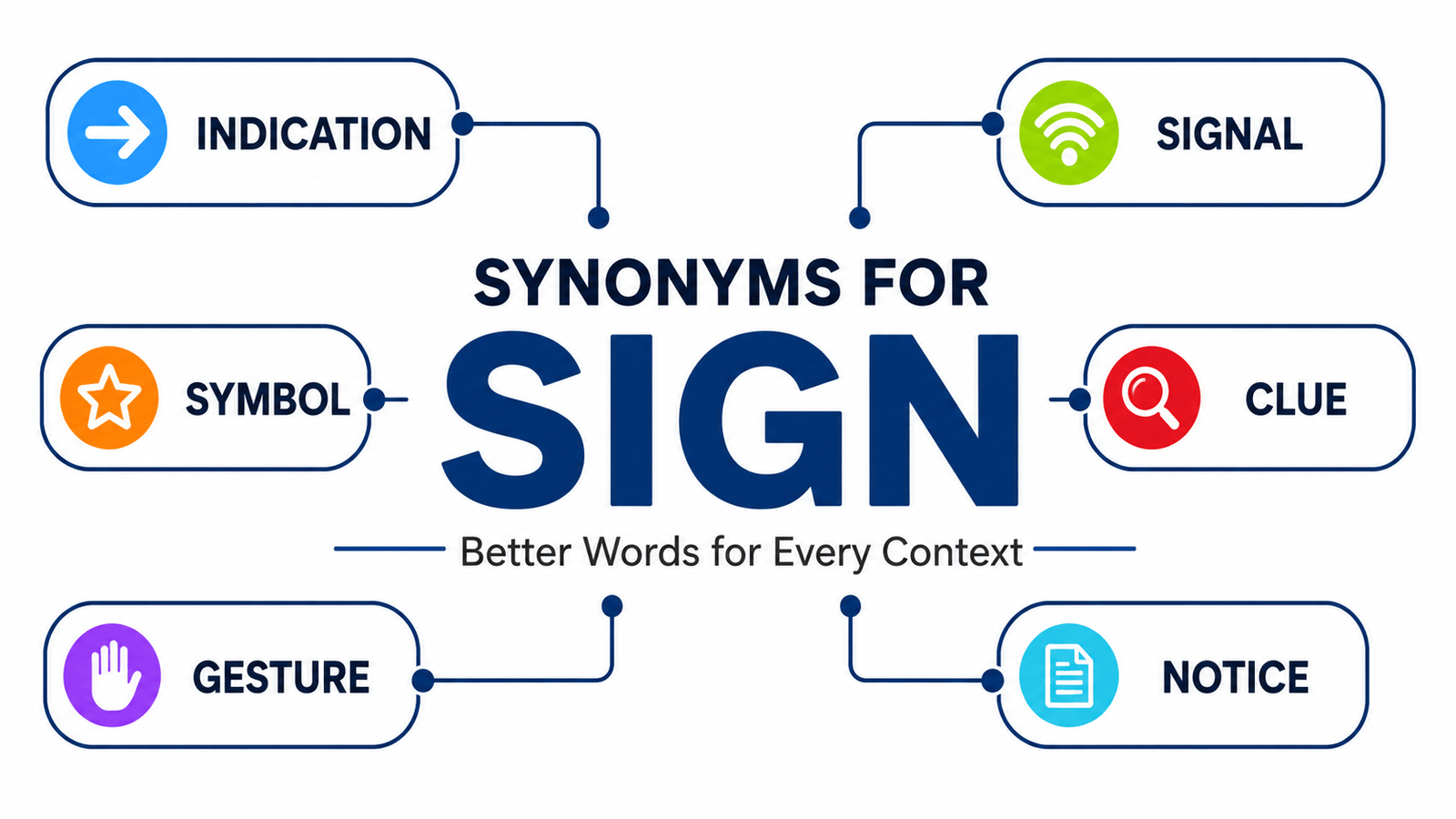
The word sign can mean several different things in English. It can be an indication that something is happening, a gesture used to communicate, a symbol with a particular meaning, a public notice, or an act of writing your name on a document. Because of these different meanings, there is no single synonym that works everywhere. Cambridge lists senses including a notice, body movement, indication, and written or printed mark, while Merriam-Webster also distinguishes meanings involving gestures, symbols, displays, and evidence.
The best synonym depends on what kind of sign you mean and what you want to emphasize.
Quick Answer: What Are the Best Synonyms for Sign?
The closest alternatives to sign include indication, signal, symbol, clue, mark, evidence, gesture, hint, token, symptom, notice, and motion. However, they are not interchangeable in every sentence. Use indication for evidence of a condition or situation, signal for an intentional message, symbol for something representing an idea, gesture for body movement, and notice for a public written message.
Core Synonyms for Sign
| Word | Relationship | Meaning | Best Context |
| Indication | Direct/near synonym | Something that points to or suggests a fact | Evidence, situations, trends |
| Signal | Near synonym | A message or indication, often intentional | Communication, warnings, events |
| Symbol | Contextual synonym | Something representing an idea or concept | Mathematics, culture, writing |
| Clue | Contextual synonym | Information that helps reveal something | Investigation, mystery, discovery |
| Evidence | Near synonym | Information supporting a conclusion | Arguments, research, investigations |
| Mark | Near synonym | A visible or characteristic indication | Features, records, distinctions |
| Hint | Contextual synonym | A subtle indication or suggestion | Conversation, writing, behavior |
| Gesture | Direct in one sense | A body movement conveying meaning | Nonverbal communication |
| Motion | Contextual synonym | A movement used to communicate | Instructions, gestures |
| Token | Near synonym | Something representing or demonstrating another thing | Appreciation, affection, proof |
| Symptom | Contextual synonym | An observable indication of an underlying condition | Health and problems |
| Notice | Contextual synonym | A public written message | Buildings, stores, warnings |
| Clue | Contextual synonym | A piece of information pointing toward an answer | Problems, investigations |
| Omen | Specialized near synonym | A sign believed to predict something | Fortune, superstition, literature |
| Warning | Contextual synonym | A sign indicating danger or trouble | Safety, risk, consequences |
Not every word in this table can replace sign in every sentence. The distinction is what makes synonym selection useful.
What Does “Sign” Mean?
As a noun, sign has several major meanings.
It can refer to something that shows that another thing exists or may happen:
The dark clouds were a sign of rain.
It can mean a movement used to communicate information:
She gave me a sign to wait.
It can mean a written or printed mark with a particular meaning:
The plus sign indicates addition.
It can also mean a public notice:
There was a sign outside the store.
As a verb, sign commonly means writing your name on a document to show agreement, authorship, or responsibility:
Please sign the contract.
It can also mean communicating through gestures or sign language.
This range of meanings explains why a context-based synonym is much more useful than a long list of loosely related words.
1. Indication — Best for Something That Shows or Suggests
Indication is one of the closest alternatives to sign when you mean something that provides evidence or suggests that something exists or is happening.
- Sign: There was a sign of improvement.
- Indication: There was an indication of improvement.
Use indication when the emphasis is on something pointing toward a conclusion rather than physically communicating a message.
Natural examples:
- The results are an indication that the strategy is working.
- There was no indication of damage.
- Her expression was an indication of concern.
Best for: situations, evidence, trends, conditions, and conclusions.
2. Signal — Best for Communication or Intentional Messages
Signal overlaps strongly with sign, but it often suggests an intentional communication.
The manager gave a signal to begin.
Here, signal is more natural than indication because someone deliberately communicated an instruction.
It can also describe an event or action interpreted as communicating a message:
The decision was a signal of the company’s changing priorities.
Choose signal when the idea involves communication, coordination, or a deliberate message.
3. Symbol — Best for Representation
A symbol represents an idea, object, quantity, relationship, or concept.
Examples include mathematical symbols, national symbols, religious symbols, and symbols used in writing.
The dove is often used as a symbol of peace.
You could not normally replace symbol with signal here without changing the meaning.
Sign and symbol overlap because a sign can be a mark with a conventional meaning. Cambridge specifically includes written or printed marks such as mathematical signs among the meanings of sign.
Choose symbol when something stands for or represents something else.
4. Clue — Best When Something Helps You Discover an Answer
Clue is a useful alternative to sign when the indication helps someone discover information.
The footprints were a sign that someone had been there.
More naturally, in an investigation:
The footprints were a clue that someone had been there.
A clue usually implies that someone is trying to interpret information and reach an answer.
Best contexts:
- investigations
- mysteries
- puzzles
- research
- problem-solving
5. Evidence — Stronger When Proof or Support Matters
Evidence is related to sign, but it generally carries a stronger implication of support for a conclusion.
Compare:
There are signs that the economy is improving.
with:
There is evidence that the economy is improving.
The second sentence emphasizes information supporting the conclusion.
Do not automatically replace every use of sign with evidence. A road sign is not evidence, and a hand gesture is not normally evidence.
6. Mark — Best for a Distinguishing Feature or Trace
Mark can overlap with sign when something serves as an observable indication or characteristic.
The scar was a sign of the injury.
The scar was a mark left by the injury.
Mark often emphasizes something visible, impressed, left behind, or characteristic.
Merriam-Webster notes that mark can suggest something impressed on or inherently characteristic of a thing, which gives it a different nuance from the broader word sign.
7. Hint — Best for a Subtle Suggestion
A hint is usually less direct than a sign or signal.
Her smile was a sign that she approved.
Her smile was a hint that she approved.
The second sentence suggests something subtle rather than clear or definitive.
Choose hint when the information is indirect or deliberately understated.
8. Gesture — Best for Body Movements
When sign means a movement of the hand, face, or body used to communicate, gesture is often an excellent substitute.
He made a sign for me to sit down.
He made a gesture for me to sit down.
Cambridge specifically defines this sense of sign as a body movement that gives information or an instruction, and its thesaurus lists gesture, signal, motion, and wave in this sense.
Best for: body language, communication, instructions, and nonverbal behavior.
9. Motion — Best for a Deliberate Movement
Motion can replace sign when someone communicates through a physical movement.
She made a sign for him to come closer.
She made a motion for him to come closer.
Motion emphasizes the physical movement itself. Gesture usually emphasizes its communicative or expressive purpose.
10. Token — Best for Something That Represents a Feeling or Relationship
A token is something that represents or demonstrates a feeling, quality, or relationship.
The gift was a sign of appreciation.
The gift was a token of appreciation.
This phrase is especially natural in formal or conventional expressions.
Merriam-Webster distinguishes token from the broader sign by noting its use for something serving as proof or representation of something intangible.
11. Symptom — Best for an Observable Indication of an Underlying Problem
Symptom is a specialized alternative to sign.
Falling sales may be a sign of deeper problems.
Falling sales may be a symptom of deeper problems.
It works particularly well when an observable condition points to an underlying problem or disease.
Because symptom has a more specific meaning, it should not be treated as a universal synonym.
12. Notice — Best for a Public Written Message
When sign means a public display containing information, notice can be a natural alternative.
There was a sign on the door.
There was a notice on the door.
However, the words are not always identical. A notice generally communicates information, while a sign can also advertise, direct, identify, or warn.
Other context-specific alternatives include placard, board, signboard, poster, and display. Collins lists notice, board, and placard for the public-notice sense of sign.
Which Synonym Should You Use?
The easiest way to choose the right word is to identify what your sign is doing.
Choose “indication” when:
Something suggests that a condition or situation exists.
The delay was an indication of a larger problem.
Choose “signal” when:
Something communicates a message or intention.
The announcement was a signal that changes were coming.
Choose “symbol” when:
Something represents an idea or concept.
The dove is a symbol of peace.
Choose “clue” when:
Something helps you discover an answer.
The note provided a clue to his whereabouts.
Choose “evidence” when:
Something supports a conclusion.
The results provide evidence of improvement.
Choose “gesture” when:
A physical movement communicates an idea.
She made a gesture asking everyone to be quiet.
Choose “notice” when:
A written public message provides information.
A notice was posted on the entrance.
Choose “symptom” when:
An observable problem indicates an underlying condition.
High turnover can be a symptom of poor management.
Choose “omen” when:
The sign is interpreted as predicting a future event, particularly in literary, cultural, or superstitious contexts.
They regarded the unusual event as an omen.
Sign vs. Signal
Sign is broader than signal.
A sign can be intentional or unintentional. A signal usually involves communication or an action intended to convey information.
Compare:
The patient’s pale skin was a sign of illness.
The flashing light was a signal to stop.
The first may be an observable indication without intentional communication. The second is deliberately communicating information.
This distinction is also reflected in traditional thesaurus treatment of the two words.
Sign vs. Indication
These words are often interchangeable when sign means evidence of something.
There were signs of improvement.
There were indications of improvement.
Sign is more common and flexible in everyday English. Indication can sound slightly more formal and analytical.
Use sign for general communication and everyday writing. Use indication when discussing evidence, trends, findings, or implications.
Sign vs. Symbol
A symbol is specifically representational.
The heart is a symbol of love.
A sign can be a symbol, but it can also be an indication, gesture, notice, or evidence.
Therefore:
Every symbol can function as a sign in some contexts, but not every sign is a symbol.
Sign vs. Clue
A clue helps someone discover something.
The broken window was a sign that someone had entered.
The broken window was a clue in the investigation.
Clue implies a search for an explanation. Sign does not necessarily imply investigation.
Synonyms for “Sign” as a Verb
The verb sign has more than one important meaning.
When “sign” means writing your name
Useful alternatives include:
- autograph
- endorse
- inscribe
- initial
- countersign
- undersign
For example:
She signed the contract.
She endorsed the agreement.
But these are not always interchangeable. Autograph usually emphasizes writing one’s name, often as a keepsake. Initial means writing one’s initials, while countersign has a more specialized meaning.
Cambridge defines the common verb sense as writing one’s name on a document to show agreement, authorship, or responsibility, while Merriam-Webster’s thesaurus includes alternatives such as autograph, endorse, inscribe, and countersign.
When “sign” means communicating with gestures
Possible alternatives include:
- gesture
- signal
- indicate
- beckon
- motion
- wave
- gesticulate
Example:
She signed for the waiter to come over.
She gestured for the waiter to come over.
These alternatives are more natural when the intended meaning is physical communication rather than signing a document.
Common Mistakes When Choosing a Synonym for Sign
1. Treating every related word as an exact synonym
Words such as omen, symptom, clue, symbol, and warning overlap with sign but have additional meanings or restrictions.
2. Using “signal” for an accidental indication
A signal often implies communication, while a sign can simply be evidence.
3. Using “symbol” for every kind of sign
A symbol represents something. A sign can also be a symptom, clue, gesture, or public notice.
4. Using “evidence” when there is no proof-related meaning
A road sign is not normally called evidence.
5. Using “autograph” for every use of the verb “sign”
Autograph specifically emphasizes writing one’s name, whereas sign can mean agreeing to or authorizing a document.
6. Choosing “symptom” outside an appropriate context
Symptom is most natural for an observable indication of an underlying condition or problem.
Common Collocations With Sign
Understanding common phrases can make synonym selection easier.
Sign of
- sign of progress
- sign of weakness
- sign of trouble
- sign of improvement
- sign of respect
- sign of illness
- sign of change
Sign that
- a sign that things are improving
- a sign that something is wrong
- a sign that the plan is working
Give a sign
- give a sign to stop
- give a sign to begin
- give a sign of approval
Show signs of
- show signs of improvement
- show signs of stress
- show signs of damage
The best alternative changes according to the phrase. For example, sign of progress can often become indication of progress, while give a sign to stop is more naturally replaced by give a signal to stop.
Antonyms of Sign
There is no single universal antonym for sign because the word has several meanings.
Depending on context, opposites or contrasting ideas can include:
- concealment — when information is hidden
- absence — when no indication is present
- silence — when communication is absent
- uncertainty — when there is no clear indication
- obscurity — when something is difficult to detect or interpret
For example:
There was no sign of damage.
Here, absence expresses the opposite condition more naturally than a fixed antonym of sign.
Frequently Asked Questions
What is the closest synonym for sign?
The closest synonym depends on the meaning. Indication is often closest when sign means evidence of something, while signal works well for intentional communication. Symbol is appropriate when the sign represents an idea, and gesture is appropriate when it means a body movement.
What is another word for a sign or indication?
Indication, signal, clue, evidence, mark, hint, symptom, and token can work depending on context. Indication is one of the safest general alternatives when sign means something that shows or suggests that another thing exists.
Is “signal” a synonym for “sign”?
Yes, in some contexts. A signal is especially appropriate when a sign communicates information or an instruction. However, sign can also refer to accidental evidence, a symbol, or a public notice, where signal may not be appropriate.
Is “symbol” another word for “sign”?
Sometimes. A symbol is a type of sign that represents an idea, object, quantity, or concept. However, sign has a much broader range of meanings, so symbol cannot replace it in every context.
What is a formal synonym for sign?
Indication is often a useful formal alternative when sign means evidence or suggestion. Depending on context, manifestation, indicator, evidence, or signal may also work.
What is a synonym for sign as a gesture?
The best alternatives include gesture, signal, motion, wave, nod, and beckon. The choice depends on the exact physical movement and what it communicates.
What is a synonym for sign on a building or road?
Depending on its function, alternatives include notice, placard, signboard, board, poster, or marker. For road directions, signpost or road sign may be more precise.
What is the synonym for sign as a verb?
When sign means writing your name, alternatives include autograph, endorse, inscribe, initial, countersign, and undersign. When it means communicating through movement, alternatives include gesture, signal, indicate, beckon, and motion.
Conclusion
The best synonym for sign depends on its meaning. Use indication when something shows or suggests a condition, signal when it communicates intentionally, symbol when it represents an idea, clue when it helps reveal an answer, evidence when it supports a conclusion, gesture for body movement, and notice for a public written message.
The key is not to replace sign mechanically. First identify the sense you mean, then choose the word that communicates that particular idea most naturally.

Emily Johnson is a linguistics graduate and vocabulary specialist. She writes detailed synonym explanations and helps readers understand subtle differences between words, improving both writing and speaking skills. Synonyms help express ideas more clearly and precisely in English.