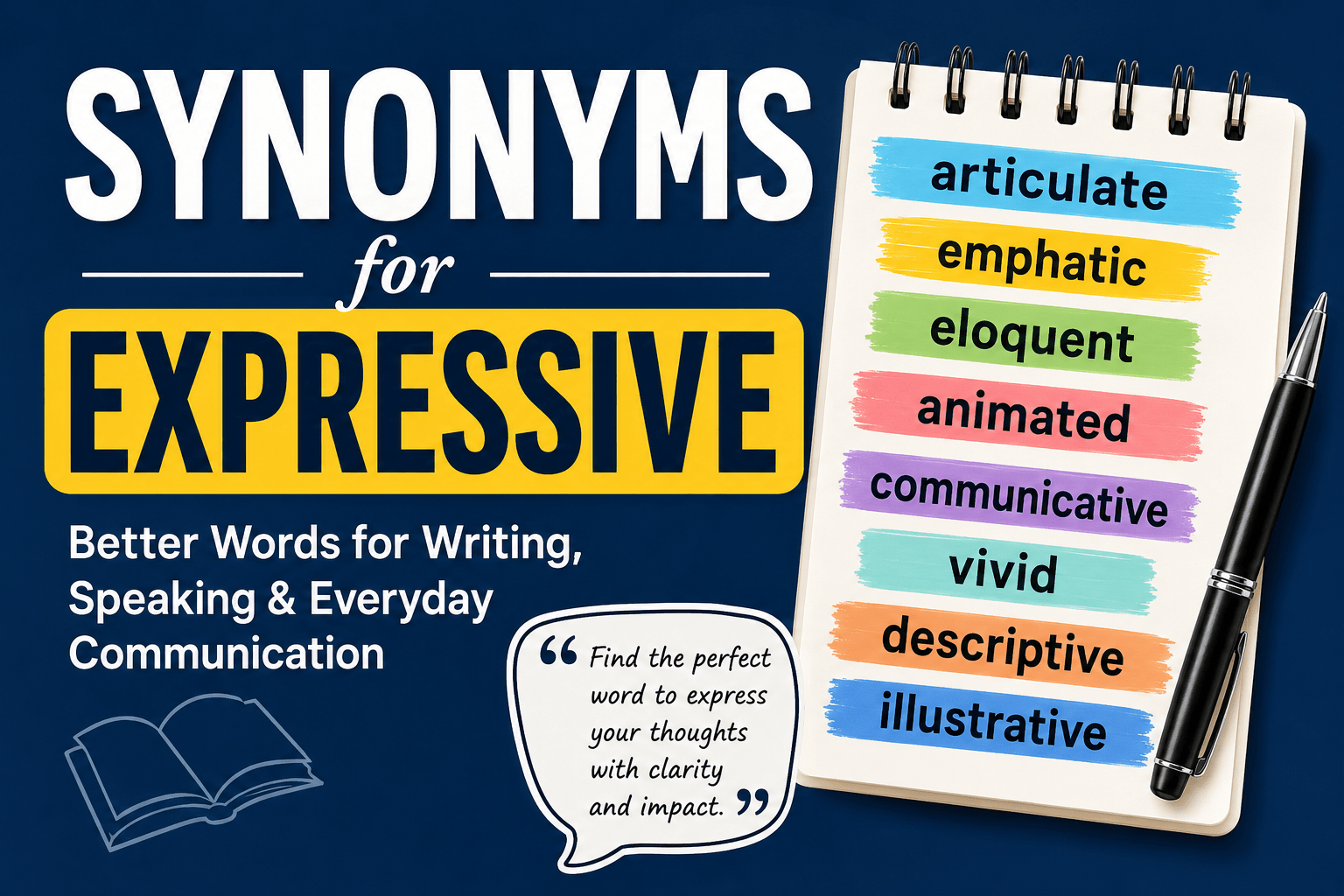
Finding the right synonym for expressive depends heavily on what you are describing. A person may be demonstrative or emotional, while writing may be eloquent, vivid, or evocative. Music can be moving, powerful, or poignant, and a facial expression may be revealing or telling.
The closest alternatives are not interchangeable in every sentence. The best choice depends on whether you mean showing feelings openly, communicating ideas effectively, creating a strong emotional response, or conveying meaning clearly.
This guide separates genuine synonyms from context-specific alternatives so you can choose the word that sounds natural and precise.
Quick Answer
The strongest general synonyms for expressive include eloquent, vivid, demonstrative, revealing, evocative, meaningful, articulate, moving, and emotional. Eloquent works especially well for effective speech or writing, demonstrative for openly showing feelings, vivid for striking description or imagery, and evocative for art, writing, music, or images that bring emotions or memories to mind.
What Does “Expressive” Mean?
Expressive is an adjective meaning effective at conveying thoughts, feelings, ideas, or meaning.
It can describe a person, a physical feature, a form of communication, or a creative work:
- an expressive face
- an expressive speaker
- expressive writing
- an expressive gesture
- expressive music
- an expressive painting
The word often suggests that something communicates more than its literal surface. An expressive face, for example, visibly reveals emotion; expressive writing communicates ideas or feelings vividly.
Merriam-Webster defines the word around clearly conveying a particular meaning or mood, while Cambridge and Collins group it with words such as eloquent, vivid, meaningful, telling, moving, and demonstrative.
Part of Speech
Expressive is an adjective.
Pronunciation:
- US: /ɪkˈspresɪv/
- UK: /ɪkˈspresɪv/
The Best Synonyms for Expressive
| Word | Relationship | Strength | Formality | Best Context |
|---|---|---|---|---|
| Eloquent | Near synonym | Strong | Neutral–formal | Speech, writing, communication |
| Vivid | Near synonym | Strong | Neutral | Description, imagery, memories |
| Demonstrative | Contextual alternative | Strong | Neutral–formal | Open displays of emotion |
| Revealing | Contextual alternative | Moderate | Neutral | Faces, behavior, remarks |
| Evocative | Near synonym | Strong | Neutral–formal | Art, music, writing, images |
| Meaningful | Near synonym | Moderate | Neutral | Words, gestures, experiences |
| Articulate | Contextual alternative | Strong | Neutral–formal | People, speech, ideas |
| Moving | Contextual alternative | Strong | Neutral | Music, stories, speeches |
| Poignant | Contextual alternative | Strong | Neutral–formal | Emotional or sad subjects |
| Telling | Near synonym | Moderate | Neutral | Signs, gestures, details |
| Significant | Contextual alternative | Moderate | Neutral–formal | Meaning or importance |
| Forceful | Contextual alternative | Strong | Neutral | Speech, writing, arguments |
| Compelling | Contextual alternative | Strong | Neutral | Writing, arguments, performances |
| Striking | Contextual alternative | Strong | Neutral | Appearance, imagery, artistic work |
| Emotional | Contextual alternative | Moderate–strong | Neutral | People, reactions, communication |
These distinctions broadly reflect how established thesaurus references divide the semantic range of expressive.
Closest Synonyms for Expressive
1. Eloquent
Meaning: Expressing thoughts or feelings clearly, effectively, and often persuasively.
How it differs: Eloquent emphasizes the quality and effectiveness of communication, whereas expressive has a broader meaning.
Best used for: Speech, writing, speakers, arguments, and sometimes gestures or looks.
Example:
Her eloquent speech captured the audience’s attention.
Eloquent is particularly close to expressive when talking about language or communication. Collins notes that both words can describe effective speech, although eloquent places more emphasis on clarity and force.
2. Vivid
Meaning: Producing a strong, clear, almost visual impression.
How it differs: Vivid emphasizes intensity and clarity of impression, rather than expression alone.
Best used for: Writing, descriptions, memories, imagery, colors, and artistic work.
Example:
The novelist uses vivid language to portray life in the city.
3. Demonstrative
Meaning: Openly showing feelings or affection.
How it differs: This is narrower than expressive. Someone can be expressive without being demonstrative, but a demonstrative person tends to show emotions openly.
Best used for: People, affection, gestures, and emotional behavior.
Example:
He became more demonstrative after spending time with his grandchildren.
This distinction is especially useful because Collins specifically identifies demonstrative with openly showing one’s feelings.
4. Revealing
Meaning: Providing information about someone’s feelings, thoughts, character, or intentions.
How it differs: Revealing focuses on what an expression discloses, rather than simply how strongly something is expressed.
Best used for: Facial expressions, gestures, comments, behavior, and details.
Example:
Her revealing smile suggested that she already knew the answer.
5. Evocative
Meaning: Bringing a particular feeling, image, memory, or association strongly to mind.
How it differs: Evocative emphasizes the response created in the audience or reader.
Best used for: Literature, music, photography, film, art, and descriptions.
Example:
The photograph is evocative of summers spent by the sea.
This makes evocative an excellent alternative when expressive refers to creative work that communicates atmosphere or emotion.
6. Meaningful
Meaning: Conveying significance or having an important message or emotional value.
How it differs: Meaningful focuses on significance, while expressive focuses more directly on communication or expression.
Best used for: Words, gestures, conversations, looks, experiences, and relationships.
Example:
They exchanged a meaningful glance before leaving the room.
7. Articulate
Meaning: Able to express thoughts clearly and effectively.
How it differs: Articulate usually describes someone’s ability to communicate ideas, particularly through speech or writing.
Best used for: People, speakers, arguments, opinions, and explanations.
Example:
She is an articulate advocate for educational reform.
It should not automatically replace expressive when describing emotional faces, music, or artwork.
8. Moving
Meaning: Producing strong feelings, especially sympathy, sadness, affection, or admiration.
How it differs: Moving emphasizes the emotional effect on the audience.
Best used for: Speeches, stories, music, films, performances, and personal accounts.
Example:
His tribute to his father was deeply moving.
9. Poignant
Meaning: Producing a particularly strong emotional response, often involving sadness, tenderness, or regret.
How it differs: This is more emotionally specific than expressive.
Best used for: Memories, scenes, stories, photographs, remarks, and moments.
Example:
The film ends with a poignant reflection on childhood.
10. Telling
Meaning: Revealing something important or significant.
How it differs: Telling often describes a small detail, gesture, or sign that communicates more than it appears to.
Best used for: Gestures, expressions, details, comments, and evidence.
Example:
His telling pause revealed that he was uncomfortable with the question.
Expressive Synonyms by Context
For an Expressive Person
When describing someone who openly communicates feelings, these choices are especially useful:
- demonstrative — openly shows emotion
- emotional — strongly affected by or displaying feelings
- outgoing — socially open, though not necessarily emotionally expressive
- communicative — willing and able to communicate
- animated — energetic and visibly expressive
Example:
Maya is very demonstrative and rarely hides how she feels.
For Expressive Speech
For a person or speech that communicates ideas effectively:
- eloquent
- articulate
- forceful
- persuasive
- powerful
Example:
The lawyer delivered an eloquent closing argument.
For Expressive Writing
For writing that creates strong images, emotions, or impressions:
- vivid
- evocative
- eloquent
- descriptive
- powerful
- moving
Example:
Her vivid descriptions made the landscape easy to imagine.
For Expressive Art or Music
For creative work that communicates emotion or atmosphere:
- evocative
- moving
- poignant
- vivid
- powerful
- striking
Example:
The pianist gave an extraordinarily expressive performance.
Here, moving or evocative may be better than eloquent, because the subject is artistic emotion rather than verbal communication.
Which Word Should You Use?
The easiest way to choose is to identify what kind of expression you want to emphasize.
Use eloquent when:
The focus is clear, effective, or persuasive communication.
She gave an eloquent explanation of the problem.
Use vivid when:
The expression creates a strong mental image.
He gave a vivid description of the accident.
Use demonstrative when:
Someone openly displays emotions or affection.
Her parents were affectionate and demonstrative.
Use evocative when:
Something brings a feeling, memory, or image to mind.
The old photograph was deeply evocative.
Use articulate when:
Someone expresses ideas clearly.
He is an articulate and thoughtful speaker.
Use moving when:
Something creates a strong emotional response.
Her farewell speech was incredibly moving.
Use revealing when:
An expression gives away someone’s hidden feelings or thoughts.
His expression was surprisingly revealing.
Expressive vs. Eloquent vs. Articulate
These three words are closely related but are not identical.
| Word | Main Focus | Example |
|---|---|---|
| Expressive | Communicates feelings, ideas, or meaning | She has an expressive face. |
| Eloquent | Communicates skillfully and effectively | He gave an eloquent speech. |
| Articulate | Expresses ideas clearly | She is an articulate speaker. |
A useful rule is:
Expressive = conveys something clearly or strongly
Eloquent = expresses it skillfully and effectively
Articulate = expresses ideas clearly and coherently
Eloquent and articulate therefore overlap with expressive, but neither is a universal substitute. Collins similarly distinguishes eloquent, fluent, articulate, and expressive according to the particular quality of communication involved.
Expressive vs. Evocative
These words are often confused in descriptions of art and writing.
Expressive means the work communicates an idea or emotion effectively.
Evocative means the work causes the audience to experience or recall a particular feeling, image, or memory.
Compare:
The artist’s expressive brushwork conveys anger.
The artist’s evocative painting reminds me of my childhood.
The first emphasizes expression. The second emphasizes the reaction or association created by the artwork.
Expressive vs. Demonstrative
These words overlap when talking about people.
Expressive is broader. Someone can be expressive through facial expressions, speech, gestures, writing, or behavior.
Demonstrative specifically emphasizes open displays of emotion or affection.
Compare:
She has an expressive face.
She is very demonstrative with her children.
The second sentence strongly suggests visible displays of affection.
Common Mistakes
1. Treating every related word as a direct synonym
Words such as powerful, striking, and meaningful can replace expressive in particular contexts, but they do not share its entire meaning.
2. Using “articulate” for every kind of expression
Articulate normally concerns clear communication of ideas, especially through language.
She is an articulate writer. ✓
But:
She has an articulate face. ✗
Expressive is much more natural in the second sentence.
3. Assuming “emotional” always means “expressive”
An emotional person feels things strongly, but that does not necessarily mean they show those feelings openly.
Someone may be highly emotional yet outwardly reserved.
4. Confusing “expressive” with “impressive”
These words sound somewhat similar but have different meanings.
- Expressive = clearly conveying thoughts, feelings, or meaning
- Impressive = causing admiration because something is unusually good, large, skillful, etc.
Natural Collocations with Expressive
Some common combinations include:
- expressive face
- expressive eyes
- expressive gesture
- expressive voice
- expressive speech
- expressive writing
- expressive language
- expressive style
- expressive performance
- expressive music
- expressive movement
- expressive use of color
Merriam-Webster’s recent examples likewise show expressive being used naturally with eyes, color, performances, displays, and personal communication.
Better Alternatives by Collocation
| Original phrase | Possible alternative |
|---|---|
| expressive face | revealing face / animated face |
| expressive writing | vivid writing / evocative writing |
| expressive speech | eloquent speech |
| expressive speaker | articulate speaker |
| expressive music | moving music / evocative music |
| expressive gesture | telling gesture |
| expressive performance | powerful performance |
| expressive artwork | evocative artwork |
| expressive eyes | revealing eyes |
| expressive emotions | openly displayed emotions |
Antonyms of Expressive
Depending on the intended meaning, useful opposites include:
- inexpressive
- unexpressive
- expressionless
- reserved
- restrained
- impassive
- deadpan
These are not all exact opposites in every context. For example, reserved describes someone’s behavior or personality, whereas expressionless specifically suggests a lack of visible emotion. Merriam-Webster lists inexpressive, deadpan, blank, vacant, and expressionless among the antonymic or near-antonymic terms for expressive.
FAQ
What is another word for expressive?
Common alternatives include eloquent, vivid, demonstrative, revealing, evocative, meaningful, articulate, moving, and emotional. The best option depends on what is being described.
What is the closest synonym for expressive?
Eloquent is often one of the closest choices when expressive describes effective speech or writing. For visible emotion, demonstrative can be more precise; for artistic expression, evocative may fit better.
What is a formal synonym for expressive?
Eloquent, articulate, evocative, demonstrative, and significant can work in formal contexts, although each carries a different nuance.
What is a synonym for an expressive person?
Depending on the intended meaning, use demonstrative, emotional, animated, communicative, or outgoing. Demonstrative is particularly appropriate for someone who openly displays feelings.
What is a synonym for expressive writing?
Strong choices include vivid, evocative, eloquent, descriptive, and powerful. Vivid emphasizes imagery, while evocative emphasizes the feelings or memories the writing creates.
What is the difference between expressive and eloquent?
Expressive means capable of conveying thoughts, feelings, or meaning effectively. Eloquent usually emphasizes skillful, powerful, and effective communication, especially through speech or writing.
What is the difference between expressive and articulate?
Expressive has a broad range and can describe faces, gestures, art, music, speech, and writing. Articulate generally focuses on expressing ideas clearly through language.
What is the opposite of expressive?
Depending on context, opposites include inexpressive, expressionless, impassive, reserved, and unexpressive.
Conclusion
The best synonym for expressive depends on what kind of expression you mean. Choose eloquent for effective speech or writing, vivid for strong imagery, demonstrative for openly displayed emotion, evocative for art that stirs memories or feelings, and articulate for clear communication of ideas.
Rather than replacing expressive mechanically, identify the specific quality you want to emphasize. That small distinction produces more natural, precise English.

Sarah Williams is an ESL teacher and content writer with a passion for simplifying English vocabulary. She creates easy-to-understand synonym guides and learning resources that help beginners and intermediate learners build strong language skills.