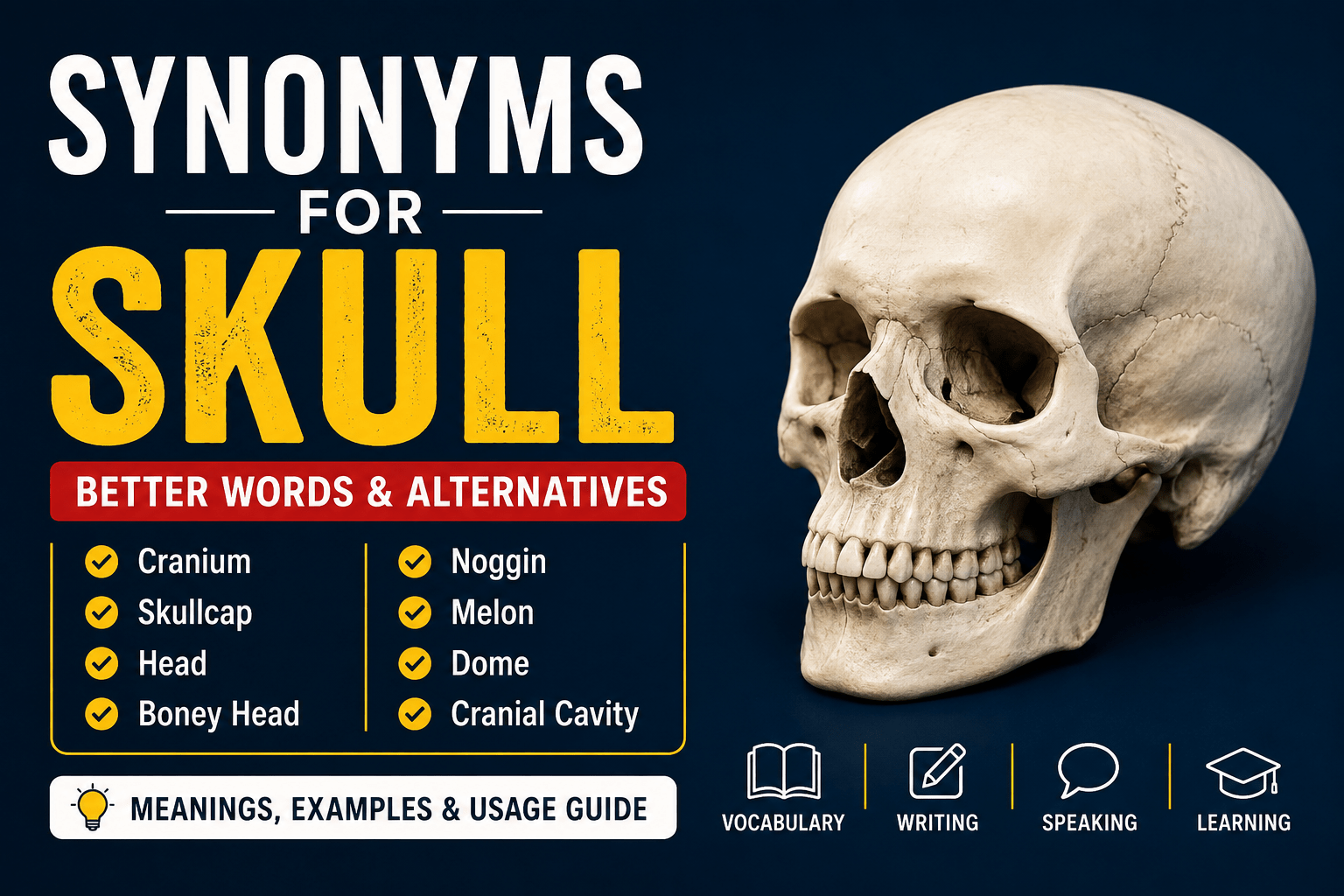
If you need another word for skull, the best choice depends on what you mean. Cranium is the closest standard anatomical synonym, while brainpan can also refer to the skull or cranium. Braincase is more specific because it refers to the part of the skull that encloses the brain. In informal English, words such as noggin, noddle, and pate can refer to the head, but they are not exact anatomical substitutes for skull.
This distinction matters because many thesaurus lists mix true synonyms with broader words, slang, and related anatomical terms.
Quick Answer
The closest synonyms for skull are cranium and brainpan. Braincase is a specialized term for the portion of the skull that encloses the brain. Head is a broader everyday term, while noggin, noddle, and pate are informal or humorous words for the head rather than exact anatomical equivalents.
What Does “Skull” Mean?
Skull is a countable noun referring to the bony structure that forms the head and surrounds and protects the brain. It also contributes to the structure of the face and supports the jaws. Cambridge and Oxford both identify cranium as a synonym or close equivalent.
The word also has an informal figurative use meaning a person’s head or brain, as in:
I can’t get that idea through my skull.
In this second sense, words such as head, brain, or informal terms for the head may work better than an anatomical term. Oxford specifically records the informal sense of skull as the head or brain.
Pronunciation
Skull: /skʌl/ in both standard US and UK pronunciation.
Word Origin
Skull comes from Middle English and is of Scandinavian origin. Merriam-Webster traces it to Middle English skulle and notes that the noun has been used in English since the 13th century.
The Best Synonyms for Skull
Not every word found in a thesaurus should be treated as an exact synonym. The table below separates close equivalents from words that merely overlap with skull in particular contexts.
| Word | Relationship | Strength | Formality | Best Context |
|---|---|---|---|---|
| Cranium | Direct/closest synonym | Equal | Formal / technical | Anatomy, medicine, science |
| Brainpan | Near synonym / contextual equivalent | Equal | Informal to neutral | Skull, cranium, literary description |
| Braincase | Context-specific | Narrower | Technical | Anatomy, zoology, paleontology |
| Head | Near synonym | Broader | Neutral | Everyday English |
| Noggin | Contextual alternative | Broader | Informal | Casual or humorous speech |
| Noddle | Contextual alternative | Broader | Informal / humorous | Casual and playful writing |
| Pate | Contextual alternative | Broader | Humorous / old-fashioned | Literary or humorous descriptions |
| Poll | Contextual alternative | Narrower | Formal / literary | Back or top of the head |
| Crown | Contextual alternative | Narrower | Neutral | Top of the head |
| Scalp | Related word | Different | Neutral | Skin and tissue covering the skull |
| Skullcap | Related word | Different | Neutral / technical | A cap-like part or covering; not generally the whole skull |
| Vertex | Related anatomical term | Narrower | Technical | Highest point of the head |
Merriam-Webster’s thesaurus lists cranium, head, braincase, crown, scalp, noggin, pate, poll, noddle, and death’s-head among words similar to skull. However, those terms do not all have identical meanings.
1. Cranium — The Closest Formal Synonym
Cranium is the strongest choice when you need a formal or anatomical alternative to skull.
In ordinary anatomy, cranium refers to the bony structure of the head that surrounds and protects the brain. Oxford explicitly gives cranium as a synonym for skull.
Best used for:
- medical writing
- anatomy
- biology
- scientific descriptions
- academic writing
Example:
The X-ray revealed a small fracture in the cranium.
Skull vs cranium:
These words are often interchangeable, but cranium sounds more technical and scientific.
2. Brainpan — An Informal or Older Alternative
Brainpan can mean the skull or cranium. Merriam-Webster defines it as braincase, while Collins records both the sense of the part of the skull containing the brain and the broader sense of skull or cranium.
Example:
The old legend described a warrior wearing a helmet over his battered brainpan.
It is much less common than skull or cranium in modern formal writing, so it is usually better suited to informal, literary, historical, or vivid descriptions.
3. Braincase — A More Specific Anatomical Term
Braincase should not automatically be treated as a perfect synonym for skull.
Cambridge defines it as the part of the skull that holds and protects the brain.
That makes it a narrower anatomical term.
Example:
Researchers compared the braincase morphology of several fossil species.
Use braincase when discussing the portion of the skull associated specifically with the brain.
4. Head — A Broader Everyday Alternative
Head is sometimes used where skull might appear, especially in ordinary speech, but the two words are not identical.
A head includes much more than the bones of the skull. It can refer to the entire anatomical region containing the skull, brain, face, eyes, ears, skin, and other structures.
Compare:
He suffered a fracture to his skull.
with:
He suffered an injury to his head.
The first is anatomically more specific. The second is broader.
Use “head” when: you mean the general body region rather than specifically the bony structure.
5. Noggin — Informal and Often Humorous
Noggin is an informal word for a person’s head or mind, especially in casual English. Cambridge labels this use mainly US informal.
Example:
I bumped my noggin on the low doorway.
It can sound playful or humorous, so it is not appropriate for most medical or academic writing.
6. Noddle — Informal or Humorous
Noddle is another informal word for the head. It can work well in humorous or conversational writing.
He gave his noddle a quick scratch and went back to work.
Like noggin, it refers to the head, not specifically to the bones of the skull. It should therefore be classified as a contextual alternative rather than an exact anatomical synonym.
7. Pate — The Top of the Head
Pate refers specifically to the top part of the head, particularly when it is bald. Oxford labels the modern use old-fashioned or humorous.
The sunlight reflected off his bald pate.
Because pate identifies a particular part or appearance of the head, it is not a precise replacement for skull.
8. Poll — A More Specialized Head Term
Poll can refer to the head, especially the back or upper part of the head.
It is relatively uncommon in everyday modern English and has literary, historical, and specialized uses.
The blow landed near the back of his poll.
It should be treated as a contextual alternative, not a universal synonym for skull.
9. Crown — The Top of the Head
Crown refers to the uppermost part of the head.
She wore a small ornament on the crown of her head.
Because it describes a part of the head, it cannot normally replace skull.
Closest Synonyms vs Related Words
One of the biggest problems with online synonym lists is that they can place anatomically related words beside genuine synonyms.
Closest equivalents
- cranium
- brainpan
Useful but narrower
- braincase
Broader words for the head
- head
- noggin
- noddle
- pate
- poll
Related anatomical terms that are not exact synonyms
- scalp
- crown
- vertex
- skullcap
This distinction is important. For example, the scalp is the skin and associated tissue covering the head; it is not another name for the skull. Similarly, the braincase is only a portion of the skull. Cambridge explicitly describes it as “the part of the skull” that protects the brain.
Which Word Should You Use?
Use cranium when:
You are writing about anatomy, medicine, biology, or science.
The researchers examined the cranium for evidence of injury.
Use brainpan when:
You want an informal, literary, or somewhat old-fashioned alternative.
The helmet protected his brainpan from the impact.
Use braincase when:
You specifically mean the portion of the skull enclosing the brain.
The fossil had an unusually large braincase.
Use head when:
You mean the entire head rather than specifically its bones.
She hit her head on the cabinet.
Use noggin or noddle when:
You want a casual, playful expression.
Watch your noggin!
Use pate when:
You mean the top of someone’s head, especially in a humorous or literary description.
His bald pate gleamed under the lights.
Skull vs. Cranium vs. Braincase
| Word | What it refers to | Typical register |
| Skull | The bony structure of the head | Neutral |
| Cranium | The skull, especially in anatomical contexts | Technical / formal |
| Braincase | The part of the skull surrounding the brain | Specialized |
| Head | The entire head region | Everyday |
| Brainpan | Skull or cranium | Informal / literary |
The simplest rule is:
Skull is the normal general term; cranium is the best formal anatomical alternative; braincase is more specific.
Common Mistakes When Choosing a Synonym for Skull
Mistake 1: Treating “scalp” as a synonym
Incorrect:
The doctor examined his scalp for a skull fracture.
A skull fracture concerns the bone, not the scalp.
Mistake 2: Using “brain” as a direct synonym
The brain is an organ located inside the skull. It is not another name for the skull.
Mistake 3: Using “head” in technical anatomy
Head is broader than skull. In precise scientific writing, skull or cranium may be necessary.
Mistake 4: Using “noggin” in formal medical writing
The patient suffered a fracture to the noggin.
This is humorous or informal. A medical report would use skull or cranium.
Mistake 5: Treating every thesaurus entry as an exact synonym
Words such as crown, scalp, vertex, and braincase have specific relationships to the skull but do not necessarily mean the same thing.
Natural Collocations with “Skull”
Some common phrases are more natural with skull than with its alternatives.
Common combinations
- fractured skull
- skull fracture
- human skull
- animal skull
- skull bone
- base of the skull
- top of the skull
- back of the skull
- skull injury
- skull surgery
- skull shape
- skull structure
Cambridge specifically identifies combinations such as fractured skull, human skull, and partial skull in its corpus-based collocation information.
For these phrases, replacing skull with a synonym can often make the sentence sound less natural.
For example:
She suffered a fractured skull.
is much more natural than:
She suffered a fractured brainpan.
Real-World Examples
Medical or scientific writing
The CT scan showed a fracture in the patient’s skull.
The researchers examined the cranium of the fossil specimen.
Paleontology
Scientists reconstructed the animal’s cranium from several fragments.
The fossil’s braincase was unusually elongated.
Everyday English
He hit his head on the door.
Casual speech
Watch your noggin!
Literary or humorous writing
The old knight rubbed his aching pate.
These examples show why the “best synonym” depends more on context than on simply finding a word with a similar dictionary entry.
Antonyms of Skull
Skull does not have a natural direct antonym.
Terms such as boneless may be conceptually contrasted with a bony structure, but they are not true lexical antonyms of skull.
For vocabulary purposes, it is more useful to understand the semantic relationship between:
- skull → bony structure
- brain → organ inside the skull
- scalp → covering over the skull
- head → broader anatomical region
- face → front portion of the head
Frequently Asked Questions
What is another word for skull?
The closest standard alternative is cranium. Brainpan can also mean skull or cranium, while braincase refers specifically to the part of the skull surrounding the brain.
What is the most formal synonym for skull?
Cranium is the best formal or technical alternative in most anatomical contexts.
Is “cranium” the same as “skull”?
In many general and anatomical contexts, yes. Dictionaries commonly give cranium as a synonym for skull.
Is “braincase” another word for skull?
Not exactly. A braincase is the part of the skull that holds and protects the brain, so it is narrower in meaning.
Is “head” a synonym for skull?
Head can sometimes replace skull in informal contexts, but it is broader. A head includes structures beyond the skull.
Is “brainpan” a synonym for skull?
Yes, in some dictionary definitions. Brainpan can mean the skull or cranium, although it is less common and more informal than skull or cranium.
What is an informal word for skull?
Words such as noggin and noddle are informal words for the head, and can sometimes be used where skull would be used loosely in casual speech. They are not exact anatomical equivalents. Cambridge specifically labels noggin as an informal word for the head.
What is the opposite of skull?
There is no standard direct antonym for skull. It names an anatomical structure rather than a quality or action that naturally forms an opposite pair.
Conclusion
If you need the closest true synonym for skull, choose cranium. For a less formal or literary alternative, brainpan can work. Braincase is useful when you specifically mean the part of the skull surrounding the brain, while head, noggin, noddle, and pate are broader or informal alternatives.
The key is not to treat every thesaurus suggestion as interchangeable. Skull is the normal neutral term, cranium is the clearest formal equivalent, and the other alternatives become useful only when their particular meaning, register, or context fits the sentence.

Daniel Carter is a professional content strategist and language enthusiast. He focuses on semantic SEO, keyword research, and creating structured vocabulary content that ranks well on search engines while remaining user-friendly.