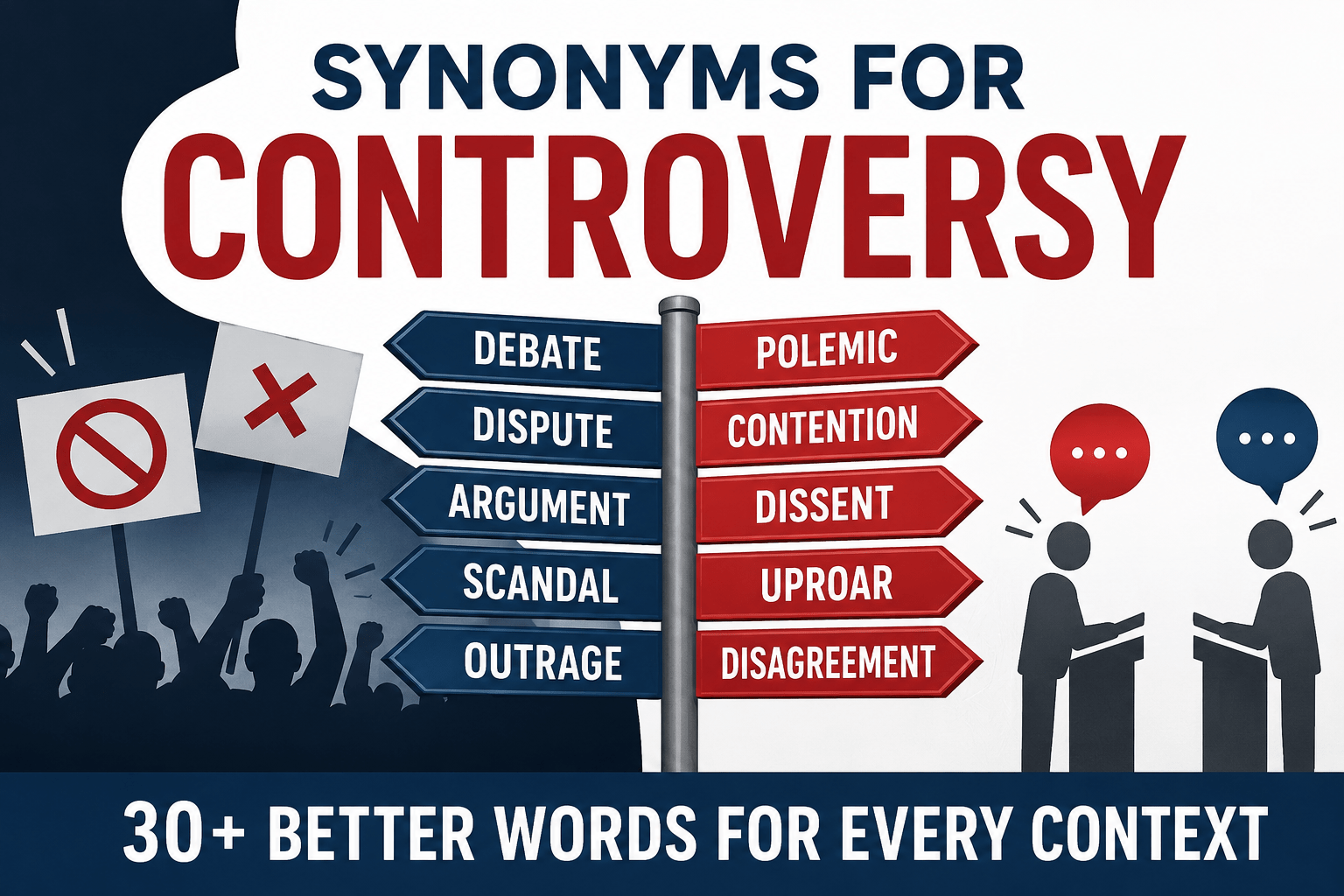
If you’re looking for synonyms for controversy, the best alternatives include dispute, debate, disagreement, contention, argument, quarrel, conflict, dissension, and wrangle. However, these words are not always interchangeable. Debate usually suggests a structured exchange of opposing views, while dispute emphasizes disagreement and quarrel often suggests a more personal conflict.
This guide explains the most useful alternatives to controversy, including their meanings, tone, formality, and natural contexts, so you can choose the right word instead of simply using the closest thesaurus entry.
Quick Answer
The closest general synonyms for controversy include dispute, disagreement, debate, contention, and argument. In formal writing, dispute, contention, and dissension are strong choices. When discussing a public issue involving opposing views, debate or dispute may sound more natural. For a personal disagreement, quarrel or conflict is usually the better choice.
Best Synonyms for Controversy
| Word | Relationship | Best Context | Formality |
|---|---|---|---|
| Dispute | Close synonym | Public, legal, political, or professional disagreement | Formal/Neutral |
| Debate | Near synonym | Opposing opinions or arguments | Neutral/Formal |
| Disagreement | Close synonym | General difference of opinion | Neutral |
| Contention | Near synonym | Strongly disputed claim or issue | Formal |
| Argument | Near synonym | Verbal disagreement or opposing views | Neutral |
| Quarrel | Contextual alternative | Personal or emotional disagreement | Neutral |
| Conflict | Related/near synonym | Serious opposition between people or groups | Neutral/Formal |
| Dissension | Near synonym | Internal disagreement within a group | Formal |
| Wrangle | Contextual alternative | Prolonged or difficult dispute | Neutral/Formal |
| Squabble | Contextual alternative | Minor or petty disagreement | Informal |
| Altercation | Contextual alternative | Heated verbal or physical confrontation | Formal |
| Feud | Contextual alternative | Long-running conflict between people or groups | Neutral |
| Scandal | Related term, not exact synonym | Controversial event involving wrongdoing or disgrace | Neutral/Formal |
| Row | Contextual alternative | Heated argument, especially in British English | Informal |
| Spat | Contextual alternative | Short, relatively minor disagreement | Informal |
Merriam-Webster lists dispute, disagreement, argument, quarrel, and altercation among words associated with controversy, while Cambridge’s thesaurus also includes debate, contention, dissension, and wrangle.
What Does “Controversy” Mean?
Controversy is a noun referring to substantial disagreement or argument about an issue, often one that attracts public attention or affects many people.
For example:
The new policy caused widespread controversy.
Cambridge defines controversy as significant disagreement or argument about something, often because the issue matters to many people. Merriam-Webster similarly defines it as a discussion characterized by opposing views and also gives dispute as a close synonym.
The word is especially common when discussing politics, science, entertainment, social issues, public policy, organizations, and media.
Common collocations
Natural phrases include:
- spark controversy
- cause controversy
- stir controversy
- surrounded by controversy
- at the center of controversy
- a heated controversy
- a public controversy
- a political controversy
- a scientific controversy
- controversy over a decision
Cambridge specifically records combinations such as fierce controversy, heated controversy, and controversy surrounding/over.
1. Dispute
Dispute is probably the strongest general replacement for controversy when the emphasis is on a disagreement between people, organizations, or sides.
Example:
The two companies became involved in a dispute over the contract.
Use dispute for:
- legal disagreements
- business conflicts
- political disagreements
- ownership issues
- public disagreements
It is generally more precise than controversy when identifiable parties are actively disagreeing.
2. Debate
Debate refers to a discussion in which opposing opinions or arguments are presented.
Example:
The proposal has sparked a national debate.
Choose debate when the emphasis is on discussion and competing viewpoints, rather than conflict itself.
Controversy: emphasizes the disagreement surrounding an issue.
Debate: emphasizes the exchange of arguments about that issue.
3. Disagreement
Disagreement is a broad, neutral word for a difference of opinion.
Example:
There was considerable disagreement over the proposed changes.
It is often less dramatic than controversy. A disagreement can involve only two people and does not necessarily attract public attention.
4. Contention
Contention is a formal word that can describe a disputed issue, claim, or point of disagreement.
Example:
The main contention was whether the evidence was reliable.
It is particularly useful in academic, legal, analytical, and professional writing.
5. Argument
Argument can refer to opposing reasons or claims, or to a verbal disagreement.
Example:
The issue has become the subject of heated argument.
Because argument has multiple meanings, context matters. In academic writing, it may mean a reasoned position; in everyday conversation, it often means a quarrel.
6. Quarrel
Quarrel usually describes an angry or personal disagreement.
Example:
The two neighbors had a bitter quarrel.
It is generally less appropriate than controversy for a major public policy or scientific issue.
7. Conflict
Conflict describes serious opposition between individuals, groups, interests, or ideas.
Example:
The decision created conflict within the organization.
Conflict is broader than controversy. It can involve competing interests or goals without necessarily being a public debate.
8. Dissension
Dissension refers to disagreement, especially disagreement among members of the same group.
Example:
The proposal caused dissension within the committee.
This is a useful formal alternative when discussing political parties, organizations, institutions, or teams.
9. Wrangle
A wrangle is a prolonged or difficult argument or dispute.
Example:
The government became involved in a lengthy wrangle over funding.
It works well when the disagreement has continued for some time.
10. Squabble
Squabble describes a minor, petty, or relatively unimportant argument.
Example:
The two departments became involved in a petty squabble.
Because it can sound dismissive, it should not normally replace controversy when discussing a serious public issue.
11. Altercation
Altercation usually refers to a heated argument or confrontation.
Example:
An altercation broke out outside the meeting.
It is much more specific than controversy and often describes an actual confrontation between people.
12. Feud
A feud is a prolonged and often bitter conflict between people, families, groups, or organizations.
Example:
The two companies have been involved in a long-running feud.
Use feud when the conflict is ongoing and personal or adversarial.
13. Scandal
Scandal is often associated with controversy, but it is not an exact synonym.
A scandal generally involves an event, behavior, or revelation considered shocking, disgraceful, or improper.
Example:
The financial scandal damaged the company’s reputation.
A scandal can cause controversy, but not every controversy is a scandal.
This distinction is important when choosing precise vocabulary.
14. Row
Row is an informal word, particularly common in British English, for a heated argument.
Example:
The two politicians had a public row over the proposal.
It is generally too informal for formal American professional writing.
15. Spat
A spat is a short or relatively minor disagreement.
Example:
The celebrities became involved in a brief public spat.
It suggests a smaller conflict than controversy and often sounds informal.
Controversy vs. Dispute
These words overlap, but they emphasize different things.
Controversy usually concerns an issue that attracts opposing opinions, often publicly.
Dispute more strongly suggests that people or groups are actively disagreeing about something.
Compare:
The new law generated considerable controversy.
The two companies are involved in a dispute over the contract.
Use controversy for the broader public issue and dispute when focusing on the parties and their disagreement.
Controversy vs. Debate
A debate is usually an exchange of arguments or viewpoints.
A controversy is the disagreement or public dispute surrounding an issue.
The proposal sparked controversy.
Lawmakers held a debate about the proposal.
A controversy may produce a debate, but the two words are not identical.
Controversy vs. Disagreement
Disagreement is the broadest and most neutral of the three.
A disagreement can be private, minor, or temporary.
A controversy usually has greater significance or public visibility.
We had a disagreement about the schedule.
The new policy caused widespread controversy.
Controversy vs. Conflict
Conflict suggests opposition that may involve competing interests, goals, or relationships.
Controversy focuses more specifically on disagreement surrounding an issue.
The proposal created controversy among voters.
The policy created conflict between the two departments.
Which Word Should I Use?
Use “dispute” when:
You are describing a disagreement between identifiable people, groups, companies, or institutions.
Use “debate” when:
The focus is on opposing arguments or viewpoints.
Use “disagreement” when:
You want a neutral, general word for different opinions.
Use “contention” when:
You are writing formally about a disputed claim or issue.
Use “quarrel” when:
The disagreement is personal or emotional.
Use “conflict” when:
The opposing interests or relationships are more important than the public discussion.
Use “dissension” when:
People within the same organization or group disagree.
Use “wrangle” when:
The dispute is prolonged or difficult.
Use “scandal” when:
The controversy involves behavior or an event regarded as shocking or disgraceful.
Common Mistakes
Treating “scandal” as an exact synonym
A scandal is a type of controversial situation, not simply another word for every controversy.
Using “squabble” for a serious public issue
Squabble suggests a petty or minor disagreement and can make a serious issue sound trivial.
Using “altercation” for a general controversy
An altercation normally involves a confrontation between people. It does not simply mean public disagreement over an issue.
Assuming “debate” always means controversy
A debate can be calm, structured, and productive. A controversy usually implies stronger disagreement or public contention.
Using “feud” for a one-time disagreement
A feud normally suggests a continuing or repeated conflict rather than a single disagreement.
Frequently Asked Questions
What is the closest synonym for controversy?
Dispute is one of the closest general synonyms for controversy. Other strong alternatives include disagreement, debate, and contention, but each emphasizes a slightly different aspect of opposing views.
What is another word for public controversy?
Depending on context, public dispute, public debate, or public disagreement can work. Public dispute is particularly useful when identifiable parties are openly disagreeing.
What is a formal synonym for controversy?
Contention, dispute, dissension, and disputation can work in formal contexts. The best choice depends on whether you are describing a disputed claim, disagreement between parties, or opposition within a group.
Is “debate” a synonym for “controversy”?
Sometimes, but not always. A debate is an exchange of opposing arguments, whereas a controversy is the broader disagreement surrounding an issue. A controversy can lead to a debate, but the words are not interchangeable in every sentence.
Is “dispute” the same as “controversy”?
They overlap considerably. Dispute usually emphasizes disagreement between parties, while controversy often emphasizes a contested issue that attracts attention or opposing opinions.
What is a synonym for controversy in academic writing?
Depending on the sentence, debate, dispute, contention, disagreement, or dissension may work. Debate is especially useful for competing scholarly viewpoints, while contention works well for a disputed claim.
What is a synonym for a minor controversy?
Disagreement, squabble, spat, or minor dispute may work depending on the situation. Squabble and spat are more informal and suggest a relatively small conflict.
What is the opposite of controversy?
There is no single perfect antonym in every context, but agreement, consensus, accord, and unanimity can express the opposite idea. Cambridge’s thesaurus lists agreement, unanimity, and accord as antonyms associated with controversy.
Conclusion
The best synonym for controversy depends on what you want to emphasize. Choose dispute for disagreement between parties, debate for opposing arguments, disagreement for a neutral difference of opinion, contention for formal writing, and quarrel for personal conflict.
Remember that related words such as scandal, conflict, feud, and altercation are not automatically interchangeable with controversy. Choosing the word that matches the exact context will make your writing more precise, natural, and effective.

Michael Thompson is an English language specialist and experienced editor who focuses on vocabulary development and clear communication. He creates high-quality synonym guides, word comparisons, and writing tips to help students and professionals express their ideas more effectively. His work combines linguistic knowledge with practical SEO strategies to make learning both useful and engaging.