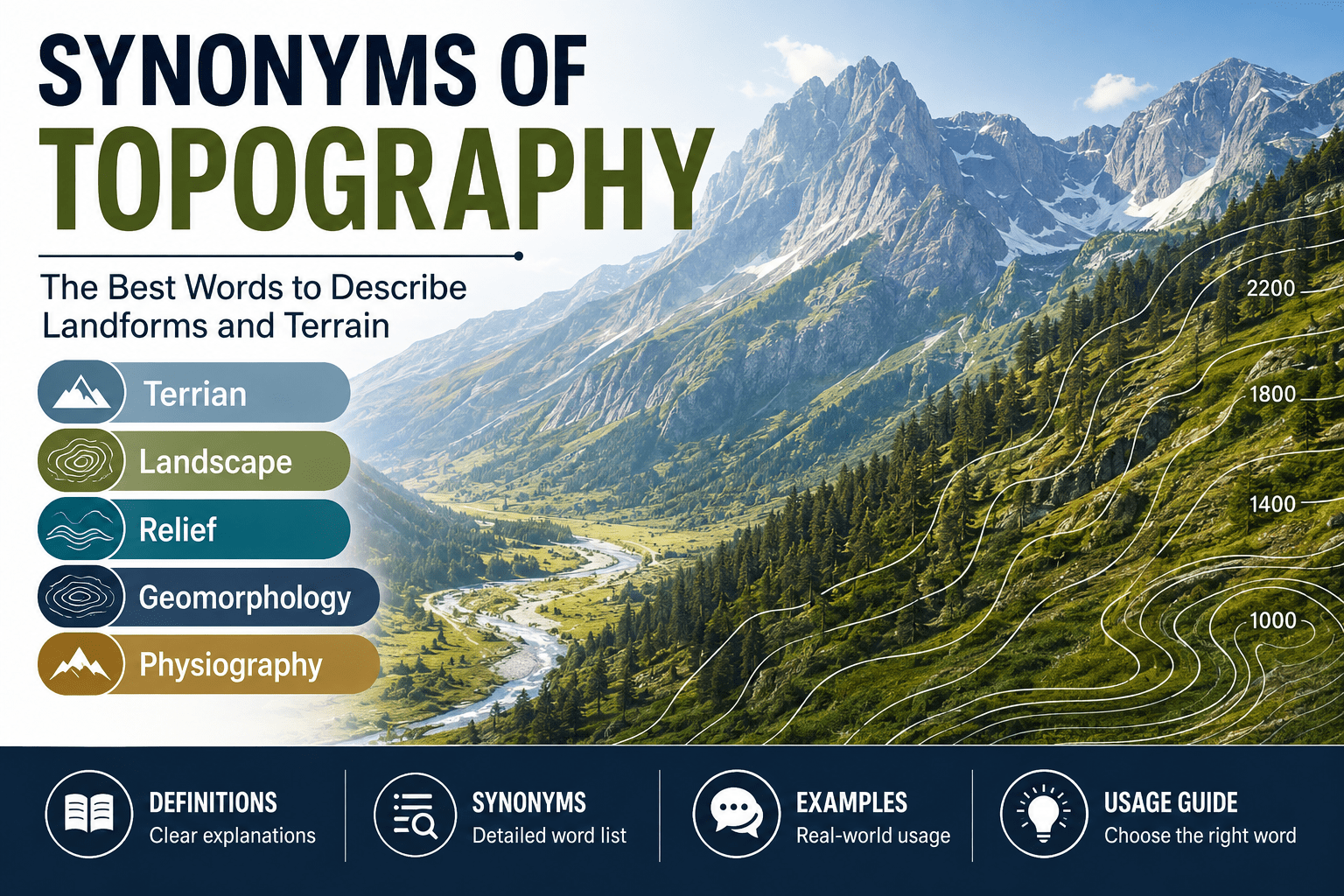
If you’re looking for synonyms of topography, the closest alternatives include terrain, landscape, geography, landform, and geomorphology. However, these words are not perfect substitutes in every sentence.
Terrain usually emphasizes the character or surface of land, while landscape is broader and can include the visible appearance of an area. Geography is broader still, covering the study and spatial characteristics of places. Merriam-Webster lists geography, landscape, and terrain among the principal synonyms of topography.
Quick Answer: What Are the Best Synonyms of Topography?
The best synonyms and closely related alternatives to topography are:
- Terrain — the physical character or surface of land
- Landscape — the visible features and overall appearance of an area
- Geography — the physical and spatial characteristics of a place
- Landform — a specific natural feature such as a valley, hill, or plateau
- Geomorphology — the scientific study of landforms and the processes that shape them
- Scenery — the natural or visible features of a place, especially aesthetically
- Ground — the surface or physical land in a particular area
- Terrane — a geological term for a distinct piece or region of Earth’s crust
- Chorography — the description or mapping of a particular region
- Land — a broad, general term for an area of ground or territory
The best choice depends on what you mean by topography.
What Does Topography Mean?
Topography is a noun referring to the physical features and shape of an area, especially its surface, elevations, and natural or constructed features. It can also refer to the practice of describing or mapping those features. Cambridge defines it as the physical appearance of the natural features of an area of land, particularly the shape of its surface.
For example:
The mountain’s steep topography makes construction difficult.
In this sentence, terrain would be a natural alternative:
The mountain’s steep terrain makes construction difficult.
Topography can also be used beyond ordinary geography, such as in phrases describing the surface features of a physical object or the structural relationships within a system.
Core Synonyms of Topography
| Word | Relationship | Main Meaning | Best Context |
|---|---|---|---|
| Terrain | Near-synonym | Character and features of land | Hiking, geography, construction |
| Landscape | Near-synonym | Overall visible features of an area | Nature, photography, design |
| Geography | Broader alternative | Physical and spatial characteristics of places | Academic and general writing |
| Landform | Contextual alternative | A particular physical feature | Geology and geography |
| Geomorphology | Related technical term | Scientific study of landforms | Earth science |
| Scenery | Contextual alternative | Attractive or visible natural features | Travel and description |
| Ground | Contextual alternative | Surface or area of land | Everyday language |
| Terrane | Technical term | Distinct geological region | Geology |
| Chorography | Technical alternative | Detailed description of a region | Geography and cartography |
| Land | Broad alternative | Ground or territory | General usage |
1. Terrain
Terrain is one of the closest everyday alternatives to topography. It refers to the physical characteristics of an area of land, especially when those characteristics affect movement or activity.
Example:
The rough terrain made the hiking expedition challenging.
Use terrain when talking about whether land is:
- rocky
- mountainous
- flat
- steep
- muddy
- uneven
- difficult to cross
Topography vs. terrain: Topography focuses more on the arrangement and shape of land features, while terrain often emphasizes the character or conditions of the land.
2. Landscape
Landscape refers to the visible features and overall appearance of an area.
The landscape was dominated by rolling hills and dense forests.
It is broader and often more visual or descriptive than topography. It can also include human-made features such as buildings, roads, and fields.
Choose landscape when discussing how a place looks as a whole.
3. Geography
Geography is a broader term involving places, spatial relationships, and physical or human features of Earth.
The geography of the region includes mountains, rivers, and extensive plains.
It can sometimes replace topography, but it is not an exact synonym.
Use geography when the discussion goes beyond land shape and includes climate, population, location, resources, or other characteristics of a place.
4. Landform
A landform is a particular physical feature of Earth’s surface.
Examples include:
- mountain
- valley
- plateau
- canyon
- ridge
- plain
The valley is one of the area’s most distinctive landforms.
Unlike topography, which can describe the arrangement of many features, landform usually identifies one feature or type of physical feature.
5. Geomorphology
Geomorphology is the scientific study of landforms and the processes that create and change them.
Researchers used geomorphology to study how erosion shaped the valley.
This is not an everyday synonym for topography. It is a specialized scientific term.
Use it in academic or geological contexts when referring to the study of Earth’s surface forms.
6. Scenery
Scenery refers to the visible natural features of a place, particularly when they are considered attractive.
The mountain scenery was spectacular.
It can overlap with landscape, but scenery usually emphasizes visual appeal rather than precise elevation or surface structure.
Therefore, scenery is generally a poor replacement in technical writing about maps or land elevation.
7. Ground
Ground can sometimes replace topography when referring generally to the physical surface of an area.
The uneven ground made it difficult to install the equipment.
However, it is much less precise. Ground does not necessarily communicate the detailed shape or elevation of an area.
8. Terrane
Terrane is a specialized geological term referring to a distinct region or fragment of Earth’s crust with a particular geological history.
The researchers identified a separate geological terrane.
Because it has a specific geological meaning, terrane should not normally be used as an everyday synonym for topography.
9. Chorography
Chorography is a specialized term associated with describing or mapping the characteristics of a particular region.
It is much less common in modern everyday English than topography.
Use it mainly in historical, geographical, or cartographic contexts.
10. Land
Land is a broad everyday word that can sometimes substitute for topography when the context is simple.
The developers studied the land before beginning construction.
However, land does not specifically mean the arrangement of elevations and physical features. It is therefore a broad alternative rather than a precise synonym.
Which Word Should You Use?
The right synonym depends on your sentence.
Choose terrain when:
You mean the physical character or difficulty of the land.
The vehicle can handle rough terrain.
Choose landscape when:
You mean the overall visible appearance of an area.
The desert landscape stretched for miles.
Choose geography when:
You mean the broader physical or spatial characteristics of a place.
The geography of the region influences its climate.
Choose landform when:
You mean one specific physical feature.
The glacier created a distinctive landform.
Choose geomorphology when:
You mean the scientific study of landforms and surface processes.
The course covers geomorphology and erosion.
Choose scenery when:
You are emphasizing visual beauty or appearance.
The coastal scenery was breathtaking.
Topography vs. Terrain
Topography and terrain are closely related, but they are not identical.
The term topography describes the arrangement, shape, elevation, and physical features of land. Terrain, by contrast, usually refers to the character or condition of the land, especially when discussing movement or travel.
Terrain generally describes the character or type of land, particularly in relation to travel, construction, or activity.
Compare:
The map shows the topography of the region.
The hikers struggled with the rocky terrain.
The first sentence focuses on the land’s physical configuration. The second focuses on the nature of the surface encountered by hikers.
Topography vs. Landscape
Landscape is broader and more visual.
A landscape may include:
- mountains
- rivers
- forests
- buildings
- roads
- fields
Topography focuses more specifically on physical configuration, surface shape, and elevation.
So:
The landscape of the valley is beautiful.
sounds natural when discussing appearance, while:
The topography of the valley is complex.
is more appropriate for geography, surveying, or physical description.
Topography vs. Geography
Geography covers a much wider field than topography.
Geography can involve:
- landforms
- climate
- population
- cities
- resources
- political boundaries
- human activity
Topography is more specifically concerned with the physical configuration and features of a surface.
Therefore, replacing topography with geography can make your meaning much broader.
Common Mistakes With Topography Synonyms
Mistake 1: Treating every related word as an exact synonym
Words such as scenery, landform, and geomorphology are related to topography but have different meanings.
Mistake 2: Using “geography” when you mean elevation
If you’re specifically discussing hills, slopes, elevations, and surface features, topography or terrain is usually more precise.
Mistake 3: Using “scenery” in technical writing
Scenery emphasizes visual appearance and often beauty. It is not a good substitute for topography in a technical report.
Mistake 4: Confusing topography with topographic
Topography is a noun.
The area’s topography is mountainous.
Topographic is an adjective.
We studied a topographic map.
Merriam-Webster defines topographic as relating to or concerned with topography.
Natural Collocations With Topography
Topography commonly appears with adjectives and nouns that describe the location, character, shape, or physical features of an area. Understanding these collocations can help you use topography naturally in academic, geographical, technical, and professional writing.
1. Local Topography
Local topography refers to the physical features and shape of land in a specific nearby area. It can include hills, slopes, valleys, elevations, and other surface features.
Example:
The engineers studied the local topography before designing the road.
Common contexts: construction, surveying, engineering, geography, urban planning.
2. Natural Topography
Natural topography describes the physical features of land that have developed naturally rather than being created or significantly altered by humans.
Example:
The hiking trail follows the natural topography of the mountain.
This phrase is useful when distinguishing natural landforms from artificial structures or modified landscapes.
3. Rough Topography
Rough topography describes land with an uneven, irregular, or difficult surface. It may include steep slopes, rocks, deep valleys, or other obstacles.
Example:
The rescue team had difficulty crossing the area’s rough topography.
Related idea: rough terrain is often more natural when talking about movement or travel.
4. Complex Topography
Complex topography refers to an area where the land has many different elevations, slopes, valleys, ridges, or other physical features.
Example:
The region’s complex topography makes transportation difficult.
This collocation is especially common in geography, environmental science, meteorology, and engineering.
5. Mountainous Topography
Mountainous topography describes land characterized by mountains, steep slopes, ridges, and significant changes in elevation.
Example:
The country’s mountainous topography limits the development of large transportation networks.
This phrase is particularly useful in discussions of mountain regions, climate, transportation, agriculture, and settlement.
6. Flat Topography
Flat topography refers to land with little variation in elevation and relatively few slopes or hills.
Example:
The area’s flat topography makes it suitable for large-scale agriculture.
It is commonly used in geography, agriculture, construction, and urban planning.
7. Regional Topography
Regional topography refers to the physical characteristics and elevation patterns of a larger geographical region.
Example:
The regional topography influences rainfall patterns across the area.
This phrase is useful when discussing the relationship between land features and climate, ecosystems, water flow, or human settlement.
8. Surface Topography
Surface topography refers specifically to the shape, structure, and physical characteristics of a surface.
Example:
Scientists analyzed the surface topography of the material using specialized equipment.
Unlike ordinary geographical uses, this phrase can also appear in engineering, materials science, medicine, and other technical fields.
9. Underwater Topography
Underwater topography describes the shape and physical features of surfaces beneath oceans, seas, lakes, or other bodies of water.
Example:
Researchers mapped the underwater topography of the ocean floor.
It may include features such as trenches, ridges, seamounts, valleys, and underwater plains.
10. Topographic Map
Topographic map is a closely related and very common term rather than a simple adjective + noun collocation. A topographic map represents the physical features and elevation of an area, often using contour lines.
Example:
We used a topographic map to identify the steepest part of the mountain.
Topographic maps are commonly used in hiking, surveying, engineering, military planning, geography, and land management.
Quick Usage Guide
| Collocation | Main Meaning | Common Context |
|---|---|---|
| Local topography | Features of a specific area | Engineering, construction |
| Natural topography | Naturally formed land features | Geography, environment |
| Rough topography | Uneven or difficult land | Travel, geography |
| Complex topography | Many varied physical features | Science, geography |
| Mountainous topography | Land dominated by mountains | Geography, climate |
| Flat topography | Land with little elevation change | Agriculture, planning |
| Regional topography | Features across a region | Geography, climate |
| Surface topography | Shape of a particular surface | Science, engineering |
| Underwater topography | Features beneath water | Oceanography |
| Topographic map | Map showing land features and elevation | Mapping, hiking, surveying |
specifically records combinations such as flat topography, local topography, and natural topography.
What Is the Closest Synonym for Topography?
Terrain is often the closest natural everyday alternative when topography refers to the physical character of land. Landscape and geography are also common alternatives, but they are broader or emphasize different aspects of a place.
For technical mapping or precise descriptions of elevation and surface features, topography itself is usually the better word.
FAQ
What is another word for topography?
Common alternatives include terrain, landscape, geography, and landform. The best choice depends on context. Terrain is often the closest everyday alternative, while landscape emphasizes overall appearance and landform refers to a specific physical feature.
Is terrain a synonym for topography?
Terrain is a close synonym, but not an exact replacement in every context. Terrain usually emphasizes the character or physical conditions of land, whereas topography focuses more on the arrangement, shape, and elevation of its features.
Is landscape the same as topography?
No. Landscape is broader and more visual. It can describe the overall appearance of an area, including natural and human-made features. Topography is more specifically concerned with the physical configuration of a surface.
What is the difference between topography and geography?
Geography is broader than topography. Geography examines places and spatial relationships, including physical and human characteristics. Topography focuses more specifically on the physical configuration and features of a surface.
What is a synonym for topography in geography?
Depending on context, terrain, landscape, landform, or geography may work. For a precise description of the shape and elevation of land, however, topography is often the most accurate term.
What is the opposite of topography?
There is no single standard antonym for topography. Depending on the intended contrast, a writer might discuss flatness, uniformity, or lack of relief, but these describe particular characteristics rather than direct opposites.
Is geomorphology a synonym for topography?
Not exactly. Geomorphology is the scientific study of landforms and the processes that shape Earth’s surface. Topography refers primarily to the physical configuration or features of a surface.
Conclusion
The best synonyms of topography include terrain, landscape, geography, and landform, but each has a different range of meaning. Terrain is often the closest everyday alternative, while landscape emphasizes overall appearance and geography has a much broader meaning. For precise technical writing about surface shape, elevation, and physical features, topography remains the most accurate choice.
The key is not simply to find a word that looks similar in a thesaurus. Choose the alternative that matches the context, meaning, and level of precision you need.

Michael Thompson is an English language specialist and experienced editor who focuses on vocabulary development and clear communication. He creates high-quality synonym guides, word comparisons, and writing tips to help students and professionals express their ideas more effectively. His work combines linguistic knowledge with practical SEO strategies to make learning both useful and engaging.