Quick Answer: What Are Some Similes for Many?
Similes for many describe a large number of people, objects, or things by comparing them to familiar images. Examples include as numerous as stars in the sky, like ants at a picnic, and like grains of sand on a beach. These comparisons help readers picture abundance, crowded spaces, or quantities too large to count easily.
What Does “Many” Mean in a Simile?
The word many refers to a large number of people, objects, or things. In descriptive writing, similes can make that quantity easier to imagine by comparing it with something familiar.
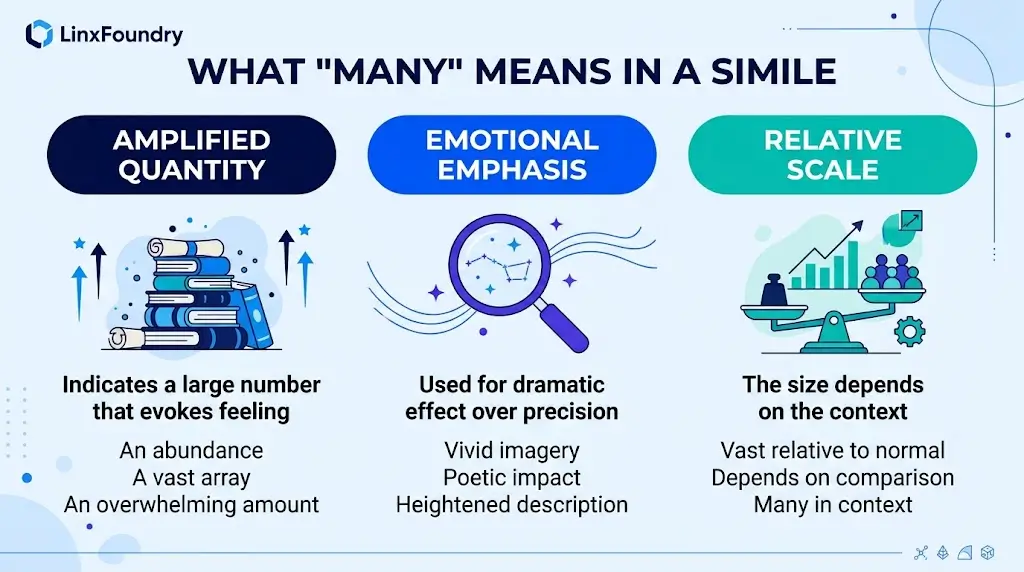
For example, saying “There were many stars” gives readers a basic fact. However, saying “Stars filled the sky like diamonds scattered across black velvet” creates a more vivid picture.
A simile compares two different things using words such as like or as. When describing many things, a good simile helps readers understand not only the quantity but also the appearance, movement, or feeling associated with it.
45 Best Similes for Many
These similes describe large quantities, crowded places, numerous objects, and things that seem almost endless. Each includes a meaning and an example sentence to help you use it naturally.
Simple Similes for Many
These straightforward comparisons work well in school assignments, everyday descriptions, and beginner-level creative writing.
1. As numerous as stars in the sky
Meaning: Existing in an extremely large number.
Example: The possibilities for her future were as numerous as stars in the sky.
2. Like grains of sand on a beach
Meaning: So many that counting them would be difficult.
Example: Tiny shells covered the shoreline like grains of sand on a beach.
3. Like leaves on a tree
Meaning: Present in a large quantity, especially when spread across an area.
Example: Ideas filled his notebook like leaves on a tree.
4. As plentiful as flowers in a meadow
Meaning: Available in abundance.
Example: During spring, colorful wildflowers were as plentiful as flowers in a meadow.
5. Like raindrops in a storm
Meaning: Appearing in great numbers over a short period.
Example: Questions came from the audience like raindrops in a storm.
6. Like pebbles along a riverbank
Meaning: Numerous objects scattered across a surface.
Example: Memories of their childhood lay in her mind like pebbles along a riverbank.
7. As common as blades of grass
Meaning: Found in many places or occurring frequently.
Example: In that busy neighborhood, small coffee shops were as common as blades of grass.
8. Like stars scattered across the night sky
Meaning: Spread across a wide area in large numbers.
Example: The village lights twinkled across the valley like stars scattered across the night sky.
9. Like beads spilling from a broken necklace
Meaning: Many small objects spreading out in different directions.
Example: Colorful marbles rolled across the floor like beads spilling from a broken necklace.
10. As abundant as apples in an orchard
Meaning: Available in large quantities.
Example: During harvest season, fresh apples were as abundant as apples in an orchard.
Similes for Many People and Crowds
These comparisons help describe busy streets, packed rooms, large audiences, and groups of people.
11. Like ants around a picnic
Meaning: A large group gathered closely around something interesting.
Example: Curious children surrounded the magician like ants around a picnic.
12. Like bees around a hive
Meaning: People gathering and moving busily around a central place.
Example: Reporters crowded around the celebrity like bees around a hive.
13. Like fish in a school
Meaning: A large group moving together in the same direction.
Example: The students streamed through the hallway like fish in a school.
14. Like sardines in a can
Meaning: People packed tightly into a small space.
Example: During the concert, we stood together like sardines in a can.
15. Like bees around a flower
Meaning: People gathering eagerly around someone or something attractive.
Example: Young fans gathered around the visiting athlete like bees around a flower.
16. Like shoppers on a holiday sale
Meaning: A large number of people gathering eagerly in one place.
Example: Visitors rushed toward the new attraction like shoppers on a holiday sale.
17. Like birds gathering before migration
Meaning: A large group assembling before moving somewhere together.
Example: Travelers filled the station like birds gathering before migration.
18. Like waves of people entering a stadium
Meaning: Large groups arriving one after another.
Example: Supporters poured through the gates like waves of people entering a stadium.
19. Like bees in a busy garden
Meaning: Numerous people moving around actively.
Example: Volunteers worked throughout the community center like bees in a busy garden.
20. Like penguins huddled together
Meaning: Many individuals standing closely together in a small area.
Example: The children waited outside the classroom like penguins huddled together.
Creative Similes for Many Things
Use these imaginative comparisons to describe collections, scattered objects, busy scenes, or an overwhelming quantity of something.
21. Like confetti after a parade
Meaning: Numerous small objects scattered across an area.
Example: Colorful papers covered the street like confetti after a parade.
22. Like fireworks filling the sky
Meaning: A large number of bright or exciting things appearing at once.
Example: New ideas burst into her mind like fireworks filling the sky.
23. Like pearls spilling from a jewelry box
Meaning: Many small, valuable objects scattered across a surface.
Example: Water droplets covered the petals like pearls spilling from a jewelry box.
24. Like buttons scattered across a table
Meaning: Numerous small objects spread across a flat surface.
Example: The craft supplies lay everywhere like buttons scattered across a table.
25. Like puzzle pieces covering the floor
Meaning: Many separate pieces spread across an area.
Example: Papers and sketches covered his bedroom floor like puzzle pieces covering the floor.
26. Like pages in an unfinished novel
Meaning: A seemingly endless collection of written material or ideas.
Example: The stories waiting to be told were like pages in an unfinished novel.
27. Like sparks from a blazing fire
Meaning: Many small things appearing or moving rapidly.
Example: Creative suggestions flew around the meeting like sparks from a blazing fire.
28. Like bubbles rising from boiling water
Meaning: Numerous things appearing continuously.
Example: Questions kept emerging from the audience like bubbles rising from boiling water.
29. Like droplets on a foggy window
Meaning: Many small objects or marks appearing close together.
Example: Tiny beads of moisture covered the glass like droplets on a foggy window.
30. Like coins scattered across a treasure chest
Meaning: Many individual objects spread throughout a collection.
Example: Golden ornaments glittered in the display like coins scattered across a treasure chest.
Similes for Countless or Almost Endless Things
These expressions emphasize a quantity that seems impossible to count or stretches beyond easy measurement.
31. Like stars beyond the horizon
Meaning: Seemingly endless in number.
Example: Her imagination held possibilities like stars beyond the horizon.
32. Like grains of dust dancing in sunlight
Meaning: Numerous tiny particles visible in the air.
Example: Fine particles floated through the workshop like grains of dust dancing in sunlight.
33. Like waves rolling toward the shore
Meaning: Large numbers arriving continuously or in repeated groups.
Example: New messages arrived on his phone like waves rolling toward the shore.
34. Like drops of water in the ocean
Meaning: An enormous quantity in which individual items seem insignificant.
Example: Compared with the library’s collection, my five books were like drops of water in the ocean.
35. Like trees in a vast forest
Meaning: So numerous that counting each one would be difficult.
Example: Questions about the ancient civilization were like trees in a vast forest.
36. Like grains in a mountain of rice
Meaning: An overwhelming quantity of small, similar objects.
Example: The warehouse contained boxes like grains in a mountain of rice.
37. Like stars in a distant galaxy
Meaning: A vast quantity that is difficult to imagine fully.
Example: The universe seemed to hold mysteries like stars in a distant galaxy.
38. Like ripples spreading across a pond
Meaning: Numerous effects or movements extending outward.
Example: The news spread through the town like ripples spreading across a pond.
39. Like snowflakes in a winter storm
Meaning: Countless individual things appearing together.
Example: Paper scraps fluttered through the air like snowflakes in a winter storm.
40. Like grains of rice in a sack
Meaning: A large number of small, similar items gathered together.
Example: The container held tiny beads like grains of rice in a sack.
Similes for Many Ideas, Choices, and Possibilities
Not every use of many refers to physical objects. These comparisons help writers describe thoughts, opportunities, options, and experiences.
41. Like branches spreading from a tree
Meaning: Numerous ideas or possibilities extending in different directions.
Example: Her research questions grew like branches spreading from a tree.
42. Like paths through a forest
Meaning: Many possible choices or directions.
Example: After graduation, his career options appeared like paths through a forest.
43. Like pages in a diary
Meaning: Numerous memories or experiences collected over time.
Example: Their shared adventures filled his mind like pages in a diary.
44. Like keys on a crowded key ring
Meaning: Many different options, solutions, or possibilities.
Example: The software offered solutions like keys on a crowded key ring.
45. Like seeds scattered across fertile soil
Meaning: Numerous ideas or opportunities with the potential to grow.
Example: The teacher planted suggestions in the students’ minds like seeds scattered across fertile soil.
Quick-Reference Table: Similes for Many
| Simile | Meaning | Best Used For |
|---|---|---|
| As numerous as stars in the sky | Extremely numerous | Possibilities and opportunities |
| Like grains of sand on a beach | Too many to count easily | Small objects |
| Like ants around a picnic | A large gathering | Crowds and groups |
| Like sardines in a can | Packed tightly together | Crowded spaces |
| Like confetti after a parade | Scattered in large numbers | Papers and small objects |
| Like fireworks filling the sky | Many exciting things appearing at once | Ideas and events |
| Like drops of water in the ocean | Tiny compared with a huge quantity | Scale and perspective |
| Like waves rolling toward the shore | Arriving repeatedly | Messages and visitors |
| Like branches spreading from a tree | Numerous connected possibilities | Ideas and decisions |
| Like seeds scattered across fertile soil | Many opportunities for growth | Learning and creativity |
How to Use Similes for Many in Writing
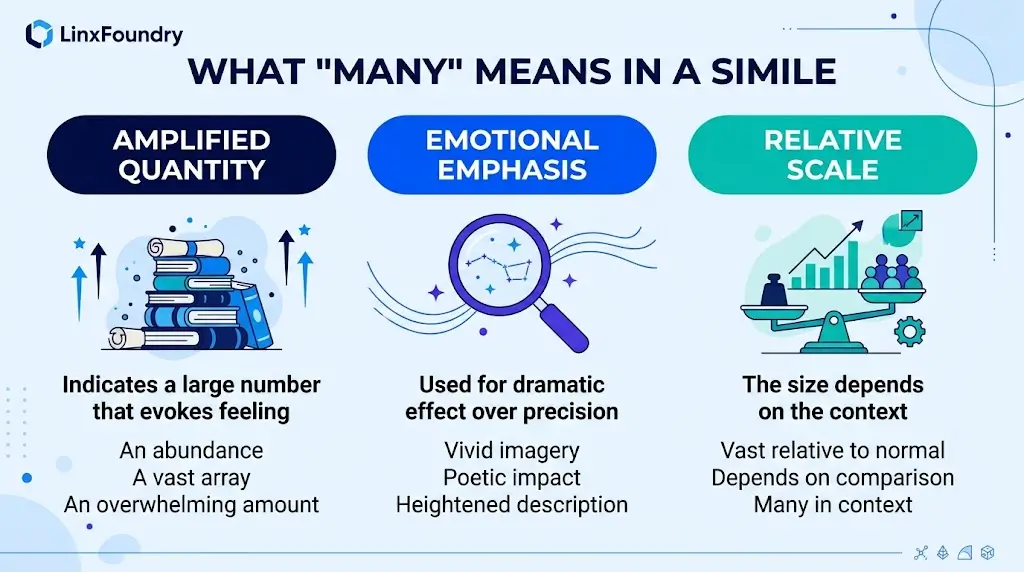
The best simile depends on what you want readers to imagine. A comparison that works for a crowded room may not suit a description of numerous ideas or opportunities.
1. Choose a Simile That Matches the Quantity
For countless objects, try “like grains of sand on a beach.” For a group moving together, “like fish in a school” may be more suitable.
Plain sentence: Many people entered the building.
Improved sentence: People streamed into the building like waves rolling toward the shore.
The comparison emphasizes the continuous movement of the crowd.
2. Consider the Tone
Some similes create a peaceful atmosphere, while others suggest confusion or excitement.
For example, “like stars scattered across the night sky” creates a calm, beautiful image. In contrast, “like ants around a picnic” can suggest a busy, energetic gathering.
Choose a comparison that supports the mood of your writing.
3. Avoid Mixing Unrelated Images
A simile should make sense in context. Comparing numerous books to stars may work in a poetic description, but it could feel distracting in a straightforward school report.
Choose familiar images when clarity matters most. Save more imaginative comparisons for stories, poems, and descriptive passages.
4. Avoid Repeating the Same Comparison
Using “like grains of sand” several times in one paragraph can make writing feel repetitive.
Instead, vary your language. You might describe scattered objects as confetti, a crowd as a school of fish, and numerous ideas as branches spreading from a tree.
Each comparison should add a different detail.
Similes Using “Like” and “As”
Two common structures can help you create comparisons that describe large quantities.
Similes Using “Like”
The word like connects two things that share a relevant quality.
Examples include:
- The stars covered the sky like diamonds scattered across velvet.
- Visitors arrived like waves rolling toward the shore.
- New ideas appeared like sparks from a blazing fire.
- Colorful leaves covered the ground like confetti after a parade.
- Opportunities spread before her like paths through a forest.
Similes Using “As”
The word as often appears in the structure “as + adjective + as.”
Examples include:
- The choices seemed as endless as the open sea.
- The flowers were as plentiful as blossoms in a meadow.
- The tiny lights were as numerous as stars in the sky.
- The small shops were as common as blades of grass.
- The available opportunities were as abundant as seeds in a garden.
Notice that natural similes focus on a meaningful shared quality. They do not simply place two unrelated things together.
FAQ Section
1. What Is a Good Simile for Many?
“As numerous as stars in the sky” is a useful simile for describing an extremely large number of things. For small objects, “like grains of sand on a beach” creates a familiar image of abundance.
2. What Is a Simile for Too Many People?
“Like sardines in a can” describes people packed tightly into a limited space. For a large, active gathering, “like ants around a picnic” offers a more energetic comparison.
3. What Is a Simile for Countless Things?
“Like drops of water in the ocean” emphasizes an enormous quantity. Another option is “like stars beyond the horizon,” which suggests a number that seems impossible to measure.
4. How Do You Describe Many Things in Creative Writing?
Compare the quantity with a familiar image that matches the scene. For example, scattered papers might resemble confetti, while numerous ideas might resemble branches spreading from a tree.
5. What Is a Simple Simile for Many for Students?
“Like grains of sand on a beach” is an easy example because most readers can picture a beach covered in sand. It helps communicate that something exists in a very large quantity.
6. Can I Use Similes for Many in Poems and Stories?
Yes. Similes can make descriptions more vivid in poems, stories, essays, and other forms of writing. Choose comparisons that match the setting, mood, and subject rather than adding them simply to make a sentence sound creative.
7. What Is the Difference Between a Simile for Many and a Simile for Crowds?
A simile for many can describe objects, ideas, opportunities, or people. A simile for crowds focuses specifically on groups of people, often emphasizing their number, movement, or closeness.
Final Thoughts
Similes for many help transform a general statement about quantity into a clear, memorable image. Comparisons such as stars in the sky, grains of sand on a beach, and ants around a picnic can describe abundance, crowds, and countless objects in different ways.
When choosing a simile, think about what makes the quantity distinctive. Is it enormous, tightly packed, scattered, constantly growing, or arriving in waves? Matching the comparison to that detail will make your writing more precise and engaging. You can also create original similes by observing familiar objects and identifying the qualities they share with the subject you want to describe.

Michael Bennett
creates educational content about English word meanings, related terms, synonyms, and usage in different contexts. His goal is to make vocabulary research easier by presenting clear explanations, useful examples, and reader-friendly guidance.