Similes for everyday use are comparisons that make descriptions clearer, more interesting, and easier to imagine. They use words such as like or as to connect different things. Examples include “as busy as a bee,” “like a fish in water,” and “as light as a feather.” These expressions can improve conversations, essays, stories, poems, and everyday writing.
35 Useful Examples With Meanings and Sentences Similes Used For?
A simile is a figure of speech that compares two different things using like or as. Writers and speakers use similes to explain ideas, describe feelings, and create pictures in the reader’s mind.
For example:
- Plain sentence: She was very happy.
- With a simile: She was as happy as a child on Christmas morning.
The second sentence gives readers a more vivid picture of her happiness.
Similes are useful because they can make ordinary descriptions more expressive without requiring complicated vocabulary.
35 Useful Similes for Everyday Writing and Communication
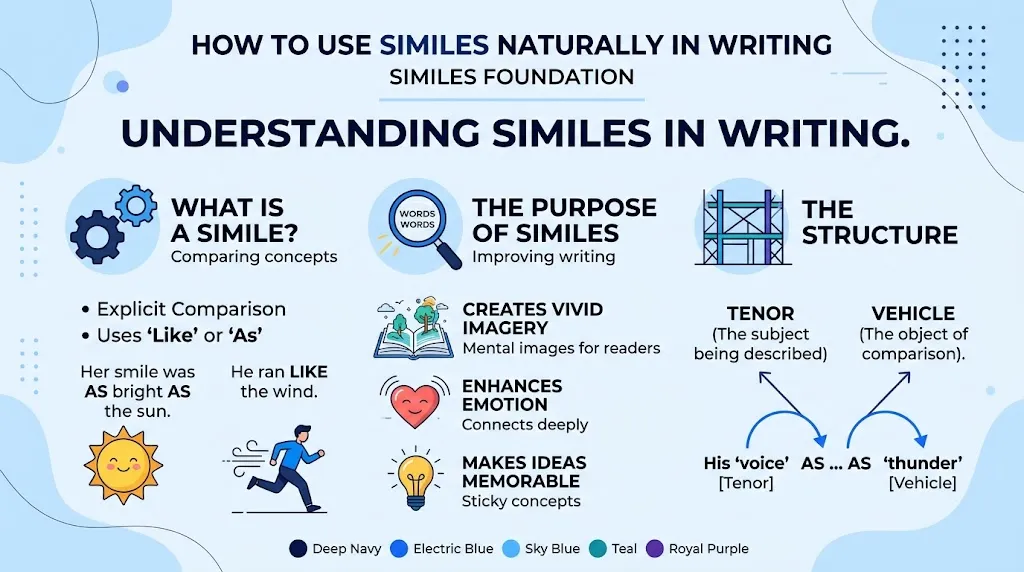
Here are practical comparisons you can use in different situations, from casual conversations to creative writing.
1. Common Similes for Everyday Use
These familiar expressions work in conversations, stories, and general descriptions.
1. As busy as a bee
Meaning: Extremely active and occupied with tasks.
Example: My mother was as busy as a bee preparing everything for the family gathering.
2. As light as a feather
Meaning: Extremely lightweight.
Example: This new jacket is as light as a feather, making it perfect for travelling.
3. As strong as an ox
Meaning: Very physically strong.
Example: My grandfather is still as strong as an ox despite his age.
4. Like a fish in water
Meaning: Completely comfortable and confident in a particular environment.
Example: She feels like a fish in water when speaking in front of an audience.
5. As clear as crystal
Meaning: Extremely easy to understand or see.
Example: His explanation was as clear as crystal.
6. As quick as lightning
Meaning: Extremely fast.
Example: The goalkeeper moved as quick as lightning to stop the ball.
7. Like clockwork
Meaning: Happening smoothly and regularly, without problems.
Example: Their morning routine runs like clockwork.
8. As cool as a cucumber
Meaning: Calm and relaxed, especially during a stressful situation.
Example: Everyone was nervous before the presentation, but Ali remained as cool as a cucumber.
2. Similes for Describing People and Personality
Use these comparisons to describe someone’s behavior, personality, or abilities.
9. As brave as a lion
Meaning: Very courageous when facing danger or difficulty.
Example: The young firefighter was as brave as a lion during the rescue.
10. As gentle as a lamb
Meaning: Very kind, calm, and soft in behavior.
Example: The teacher was as gentle as a lamb with her young students.
11. Like an open book
Meaning: Someone whose thoughts and feelings are easy to understand.
Example: My best friend is like an open book; I can always tell when something is bothering him.
12. As stubborn as a mule
Meaning: Unwilling to change an opinion or decision.
Example: My little brother is as stubborn as a mule when he wants a new toy.
13. As wise as an owl
Meaning: Very knowledgeable or sensible.
Example: People often visit my grandmother for advice because she is as wise as an owl.
14. Like a ray of sunshine
Meaning: Someone who brings happiness and positivity to others.
Example: Her cheerful personality makes her like a ray of sunshine in our office.
15. As quiet as a mouse
Meaning: Extremely silent or making very little noise.
Example: The children were as quiet as mice while their father was sleeping.
3. Similes for Feelings and Emotions
These comparisons help communicate emotions more vividly.
16. Like a volcano ready to erupt
Meaning: Feeling extremely angry and close to losing control.
Example: After hearing the unfair decision, he felt like a volcano ready to erupt.
17. As happy as a lark
Meaning: Extremely cheerful and full of happiness.
Example: She was as happy as a lark after receiving her graduation results.
18. Like a weight lifted off my shoulders
Meaning: Feeling relieved after a difficult situation ends.
Example: Finishing my final examination felt like a weight lifted off my shoulders.
19. As cold as ice
Meaning: Emotionally distant or showing little warmth.
Example: His response was as cold as ice when I asked for help.
20. Like walking on air
Meaning: Feeling extremely happy or excited.
Example: She felt like she was walking on air after getting her dream job.
21. As nervous as a cat
Meaning: Extremely anxious or uneasy.
Example: I was as nervous as a cat before my first job interview.
22. Like a storm inside
Meaning: Experiencing intense and conflicting emotions.
Example: Although she smiled at everyone, her thoughts felt like a storm inside.
4. Creative Similes for Stories and Descriptive Writing
These comparisons can help writers create more memorable scenes.
23. Like stars scattered across the sky
Meaning: Spread out beautifully over a large area.
Example: The tiny lights of the village looked like stars scattered across the sky.
24. As smooth as silk
Meaning: Extremely soft, smooth, or pleasant to touch.
Example: The fabric felt as smooth as silk against her skin.
25. Like leaves dancing in the wind
Meaning: Moving gently and freely with the breeze.
Example: The curtains moved like leaves dancing in the wind.
26. As bright as a thousand suns
Meaning: Extremely bright or radiant.
Example: The stage lights shone as bright as a thousand suns.
27. Like a river flowing downhill
Meaning: Moving continuously and naturally without interruption.
Example: Her words came out like a river flowing downhill.
28. As peaceful as a sleeping village
Meaning: Extremely quiet and calm.
Example: The countryside was as peaceful as a sleeping village after sunset.
29. Like a candle in the darkness
Meaning: A small source of hope or comfort during a difficult time.
Example: Her encouraging words were like a candle in the darkness.
5. Similes for School, Work, and Daily Situations
These examples are suitable for practical communication and educational writing.
30. As organized as a library
Meaning: Very neat and carefully arranged.
Example: Her study desk was as organized as a library.
31. Like a machine
Meaning: Working continuously and efficiently.
Example: The entire team worked like a machine to complete the project.
32. As easy as ABC
Meaning: Very simple to understand or accomplish.
Example: Once I understood the instructions, the assignment was as easy as ABC.
33. Like a walking dictionary
Meaning: Someone who knows a great deal about words and their meanings.
Example: Our English teacher is like a walking dictionary.
34. As steady as a rock
Meaning: Reliable, dependable, and emotionally stable.
Example: My colleague remained as steady as a rock during the difficult project.
35. Like a well-oiled machine
Meaning: Operating smoothly and efficiently.
Example: After months of practice, our department worked like a well-oiled machine.
Quick Reference: 35 Similes and Their Meanings
| Simile | Meaning | Best Used For |
|---|---|---|
| As busy as a bee | Very active | Work |
| As light as a feather | Lightweight | Objects |
| As strong as an ox | Powerful | People |
| Like a fish in water | Comfortable | Confidence |
| As clear as crystal | Easy to understand | Explanations |
| As quick as lightning | Very fast | Movement |
| Like clockwork | Smoothly | Routines |
| As cool as a cucumber | Calm | Situations |
| As brave as a lion | Courageous | Personality |
| As gentle as a lamb | Kind | Behavior |
| Like an open book | Easy to understand | Personality |
| As stubborn as a mule | Unyielding | Behavior |
| As wise as an owl | Knowledgeable | People |
| Like a ray of sunshine | Cheerful | Personality |
| As quiet as a mouse | Silent | Situations |
| Like a volcano ready to erupt | Extremely angry | Emotions |
| As happy as a lark | Cheerful | Happiness |
| Like a weight lifted off my shoulders | Relieved | Emotions |
| As cold as ice | Emotionally distant | Relationships |
| Like walking on air | Very happy | Excitement |
| As nervous as a cat | Anxious | Feelings |
| Like a storm inside | Emotionally troubled | Stories |
| Like stars scattered across the sky | Beautifully spread out | Nature |
| As smooth as silk | Smooth | Texture |
| Like leaves dancing in the wind | Gentle movement | Nature |
| As bright as a thousand suns | Extremely bright | Description |
| Like a river flowing downhill | Continuous movement | Writing |
| As peaceful as a sleeping village | Calm | Settings |
| Like a candle in the darkness | Hope | Emotional writing |
| As organized as a library | Neat | Work |
| Like a machine | Efficient | Work |
| As easy as ABC | Simple | Learning |
| Like a walking dictionary | Knowledgeable | Education |
| As steady as a rock | Reliable | Personality |
| Like a well-oiled machine | Efficiently coordinated | Teamwork |
How to Use Similes Naturally in Writing
A good simile should make your sentence clearer or more memorable. However, adding too many comparisons can make writing sound unnatural.
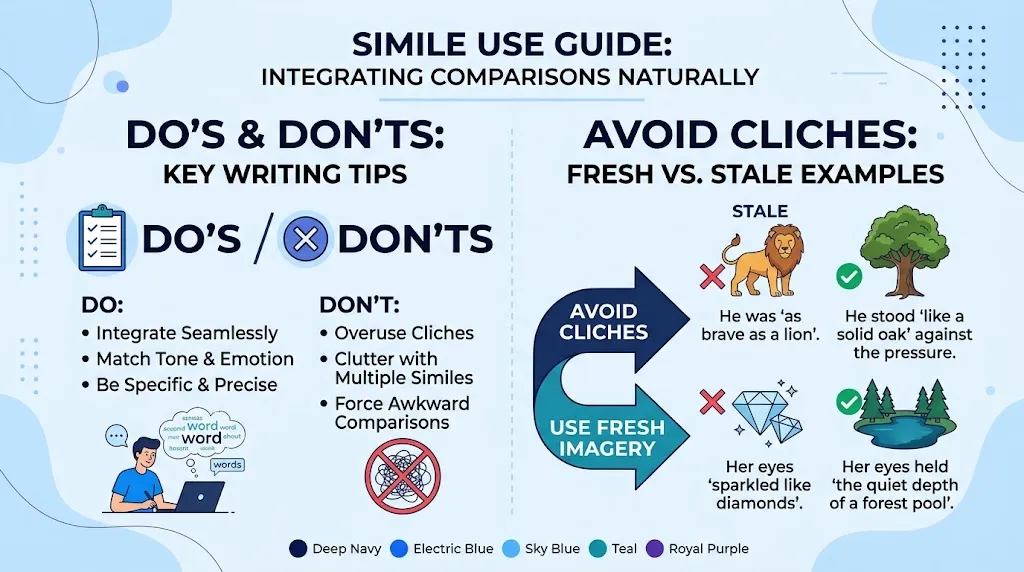
Here are five practical ways to use them.
1. Use Similes in Everyday Conversations
Similes can make ordinary conversations more expressive.
Without a simile: He works very hard.
With a simile: He works like a machine.
The comparison communicates his dedication more vividly.
2. Use Similes in Stories
Writers can use comparisons to establish a scene or describe a character.
Example: The old house stood silently on the hill, as lonely as an abandoned island.
This comparison creates a stronger atmosphere than simply saying the house was lonely.
3. Use Similes in School Essays
Choose familiar comparisons that support your main idea.
Example: The importance of teamwork became clear when our classmates worked like a well-oiled machine to finish the science project.
4. Use Similes in Poems
Poetry often benefits from comparisons that create images and emotions.
Example: Her dreams floated like clouds across an endless blue sky.
5. Use Similes in Professional Communication
Similes can make presentations and informal workplace communication more engaging. However, keep formal reports direct and avoid comparisons that might confuse readers.
Example: The new process works like clockwork, allowing our team to complete tasks efficiently.
Using “Like” and “As” in Similes
Two common ways to create similes are through like and as.
Using like
This structure compares two things directly.
- Her voice sounded like a soft melody.
- The children ran like wild horses.
- His ideas flowed like a river.
Using as
This structure commonly follows the pattern “as + adjective + as.”
- She is as brave as a lion.
- The water was as cold as ice.
- The room was as quiet as a library.
Both structures can create effective comparisons. Choose the one that sounds most natural in your sentence.
How to Create Your Own Useful Similes
You do not need to memorize every simile. You can create original comparisons by following a few simple steps.
- Choose something to describe: Select an emotion, person, object, action, or situation.
- Identify its strongest quality: Think about its appearance, behavior, sound, speed, or feeling.
- Find a familiar comparison: Choose something readers can easily imagine.
- Connect the ideas: Use like or as to form the comparison.
- Check the meaning: Make sure the comparison communicates exactly what you intend.
Example:
- Subject: A fast-moving car.
- Quality: Speed.
- Comparison: Lightning.
- Simile: The car moved like lightning along the empty road.
The best original similes are imaginative but still easy to understand.
Frequently Asked Questions
1. What are some useful similes for everyday use?
Some useful similes include as busy as a bee, as light as a feather, as clear as crystal, as cool as a cucumber, and as steady as a rock. They work well in conversations, stories, and general writing.
2. What is the easiest simile to use?
“As easy as ABC” is one of the simplest similes. It describes something that requires very little effort or understanding.
3. How can similes improve writing?
Similes make descriptions more vivid by connecting unfamiliar ideas with familiar images. They help readers imagine emotions, actions, people, and situations more clearly.
4. Can I use similes in academic writing?
Yes. Similes can be useful in descriptive and reflective essays. However, academic writing should prioritize clarity and accuracy, so avoid overly dramatic comparisons in formal research.
5. What is the difference between a simile and a metaphor?
A simile compares two things using words such as like or as. A metaphor describes one thing as another without using those comparison words.
- Simile: Her voice was like music.
- Metaphor: Her voice was music.
6. Can I create my own similes?
Absolutely. Start with something you want to describe, identify its most noticeable quality, and compare it with something familiar using like or as.
7. Are similes useful in everyday conversations?
Yes. Similes can make conversations more expressive, humorous, and memorable. Expressions such as “as busy as a bee” and “as cool as a cucumber” are commonly understood.
Practice Section: Test Your Understanding
Try these questions to see how well you understand similes.
Question 1: Which simile describes someone who is extremely busy?
A. As quiet as a mouse
B. As busy as a bee
C. As cold as ice
Question 2: Complete the simile: As light as a ______.
A. Feather
B. Rock
C. Mountain
Question 3: What does “as cool as a cucumber” mean?
A. Very cold
B. Very angry
C. Calm and relaxed
Question 4: Identify the simile in this sentence:
“Her voice sounded like a beautiful melody.”
Question 5: Complete this sentence with a suitable simile:
“The classroom was as quiet as ______.”
Question 6: Write your own simile to describe someone who is very brave.
Question 7: Is this a simile or a metaphor?
“Time is a thief.”
Practice Answers
- B — As busy as a bee.
- A — Feather.
- C — Calm and relaxed.
- “Like a beautiful melody.”
- A library or a mouse.
- Example: As brave as a lion.
- Metaphor — It directly describes time as a thief without using like or as.
Final Thoughts
Similes are useful tools for making everyday language more expressive and descriptive. They help readers understand emotions, imagine situations, and connect with ideas through familiar comparisons. From simple expressions such as “as light as a feather” to creative descriptions such as “like a candle in the darkness,” each comparison has a different purpose. Choose similes that match your message, audience, and writing style. Most importantly, use them naturally. A well-chosen comparison can make even an ordinary sentence more memorable.

Daniel Brooks
Daniel Brooks writes about English vocabulary, synonyms, antonyms, word meanings, and everyday language. He focuses on helping students, writers, and English learners choose the right words for clear and effective communication.