Similes for poverty help writers describe financial hardship, limited resources, and the challenges of living without enough money. Comparisons such as “as empty as a bare cupboard” and “like a boat without a sail” can make these experiences easier to picture. These 45 similes for poverty include simple, emotional, and creative examples for essays, poems, short stories, and descriptive writing. Each comparison includes a meaning and an example sentence to help you understand when to use it.
Quick Answer: What Are Some Similes for Poverty?
Some useful similes for poverty include as empty as a bare cupboard, like a ship without a sail, as thin as a threadbare blanket, like walking through a storm without shelter, and as scarce as rain in a desert. These comparisons describe shortages, insecurity, and difficult circumstances. Choose a simile that fits the specific situation rather than using language that stereotypes people experiencing poverty.
45 Similes for Poverty With Meanings and Examples
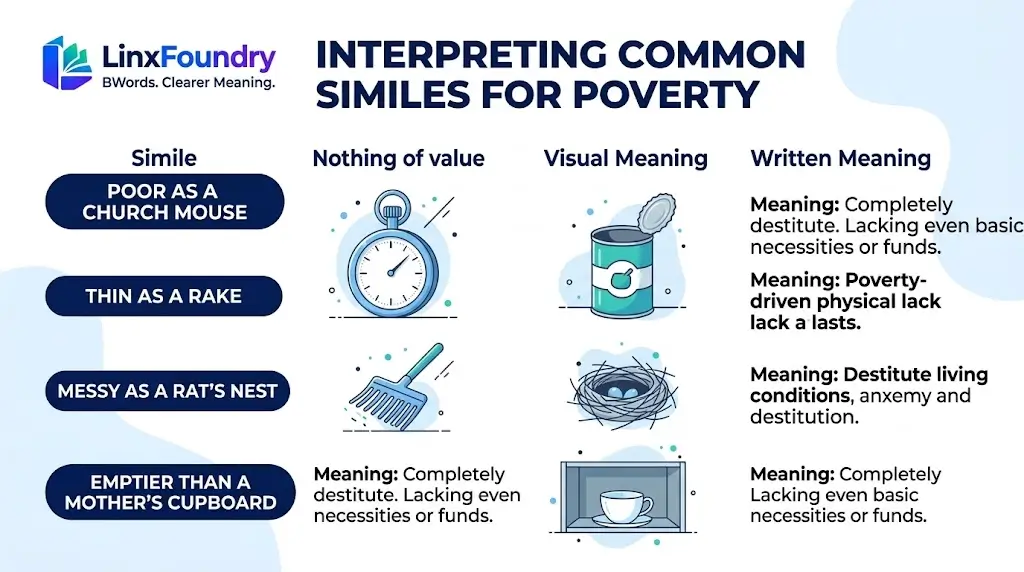
These examples explore poverty from different angles, including material shortages, financial pressure, uncertainty, and the struggle to meet everyday needs.
Simple Similes for Poverty
1. As empty as a bare cupboard
Meaning: Having very little food or few essential supplies.
Example: At the end of the month, the family’s cupboard was as empty as a bare cupboard in an abandoned house.
2. As scarce as rain in a desert
Meaning: Something essential is extremely difficult to find.
Example: In the struggling village, reliable job opportunities were as scarce as rain in a desert.
3. Like a pocket full of holes
Meaning: Having so little money that it seems to disappear quickly.
Example: After paying for rent and groceries, his budget felt like a pocket full of holes.
4. As thin as a threadbare blanket
Meaning: Having too little of something that should provide comfort or protection.
Example: Their winter blankets were as thin as a threadbare blanket, offering little protection against the cold.
5. Like a garden without water
Meaning: A situation lacking the resources needed to grow or improve.
Example: Without access to education and training, the community felt like a garden without water.
6. As bare as a stripped tree
Meaning: Having few possessions or resources left.
Example: After the flood destroyed their belongings, the family’s home was as bare as a stripped tree.
7. Like a plate without a meal
Meaning: Facing hunger or lacking enough food.
Example: For a child who had missed lunch, the afternoon seemed like a plate without a meal.
8. As worn as an old pair of shoes
Meaning: Showing the effects of prolonged use, hardship, or limited resources.
Example: His shoes were as worn as an old pair of shoes passed down through several generations.
9. Like a lamp running out of oil
Meaning: Having resources that are gradually being exhausted.
Example: Their emergency savings were like a lamp running out of oil as unexpected bills continued to arrive.
10. As small as a drop in the ocean
Meaning: Too little to meet a much larger need.
Example: The family’s limited savings were as small as a drop in the ocean compared with the cost of repairing their home.
Creative Similes for Poverty
11. Like a ship without a sail
Meaning: Facing difficulties without the resources needed to move forward.
Example: Without steady employment, the family’s plans felt like a ship without a sail.
12. Like walking through a storm without shelter
Meaning: Facing repeated hardships without adequate protection or support.
Example: Trying to manage rising bills without a financial safety net felt like walking through a storm without shelter.
13. As fragile as a house of cards
Meaning: Being in a situation that could collapse after one unexpected setback.
Example: Their carefully balanced household budget was as fragile as a house of cards.
14. Like climbing a mountain in worn-out shoes
Meaning: Struggling toward a goal while lacking essential resources.
Example: Pursuing a degree while working several jobs felt like climbing a mountain in worn-out shoes.
15. As dry as a riverbed in summer
Meaning: Lacking something that is normally necessary or plentiful.
Example: After months without regular work, their savings were as dry as a riverbed in summer.
16. Like a candle burning at both ends
Meaning: Using limited resources or energy too quickly under pressure.
Example: Working extra shifts while caring for her family felt like a candle burning at both ends.
17. As distant as a star in the night sky
Meaning: Something desirable that feels difficult to reach.
Example: For a student who could not afford tuition, university seemed as distant as a star in the night sky.
18. Like a bridge missing its final plank
Meaning: Being close to progress but lacking one essential resource.
Example: The small business had customers and a good idea, but without startup funding, it was like a bridge missing its final plank.
19. As uncertain as a leaf in the wind
Meaning: Lacking stability or control over what happens next.
Example: With temporary work and unpredictable wages, their future felt as uncertain as a leaf in the wind.
20. Like a road full of potholes
Meaning: A journey marked by repeated obstacles and setbacks.
Example: Her path toward financial independence was like a road full of potholes, with unexpected expenses at every turn.
Similes for Financial Struggles and Scarcity
21. As tight as a knot
Meaning: Describing a budget with almost no room for additional spending.
Example: After paying rent and utilities, their monthly budget was as tight as a knot.
22. Like trying to fill a bucket with a hole in it
Meaning: Struggling to save money while expenses continually consume it.
Example: Every time he saved a little money, another essential bill arrived, making budgeting feel like trying to fill a bucket with a hole in it.
23. As limited as a candle’s last light
Meaning: Having very few resources remaining.
Example: By the end of the winter, the household’s emergency funds were as limited as a candle’s last light.
24. Like counting grains of sand
Meaning: Carefully measuring very small amounts because resources are limited.
Example: With only a few dollars left, she planned each purchase like counting grains of sand.
25. As slow as a dripping tap filling a barrel
Meaning: Making progress so gradually that meeting a large need takes considerable time.
Example: Saving for a reliable car on a low income was as slow as a dripping tap filling a barrel.
26. Like carrying water in a sieve
Meaning: Trying to preserve resources when circumstances make it difficult.
Example: Unexpected medical and repair bills made building an emergency fund feel like carrying water in a sieve.
27. As unpredictable as a rolling dice
Meaning: Describing income or expenses that change without warning.
Example: When his hours depended on daily demand, his weekly earnings were as unpredictable as a roll of the dice.
28. Like standing at a crossroads without a map
Meaning: Facing important decisions without enough information or support.
Example: After losing her job, she felt like she was standing at a crossroads without a map.
29. As stretched as an old rubber band
Meaning: Being pushed close to the limit by competing demands.
Example: With rent, food, transport, and school expenses to cover, their budget was as stretched as an old rubber band.
30. Like patching a leaking roof during a storm
Meaning: Trying to solve a problem while new difficulties keep appearing.
Example: Managing overdue bills while searching for work felt like patching a leaking roof during a storm.
Emotional Similes for Poverty
31. As heavy as a sack of stones
Meaning: Describing a burden that feels difficult to carry.
Example: The uncertainty of paying next month’s rent felt as heavy as a sack of stones.
32. Like carrying an umbrella full of holes
Meaning: Having protection that is inadequate for the challenges being faced.
Example: Without affordable housing or dependable support, the family’s safety net felt like an umbrella full of holes.
33. As lonely as a lighthouse on a deserted shore
Meaning: Feeling isolated while facing difficult circumstances.
Example: When financial problems kept him from joining friends, he sometimes felt as lonely as a lighthouse on a deserted shore.
34. Like a cloud covering the sun
Meaning: A difficulty that overshadows moments of happiness or hope.
Example: The unpaid bills hung over the household like a cloud covering the sun.
35. As exhausting as running uphill
Meaning: Requiring continuous effort with little immediate relief.
Example: Working long hours while struggling to cover basic expenses was as exhausting as running uphill.
36. Like a door that keeps closing
Meaning: Experiencing repeated setbacks when trying to find opportunities.
Example: Repeated job rejections made the search for stable employment feel like a door that kept closing.
37. As cold as a winter morning without a coat
Meaning: Describing the physical discomfort and vulnerability caused by inadequate protection.
Example: On the freezing morning, waiting for the bus without a warm coat felt as cold as a winter morning without a coat.
38. Like walking through fog without a compass
Meaning: Feeling unsure about the future because the way forward is unclear.
Example: With bills piling up and work uncertain, planning the next few months felt like walking through fog without a compass.
39. As restless as waves before a storm
Meaning: Experiencing ongoing worry or uneasiness.
Example: Before the rent payment was due, her thoughts were as restless as waves before a storm.
40. Like a clock ticking in an empty room
Meaning: Feeling the pressure of time while waiting for a solution.
Example: As the deadline for paying the electricity bill approached, every passing hour felt like a clock ticking in an empty room.
Powerful Similes for Poverty in Stories and Poems
41. As exposed as a tree on an open plain
Meaning: Lacking protection against difficult conditions.
Example: Without secure housing, the family felt as exposed as a tree on an open plain.
42. Like a boat taking on water
Meaning: Becoming increasingly overwhelmed as problems accumulate.
Example: With each new expense, their already strained finances felt like a boat taking on water.
43. As distant as the horizon
Meaning: Describing a goal that seems far away.
Example: For a worker trying to escape persistent debt, financial stability seemed as distant as the horizon.
44. Like a seed struggling through hard soil
Meaning: Trying to grow or succeed in difficult circumstances.
Example: Despite limited resources, the young student continued learning like a seed struggling through hard soil.
45. As vulnerable as a paper boat in rough water
Meaning: Being easily affected by sudden difficulties because there is little protection.
Example: Without savings or secure employment, the household’s finances were as vulnerable as a paper boat in rough water.
Quick-Reference Table: Poverty Similes and Their Meanings
| Simile | Meaning | Best Used For |
|---|---|---|
| As empty as a bare cupboard | Lack of essentials | Stories about hunger |
| Like a pocket full of holes | Money disappearing quickly | Everyday financial struggles |
| Like a ship without a sail | Lack of resources to progress | Essays and narratives |
| As fragile as a house of cards | Financial instability | Explanatory writing |
| Like filling a bucket with a hole in it | Difficulty saving money | Budgeting examples |
| As heavy as a sack of stones | Emotional burden | Personal narratives |
| Like a cloud covering the sun | Worry overshadowing happiness | Poetry |
| Like a seed struggling through hard soil | Persistence in adversity | Inspirational stories |
| As distant as the horizon | A difficult-to-reach goal | Reflective writing |
| As vulnerable as a paper boat in rough water | Exposure to unexpected setbacks | Descriptive writing |
How to Use Similes for Poverty in Writing
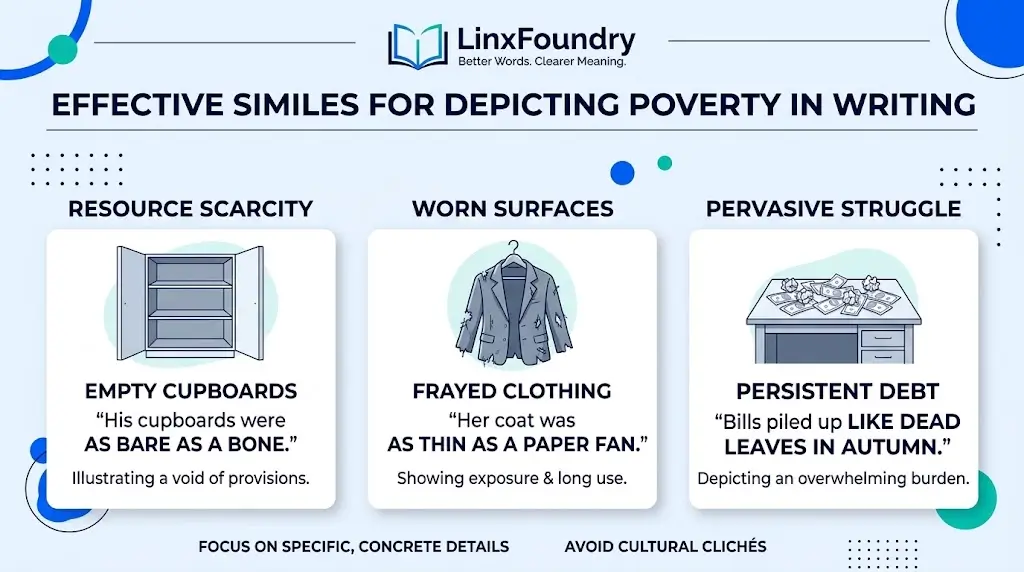
A good simile helps readers understand a situation without reducing a person’s identity to their financial circumstances. Choose a comparison based on the point you want to communicate.
1. For essays
Use clear comparisons that explain financial instability or limited resources.
Example: “For families without emergency savings, an unexpected repair can feel like a boat taking on water.”
This comparison illustrates how one expense can make an already difficult situation harder to manage.
2. For stories
Choose a simile that fits the setting and a character’s immediate experience.
Example: “The kitchen cupboard was as empty as a bare cupboard, and the family still had two days until payday.”
The comparison creates a concrete picture rather than relying on an abstract statement about hardship.
3. For poetry
Use imagery that communicates emotion through a physical scene.
Example: “Her hope flickered like a candle in a restless wind.”
This example is a related comparison about hope during hardship rather than a direct definition of poverty. It can work when the poem focuses on uncertainty and resilience.
4. For school assignments
Choose simple similes with clear meanings.
Example: “Their budget was as tight as a knot.”
The sentence communicates that little money remained after essential expenses.
5. For character descriptions
Describe a person’s circumstances without suggesting that poverty determines their character.
Example: “Despite having few resources, she kept learning like a seed struggling through hard soil.”
This comparison emphasizes persistence rather than defining the character by financial hardship.
How to Create Your Own Similes for Poverty
You can create an original simile by identifying a particular aspect of financial hardship and comparing it with a familiar image.
- Choose the idea. Decide whether you want to describe scarcity, insecurity, worry, or determination.
- Find a concrete image. Consider an empty cupboard, a leaking roof, a storm, or a seed growing in difficult soil.
- Connect the ideas naturally. Use “like” or “as” to make the comparison clear.
- Check the tone. Ask whether the simile communicates the intended experience respectfully.
- Test it in a sentence. Read the complete sentence aloud and remove anything that sounds forced.
For example, if you want to describe unstable finances, you might write: “Their savings were like a candle burning in a strong wind.” The image suggests that the money could disappear quickly under pressure.
Final Thoughts
Similes for poverty can make writing about financial hardship more vivid by connecting abstract problems with familiar images. Comparisons involving empty cupboards, fragile structures, difficult journeys, and seeds growing through hard soil can communicate scarcity, uncertainty, and resilience. The most effective choice depends on the scene, audience, and emotion you want to convey. Use direct comparisons when clarity matters, and choose more imaginative imagery when writing poetry or fiction. Above all, describe the circumstances with care and remember that poverty is an economic condition, not a measure of a person’s worth.
Frequently Asked Questions
1. What is a good simile for poverty?
“As empty as a bare cupboard” is a useful simile when describing a lack of food or household essentials. For financial instability, “as fragile as a house of cards” communicates how easily an unexpected expense can disrupt a budget.
2. How do you describe poverty in a sentence using a simile?
You can write, “Without steady work and emergency savings, their financial situation was like a boat taking on water.” This comparison suggests that difficulties are accumulating and becoming harder to manage.
3. What is a creative simile for poverty?
“Like a bridge missing its final plank” is a creative comparison for a situation in which someone has made progress but lacks one essential resource to move forward.
4. What is a simile for struggling financially?
“Like trying to fill a bucket with a hole in it” describes the difficulty of saving money when essential expenses continually use up available funds.
5. Can similes for poverty be used in poems?
Yes. Similes can communicate scarcity, uncertainty, emotional strain, or resilience through imagery. A comparison such as “like a seed struggling through hard soil” may suit a poem about perseverance despite difficult circumstances.
6. What is the difference between a simile and a metaphor about poverty?
A simile makes a comparison using words such as “like” or “as,” as in “their budget was as tight as a knot.” A metaphor describes one thing as another, such as “poverty was a heavy burden.” Both can make descriptive writing more vivid.

Daniel Brooks
Daniel Brooks writes about English vocabulary, synonyms, antonyms, word meanings, and everyday language. He focuses on helping students, writers, and English learners choose the right words for clear and effective communication.