After something important happens, the moments that follow can feel peaceful, confusing, exciting, or completely different from what came before. Similes help describe these changes through familiar images, such as a quiet room after a storm or a fresh morning after a long night.
If you are looking for similes for after, these examples can help you describe the period following an event, a difficult experience, a celebration, or a major change. Each comparison includes a meaning and an example sentence to show how it works in real writing.
What Does “After” Mean in Descriptive Writing?
The word after refers to a time or event that follows another. In descriptive writing, it can introduce a setting, a feeling, or a change that occurs once something has ended.
For example, a writer might describe a town after a storm as being “as quiet as an empty church.” The simile creates a clear image of silence and stillness.
A useful distinction is that after is not itself a quality like happiness, fear, or sadness. Instead, it provides a time or situation in which a simile can describe what remains, what changes, or how someone feels.
30 Similes for After With Meanings and Examples

1. As quiet as a sleeping village after a storm
Meaning: Extremely peaceful following a period of noise or disturbance.
Example: The streets were as quiet as a sleeping village after a storm.
Best for: Stories, descriptive paragraphs, and peaceful settings.
2. Like sunlight after a long winter
Meaning: A welcome improvement after a difficult or gloomy period.
Example: Her encouraging words felt like sunlight after a long winter.
Best for: Hopeful moments, recovery, and emotional change.
3. As fresh as the morning after rain
Meaning: Clean, renewed, and full of possibility.
Example: After the celebration, the garden looked as fresh as the morning after rain.
Best for: Nature writing and descriptions of renewal.
4. Like a calm sea after rough weather
Meaning: Peaceful after a period of conflict, stress, or uncertainty.
Example: Once the argument ended, their relationship felt like a calm sea after rough weather.
Best for: Relationships and emotional recovery.
5. As empty as a theater after the final curtain
Meaning: Completely deserted after an event has finished.
Example: The auditorium stood as empty as a theater after the final curtain.
Best for: School stories, performances, and event descriptions.
6. Like a candle after the celebration
Meaning: Quiet or subdued once an exciting event has passed.
Example: The house felt like a candle after the celebration, warm but no longer full of excitement.
Best for: Reflective creative writing. This is an imaginative comparison rather than a fixed expression.
7. As still as a pond after the wind dies
Meaning: Motionless and peaceful after activity or disturbance.
Example: The garden became as still as a pond after the wind died.
Best for: Nature scenes and quiet moments.
8. Like a page after the final sentence
Meaning: Finished, complete, or ready for reflection.
Example: When the project ended, the experience felt like a page after the final sentence.
Best for: Essays, personal reflections, and stories about completion.
9. As bright as a new day after a dark night
Meaning: Full of hope after a difficult period.
Example: Her new beginning felt as bright as a new day after a dark night.
Best for: Personal growth and hopeful endings.
10. Like echoes after a distant bell
Meaning: Lingering in the mind after an event has ended.
Example: The teacher’s final words remained in my thoughts like echoes after a distant bell.
Best for: Memories, reflective essays, and emotional storytelling.
11. As peaceful as a forest after rainfall
Meaning: Calm and refreshed after a disturbance.
Example: The campsite felt as peaceful as a forest after rainfall.
Best for: Nature descriptions and quiet settings.
12. Like footprints after fresh snowfall
Meaning: Evidence that remains after someone has passed through a place.
Example: The old photographs were like footprints after fresh snowfall, reminders of a life once lived.
Best for: Memory, history, and reflective writing.
13. As tired as a runner after a marathon
Meaning: Extremely exhausted after a demanding experience.
Example: After finishing the long assignment, I felt as tired as a runner after a marathon.
Best for: Schoolwork, physical effort, and challenging tasks.
14. Like smoke after a fire
Meaning: Something that remains after a powerful or destructive event.
Example: Confusion lingered like smoke after a fire even after the meeting ended.
Best for: Conflict, consequences, and serious stories.
15. As relieved as a traveler after reaching home
Meaning: Comforted and relaxed after a long or difficult journey.
Example: After completing her exams, she felt as relieved as a traveler after reaching home.
Best for: Exams, deadlines, and the end of stressful experiences.
16. Like a garden after spring rain
Meaning: Revitalized and ready to grow again.
Example: After their disagreement was resolved, their friendship felt like a garden after spring rain.
Best for: Relationships, recovery, and personal development.
17. As silent as a classroom after the bell
Meaning: Quiet once an activity or lesson has ended.
Example: The hallway was as silent as a classroom after the bell.
Best for: School stories and everyday descriptions.
18. Like a bridge after the last traveler
Meaning: Left behind or quiet after people have moved on.
Example: The old station stood like a bridge after the last traveler, waiting in silence.
Best for: Loneliness, abandoned places, and reflective scenes.
19. As light as a feather after setting down a heavy bag
Meaning: Free from a burden or pressure.
Example: Once she submitted her final project, she felt as light as a feather after setting down a heavy bag.
Best for: Relief and the end of demanding responsibilities.
20. Like stars after sunset
Meaning: Gradually appearing once the brightness of the day fades.
Example: Memories of his childhood returned like stars after sunset.
Best for: Nostalgia, evening scenes, and poetic writing.
21. As warm as a home after a cold journey
Meaning: Comforting after discomfort or hardship.
Example: The welcome from her family felt as warm as a home after a cold journey.
Best for: Reunions, kindness, and emotional comfort.
22. Like a clock after the alarm stops
Meaning: Returning to ordinary quiet after a sudden interruption.
Example: The office settled into routine like a clock after the alarm stops.
Best for: Workplaces, daily routines, and transitions.
23. As fragile as glass after a fall
Meaning: Easily damaged following a difficult experience.
Example: Their trust seemed as fragile as glass after a fall.
Best for: Relationships, broken trust, and emotional consequences.
24. Like a road after a parade
Meaning: Quiet or scattered once a busy public event has ended.
Example: The town square looked like a road after a parade, with ribbons and paper scattered everywhere.
Best for: Festivals, celebrations, and community events.
25. As clear as the sky after a storm
Meaning: Easier to understand once confusion or conflict has passed.
Example: After they discussed the misunderstanding, everything seemed as clear as the sky after a storm.
Best for: Problem-solving and resolving disagreements.
26. Like a song after the music fades
Meaning: A feeling or memory that continues after an enjoyable experience ends.
Example: The happiness of graduation stayed with her like a song after the music fades.
Best for: Celebrations, endings, and nostalgia.
27. As slow as a river after heavy rain ends
Meaning: Gradually settling down after intense activity.
Example: Business returned to normal as slowly as a river after heavy rain ends.
Best for: Work, community events, and changes in routine.
28. Like a blank canvas after the old painting is removed
Meaning: An opportunity to begin again after finishing or leaving something behind.
Example: Moving to a new city felt like a blank canvas after the old painting was removed.
Best for: Fresh starts, personal growth, and new opportunities.
29. As distant as thunder after the storm has passed
Meaning: A past problem or feeling that seems less immediate with time.
Example: Months later, the disagreement seemed as distant as thunder after the storm had passed.
Best for: Reflection and the passage of time.
30. Like a seed after winter
Meaning: Quietly preparing for new growth after a period of difficulty or inactivity.
Example: After months of uncertainty, her confidence returned like a seed after winter.
Best for: Resilience, progress, and hopeful endings.
Quick-Reference Table: Similes for After
| Simile | Meaning | Best Used For |
|---|---|---|
| Like sunlight after a long winter | Hope after difficulty | Personal growth |
| As quiet as a sleeping village after a storm | Deep calm | Settings |
| Like echoes after a distant bell | Lingering memories | Reflection |
| As tired as a runner after a marathon | Exhaustion | Challenges |
| As clear as the sky after a storm | Understanding after confusion | Problem-solving |
| Like a blank canvas after the old painting is removed | A fresh start | New beginnings |
| Like smoke after a fire | Lasting consequences | Serious stories |
| Like a seed after winter | Renewal and growth | Hopeful endings |
How to Use Similes for After in Writing
A good simile helps readers picture what happens after an event rather than simply telling them that it is over. Choose a comparison that matches the situation.
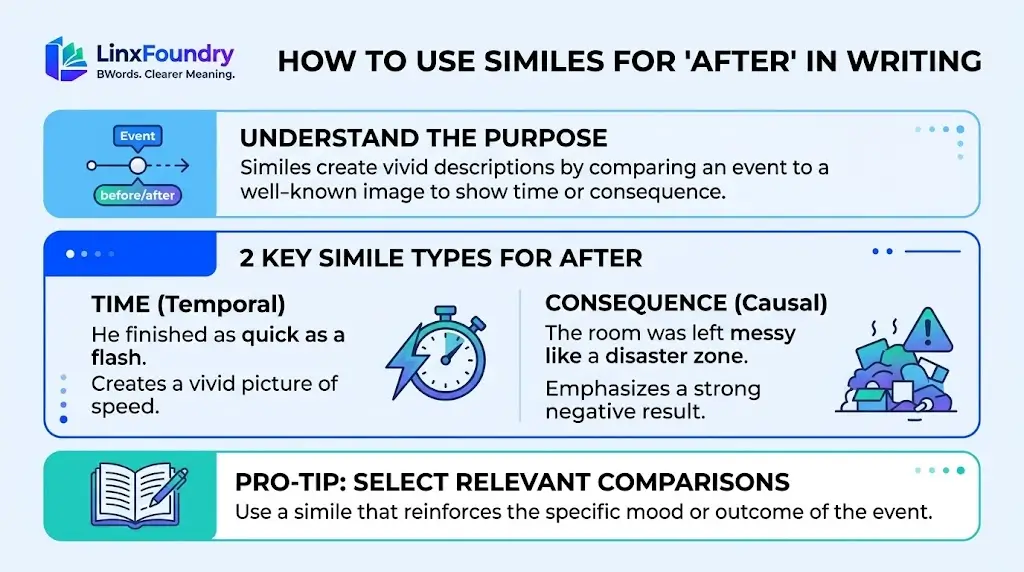
Describe a peaceful ending
Instead of writing, “The party ended and everyone went home,” try:
“The hall became as quiet as a sleeping village after a storm.”
This version emphasizes the sudden silence following a busy event.
Show relief after a challenge
Instead of writing, “I felt relieved when the test ended,” try:
“When I handed in my paper, I felt as light as a feather after setting down a heavy bag.”
The comparison communicates the feeling of releasing pressure.
Show the lasting effects of an experience
Instead of writing, “I remembered what she said,” try:
“Her words stayed with me like echoes after a distant bell.”
This image suggests that the words continued to affect the narrator after the conversation ended.
Describe a fresh beginning
Instead of writing, “She started again,” try:
“Her new life felt like a blank canvas after the old painting was removed.”
This comparison suggests opportunity and the freedom to make new choices.
Using “Like” and “As” in Similes
Similes commonly use like or as to make a comparison.
Similes using “like”
- Like sunlight after a long winter.
- Like echoes after a distant bell.
- Like a calm sea after rough weather.
- Like a blank canvas after the old painting is removed.
Example sentence: “His confidence returned like sunlight after a long winter.”
Similes using “as”
- As quiet as a sleeping village after a storm.
- As fresh as the morning after rain.
- As tired as a runner after a marathon.
- As clear as the sky after a storm.
Example sentence: “The streets were as quiet as a sleeping village after a storm.”
Remember that a simile should make sense in context. The goal is not simply to insert like or as, but to create a comparison that helps the reader imagine a feeling, place, or experience.
Frequently Asked Questions
1. What is a good simile for after?
A useful simile is “like sunlight after a long winter.” It describes relief, hope, or happiness following a difficult period. It works well in personal essays, stories, and reflective writing.
2. How do you describe what happens after an event using a simile?
Identify what changes when the event ends. For silence, compare the setting to a sleeping village. For relief, compare the feeling to putting down a heavy bag. For renewal, use an image such as a garden after rain.
3. What is a simile for life after a difficult time?
“Like a seed after winter” is a hopeful comparison for life following a challenging period. It suggests that growth can begin again after a time of difficulty.
4. What is a simile for the quiet after a storm?
“As quiet as a sleeping village after a storm” creates an image of stillness after noise and disturbance. It works especially well in descriptive writing and stories.
5. Can I use these similes in poems and essays?
Yes. Similes can enrich poems, stories, and personal essays by making abstract feelings easier to picture. In academic essays, choose comparisons carefully and use them only when they suit the purpose and tone.
6. How can I create my own simile for after?
Think about what remains when something ends. A celebration may leave memories, a storm may leave stillness, and a difficult task may bring relief. Choose an image that reflects that result, then form a natural comparison using like or as.
Final Thoughts
The moments after an event can carry just as much meaning as the event itself. A quiet street may suggest peace, echoes may represent lasting memories, and a seed after winter may symbolize renewed hope. These comparisons help readers understand not only what happened but also how it changed a person or place.
When choosing a simile, consider the mood you want to create. Use gentle imagery for peaceful endings, vivid comparisons for emotional changes, and hopeful images for new beginnings. You can also create original similes by observing what remains after a meaningful experience.

Emily Carter
Emily Carter specializes in word choice, writing clarity, vocabulary development, and practical English usage. Her articles explain similar words, highlight differences in meaning, and provide examples to help readers communicate more naturally and confidently.