Looking for similes for stupid? You can describe foolish behavior, poor judgment, or a silly mistake by comparing it to something confusing, ineffective, or out of place. For example, someone might be described as being “as confused as a compass near a magnet” or making decisions “like a squirrel crossing a busy road.” These comparisons can add humor and personality to stories, conversations, and creative writing. Below, you will find 45 similes with meanings and example sentences, from simple expressions to imaginative comparisons. Use them thoughtfully to describe a situation or fictional character without turning a lighthearted joke into a personal insult.
Quick Answer: What Are Some Similes for Stupid?
Some creative similes for stupid include “as confused as a compass near a magnet,” “like a screen door on a submarine,” and “like a puzzle with half the pieces missing.” These comparisons suggest confusion, poor judgment, or something that does not work as expected. They are useful in humorous stories and descriptive writing when you want to show a foolish decision rather than simply label someone.
What Does Stupid Mean in a Simile?
In a simile, the word stupid generally describes a lack of good judgment, understanding, or common sense. A writer can communicate this idea by comparing an action or situation to something impractical, confused, or ineffective.
For example, “His plan worked like an umbrella full of holes” suggests that the plan was poorly thought out and could not do its job. The comparison creates a picture in the reader’s mind instead of relying on a blunt adjective.
Context matters, though. Someone can make a foolish decision without being unintelligent. For that reason, similes about a particular mistake or action are often more accurate and more interesting than comparisons that label an entire person.
45 Similes for Stupid With Meanings and Examples
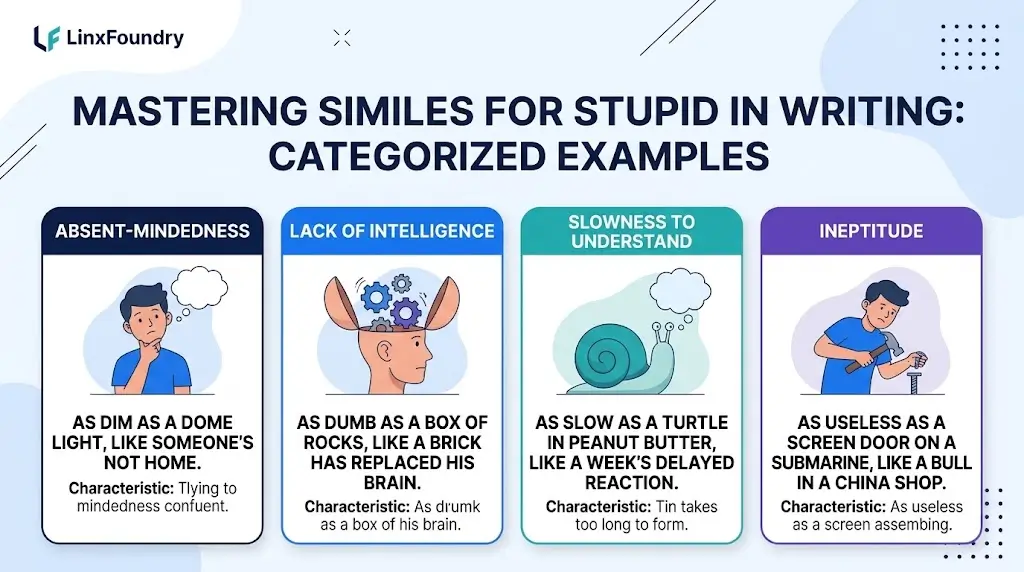
The following examples mix familiar comparisons with original, imaginative expressions. Some are playful inventions rather than established English idioms, so use them as creative writing suggestions.
Simple Similes for Stupid
These straightforward comparisons work well in everyday descriptions and beginner-level writing.
1. As confused as a compass near a magnet
Meaning: Unable to find the right direction or understand what is happening.
Example: After reading the complicated instructions, Ben looked as confused as a compass near a magnet.
Why it works: A compass relies on a stable magnetic direction, so the comparison suggests that its guidance has become unreliable.
2. Like a screen door on a submarine
Meaning: Completely unsuitable or ineffective for its intended purpose.
Example: His plan to keep the water out with a screen door was like a screen door on a submarine.
Why it works: A screen door cannot keep water out of a submarine, making the comparison a humorous way to describe a badly designed plan.
3. Like a puzzle with half the pieces missing
Meaning: Incomplete, confusing, or difficult to understand.
Example: His explanation of the missing homework was like a puzzle with half the pieces missing.
Why it works: Missing pieces make a puzzle difficult to solve, just as missing information makes an explanation hard to follow.
4. As useful as a chocolate teapot
Meaning: Almost completely useless for a particular task.
Example: Without a working battery, the emergency flashlight was as useful as a chocolate teapot.
Why it works: A chocolate teapot would melt when filled with hot liquid, making it unsuitable for its intended purpose.
5. Like a car without a steering wheel
Meaning: Unable to move in a sensible direction or make effective progress.
Example: Without a clear plan, the project moved like a car without a steering wheel.
Why it works: The car has power but lacks the control needed to reach its destination.
Funny Similes for Stupid
These playful comparisons create humor through exaggerated images. They work best when the target is a mistake, a plan, or a fictional character’s behavior.
6. Like a squirrel trying to solve a crossword puzzle
Meaning: Looking completely out of one’s depth in a difficult situation.
Example: Asked to explain the advanced formula, Jake looked like a squirrel trying to solve a crossword puzzle.
Why it works: The unexpected pairing of an animal and a word puzzle creates a silly mental image.
7. As organized as a tornado in a library
Meaning: Extremely disorganized or disruptive.
Example: His attempt to arrange the notes was as organized as a tornado in a library.
Why it works: A tornado scatters everything around it, the opposite of what an organized workspace requires.
8. Like a penguin trying to ride a bicycle
Meaning: Awkwardly attempting something unfamiliar or unsuitable.
Example: During his first cooking lesson, he moved around the kitchen like a penguin trying to ride a bicycle.
Why it works: The unusual image emphasizes awkwardness rather than intelligence.
9. As graceful as a shopping cart with a broken wheel
Meaning: Clumsy, awkward, or difficult to control.
Example: His attempt to sneak across the room was as graceful as a shopping cart with a broken wheel.
Why it works: A faulty wheel makes smooth movement almost impossible.
10. Like a goldfish trying to climb a tree
Meaning: Attempting something that is clearly beyond one’s abilities or unsuitable to one’s skills.
Example: Without any preparation, he approached the advanced coding challenge like a goldfish trying to climb a tree.
Why it works: The comparison highlights a mismatch between the task and the abilities available.
11. As predictable as a broken clock that never moves
Meaning: Consistently producing the same unhelpful result.
Example: His so-called new strategy was as predictable as a broken clock that never moves.
Why it works: A clock that never changes its display cannot provide useful time information.
12. Like a rooster giving swimming lessons
Meaning: Trying to teach something one does not understand well.
Example: He tried to explain a subject he had never studied, like a rooster giving swimming lessons.
Why it works: The humorous mismatch suggests a lack of relevant knowledge.
13. As sharp as a rubber spoon
Meaning: Not especially quick-witted in a particular situation.
Example: After making the same mistake three times, he joked that he was as sharp as a rubber spoon that morning.
Why it works: A spoon is not a cutting tool, and rubber is softer still. The image creates a gentle joke about mental sharpness.
14. Like a robot following instructions in the wrong language
Meaning: Following directions without understanding what they mean.
Example: He kept clicking the wrong buttons, like a robot following instructions in the wrong language.
Why it works: The robot follows a process but cannot interpret the instructions correctly.
15. As practical as a paper umbrella in a thunderstorm
Meaning: Entirely unsuitable for the conditions.
Example: Wearing thin paper shoes in heavy rain was as practical as a paper umbrella in a thunderstorm.
Why it works: The comparison emphasizes how quickly an unsuitable solution would fail.
Creative Similes for Stupid Decisions
Sometimes the best way to describe foolishness is to focus on a decision rather than the person making it.
16. Like bringing a spoon to a sword fight
Meaning: Being badly prepared for a challenge.
Example: Arriving at the debate without researching the topic was like bringing a spoon to a sword fight.
Why it works: A spoon is a poor tool for the situation, just as inadequate preparation weakens an argument.
17. Like trying to put out a fire with gasoline
Meaning: Making a problem worse while attempting to solve it.
Example: Arguing with an already angry customer was like trying to put out a fire with gasoline.
Why it works: Gasoline fuels fire, so the comparison captures a counterproductive response.
18. Like building a house on quicksand
Meaning: Creating a plan or project on an unstable foundation.
Example: Starting the business without researching its costs was like building a house on quicksand.
Why it works: A weak foundation makes the entire structure unreliable.
19. Like locking the barn after the horse has escaped
Meaning: Taking action too late to prevent a problem.
Example: Changing the password after sharing it publicly was like locking the barn after the horse had escaped.
Why it works: The protective action comes after the damage has already occurred. This is also a recognizable traditional expression.
20. Like throwing away the map before a journey
Meaning: Giving up useful guidance before beginning a difficult task.
Example: He started the research project without reading the requirements, like throwing away the map before a journey.
Why it works: The missing map represents the information needed to reach the right destination.
21. Like cutting off the branch you’re sitting on
Meaning: Doing something that harms your own position or interests.
Example: Insulting the client during a negotiation was like cutting off the branch he was sitting on.
Why it works: The action destroys the support on which the person depends.
22. Like trying to charge a phone with a banana
Meaning: Using a method that cannot achieve the desired result.
Example: Expecting a spreadsheet to fix missing customer data was like trying to charge a phone with a banana.
Why it works: The comparison highlights a mismatch between the solution and the problem.
23. Like sailing without checking the weather
Meaning: Taking an avoidable risk without considering important information.
Example: Investing the entire budget without checking the costs was like sailing without checking the weather.
Why it works: A sailor who ignores the forecast risks trouble that could have been anticipated.
24. Like digging a hole to escape a pit
Meaning: Trying to solve a problem with a method that makes it worse.
Example: Borrowing more money to cover unnecessary spending was like digging a hole to escape a pit.
Why it works: The attempted escape creates an even bigger problem.
25. Like putting the cart before the horse
Meaning: Doing things in the wrong order.
Example: He designed the packaging before deciding what the product would be, like putting the cart before the horse.
Why it works: The comparison describes a reversed sequence and is a well-known English expression.
Similes for Confused or Unwise Behavior
Use these examples when a character struggles to understand instructions, overlooks obvious details, or acts without thinking.
26. Like a GPS that keeps sending you in circles
Meaning: Repeatedly choosing the wrong direction or solution.
Example: His troubleshooting process was like a GPS that kept sending him in circles.
Why it works: The repeated detours suggest that the process is not leading toward a solution.
27. As lost as a tourist without a map
Meaning: Completely unsure about where to go or what to do.
Example: On the first day of the workshop, I felt as lost as a tourist without a map.
Why it works: The familiar image communicates uncertainty without implying a lack of intelligence.
28. Like a computer with too many tabs open
Meaning: Struggling to concentrate because too much information is competing for attention.
Example: After studying five subjects at once, Mia felt like a computer with too many tabs open.
Why it works: The overloaded computer represents a mind trying to manage too many tasks.
29. As focused as a butterfly in a wind tunnel
Meaning: Easily distracted and unable to concentrate.
Example: With music playing and messages arriving, he was as focused as a butterfly in a wind tunnel.
Why it works: The image suggests movement in too many directions to maintain attention.
30. Like reading a recipe upside down
Meaning: Approaching a task in a confusing or incorrect way.
Example: Without checking the instructions, he assembled the desk like someone reading a recipe upside down.
Why it works: Even useful instructions become difficult to follow when approached incorrectly.
31. Like a clock with its hands going backward
Meaning: Making progress in the wrong direction.
Example: Every time he changed the settings, the project moved like a clock with its hands going backward.
Why it works: A backward-moving clock represents actions that undo progress rather than improve it.
32. As observant as a bat wearing a blindfold
Meaning: Failing to notice obvious details.
Example: He walked past the large warning sign, as observant as a bat wearing a blindfold.
Why it works: The exaggerated image emphasizes a failure to notice something important.
33. Like trying to read a book through a brick wall
Meaning: Attempting to understand something without access to the information needed.
Example: Solving the mystery without reading the clues was like trying to read a book through a brick wall.
Why it works: The obstacle makes the task impossible, illustrating why missing information matters.
34. Like a key that fits every lock except the right one
Meaning: Having abilities or tools that do not solve the actual problem.
Example: His elaborate software was like a key that fit every lock except the right one.
Why it works: The key seems useful but fails at the one task that matters.
35. Like a student answering a question before hearing it
Meaning: Responding without understanding the problem first.
Example: He criticized the proposal before reading it, like a student answering a question before hearing it.
Why it works: The comparison shows why listening and understanding should come before responding.
Similes for Poor Judgment and Lack of Common Sense
These comparisons suit stories, essays, and discussions about consequences, careless choices, or impractical reasoning.
36. Like jumping into a pool without checking whether it has water
Meaning: Acting without checking basic facts or risks.
Example: He launched the product without testing it, like jumping into a pool without checking whether it had water.
Why it works: The missing check could prevent a serious and avoidable mistake.
37. Like trusting a weather forecast from a snowman
Meaning: Relying on an unsuitable or unreliable source.
Example: Taking financial advice from someone who knew nothing about the subject was like trusting a weather forecast from a snowman.
Why it works: The absurd image questions the source’s suitability for the task.
38. Like planting seeds on a concrete floor
Meaning: Expecting results without providing the conditions necessary for success.
Example: He expected his website to attract readers without publishing useful content, like planting seeds on a concrete floor.
Why it works: Seeds need suitable conditions to grow, just as a project needs the right foundations.
39. Like trying to catch smoke with a fishing net
Meaning: Using an ineffective method to achieve a goal.
Example: Their attempt to fix the communication problem with vague messages was like trying to catch smoke with a fishing net.
Why it works: Smoke slips through the net, representing a solution that cannot contain the problem.
40. Like spending the whole day polishing a broken window
Meaning: Improving minor details while ignoring the main problem.
Example: He adjusted the website colors instead of fixing its broken checkout, like spending the whole day polishing a broken window.
Why it works: The effort goes toward something that cannot solve the central issue.
41. Like searching for sunglasses in a dark room
Meaning: Looking for something in a way that is unlikely to help.
Example: He guessed passwords repeatedly instead of using the recovery option, like searching for sunglasses in a dark room.
Why it works: The setting makes the search needlessly difficult.
42. Like using a ladder with missing rungs
Meaning: Relying on an incomplete method to reach a goal.
Example: His study plan skipped the basics, like using a ladder with missing rungs.
Why it works: Missing rungs make climbing unsafe and difficult, just as missing steps undermine learning.
43. Like trying to steer a boat with a teaspoon
Meaning: Attempting to control a large problem with an inadequate tool.
Example: Trying to manage the entire project through scattered text messages was like steering a boat with a teaspoon.
Why it works: The tool is too small to provide meaningful control.
44. Like putting a bandage on a leaking pipe
Meaning: Applying a temporary or unsuitable fix to a problem that needs a proper solution.
Example: Repeatedly restarting the faulty server without investigating the cause was like putting a bandage on a leaking pipe.
Why it works: A bandage cannot repair the source of a water leak, just as a temporary workaround may not solve the real issue.
45. Like trying to win a race by standing still
Meaning: Expecting success without taking the necessary action.
Example: He wanted to improve his writing but never practiced, like trying to win a race by standing still.
Why it works: The comparison clearly shows the gap between an expected result and the effort required to achieve it.
Quick-Reference Table: Similes for Stupid
| Simile | Meaning | Best Used For |
|---|---|---|
| As confused as a compass near a magnet | Confused or directionless | Stories |
| Like a screen door on a submarine | Completely unsuitable | Humor |
| Like a puzzle with half the pieces missing | Incomplete understanding | Explanations |
| Like bringing a spoon to a sword fight | Poor preparation | Decisions |
| Like putting the cart before the horse | Doing things in the wrong order | Everyday writing |
| Like a GPS that keeps sending you in circles | Repeatedly going wrong | Problem-solving |
| Like jumping into a pool without checking the water | Acting without checking risks | Cautionary stories |
| Like planting seeds on a concrete floor | Ignoring necessary conditions | Essays |
| Like using a ladder with missing rungs | Following an incomplete process | Learning |
| Like trying to win a race by standing still | Expecting results without effort | Motivation and reflection |
How to Use Similes for Stupid in Writing
A strong simile does more than describe a foolish action. It helps readers picture the problem and understand why the behavior is ineffective.
1. Match the comparison to the situation
Choose an image that reflects what actually went wrong.
- Poor preparation: “He entered the competition like bringing a spoon to a sword fight.”
- Confusion: “She stared at the instructions like a compass near a magnet.”
- Bad judgment: “He spent his savings without a plan, like sailing without checking the weather.”
Each example describes a different problem. Selecting a relevant comparison makes your writing clearer.
2. Decide how humorous you want the sentence to sound
A comparison such as “as useful as a chocolate teapot” sounds playful. By contrast, “like putting a bandage on a leaking pipe” is more practical and critical.
Use lighter comparisons for comedy and more precise ones for serious discussions.
3. Show the behavior instead of labeling the person
Rather than writing, “Tom was stupid,” you might write, “Tom deleted the only backup before testing the new system, like cutting off the branch he was sitting on.”
The second sentence explains what Tom did and why it was unwise. This approach gives readers more information and creates a stronger image.
4. Use similes naturally
A simile should support your sentence, not overwhelm it. One well-chosen comparison is usually more effective than several comparisons packed together.
For example:
“Mark launched the website without testing the checkout. His plan was like building a house on quicksand.”
This example connects the comparison to the specific mistake.
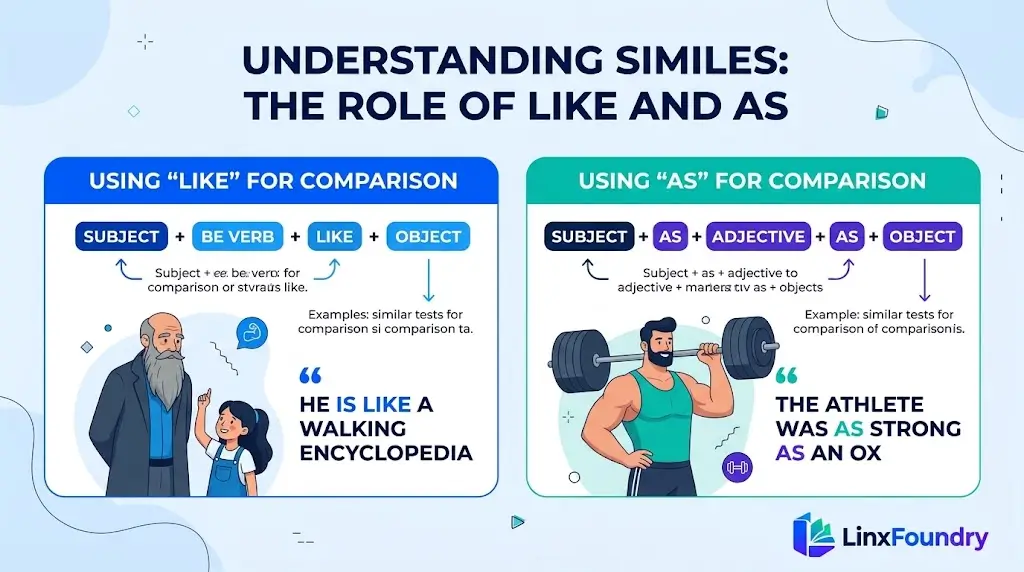
Similes Using “Like” and “As”
It commonly use like or as to compare two different things.
Similes using “like”
- Like a screen door on a submarine.
- Like a GPS that keeps sending you in circles.
- Like bringing a spoon to a sword fight.
- Like planting seeds on a concrete floor.
- Like a puzzle with half the pieces missing.
These structures work well when you want to compare an action, object, or situation with another image.
Similes using “as”
- As confused as a compass near a magnet.
- As useful as a chocolate teapot.
- As organized as a tornado in a library.
- As lost as a tourist without a map.
- As focused as a butterfly in a wind tunnel.
The as … as pattern is especially useful for describing a quality, condition, or behavior.
Remember that a comparison does not need to be an established idiom to work as a creative simile. It should simply be understandable, relevant, and grammatically natural.
FAQ: Similes for Stupid
1. What is a good simile for stupid?
A useful creative option is “as confused as a compass near a magnet.” It describes confusion through a clear image. If you want to criticize a decision rather than a person, “like putting the cart before the horse” is a familiar expression for doing things in the wrong order.
2. What is a funny simile for stupid?
“Like a screen door on a submarine” is a humorous comparison for something unsuitable or ineffective. It works well in a lighthearted story about a badly designed plan or an avoidable mistake.
3. What is an easy simile for stupid for students?
“Like a puzzle with half the pieces missing” is easy to understand. It suggests that someone lacks important information or has not fully understood a situation. Students can use it in a descriptive paragraph or a figurative-language exercise.
4. How do you describe a foolish decision using a simile?
Compare the decision to an action that clearly cannot work. For example, “He tried to fix the problem by hiding the evidence, like trying to put out a fire with gasoline.” The image shows why the decision was counterproductive.
5. Are all 45 examples common English idioms?
No. Some examples use familiar expressions, while others are original creative comparisons. Established expressions such as “putting the cart before the horse” have recognizable conventional meanings. New comparisons can also work as similes when their meaning is clear in context.
6. Can I use these similes in essays and creative writing?
Yes. Select the comparison according to the tone and purpose of your writing. For formal essays, precise comparisons about poor judgment or ineffective decisions are usually more suitable than exaggerated jokes. In fiction and comedy, playful images can help establish a character’s voice.
Final Thoughts
Similes for stupid can add humor, clarity, and vivid imagery to your writing. The most effective comparisons show the nature of a mistake, whether it involves confusion, poor preparation, or an impractical decision. Familiar expressions help readers recognize an idea quickly, while original comparisons offer opportunities for creativity. Choose the phrase that best fits the situation, and make sure the meaning is easy to understand. When possible, describe the behavior rather than insulting the person behind it. That approach makes your writing more precise, more memorable, and more useful to readers.

Michael Bennett
creates educational content about English word meanings, related terms, synonyms, and usage in different contexts. His goal is to make vocabulary research easier by presenting clear explanations, useful examples, and reader-friendly guidance.