The best similes make descriptions more vivid by comparing one thing with another in a way readers can easily imagine. They can describe a person’s character, a powerful emotion, a beautiful scene, a quick movement, or a memorable moment. These 45 best similes include familiar expressions and original comparisons, each with a meaning and an example sentence. Whether you’re writing a story, completing a school assignment, creating a poem, or improving your everyday English, these examples will help you choose comparisons that fit your message.
Quick Answer: What Are the Best Similes?
Some of the best similes include as brave as a lion, as busy as a bee, like a ray of sunshine, as quiet as a mouse, and like a spark in the darkness. Each comparison highlights a particular quality, such as courage, activity, happiness, silence, or hope. The best simile depends on what you want to describe and the feeling you want your reader to experience.
What Makes a Simile Good?
A simile is a figure of speech that compares two different things using words such as like or as. For example, “Her voice was as gentle as a breeze” compares the softness of a person’s voice with the light movement of air.
A good simile creates a clear mental picture, communicates a specific quality, and fits the context. It should make a sentence more meaningful rather than simply add extra words.
Compare these sentences:
- Plain: The runner was fast.
- With a simile: The runner moved like an arrow released from a bow.
The second sentence gives readers a stronger sense of speed and direction. However, a simple comparison may be more effective when the writing calls for a natural, conversational tone.
45 Best Similes With Meanings and Examples
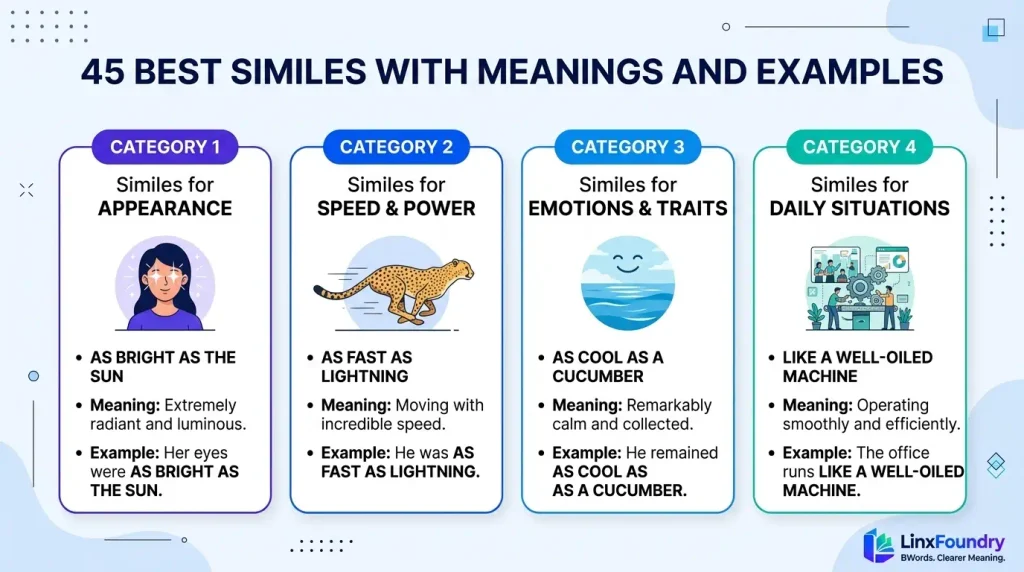
The following examples are organized by the qualities they describe, making it easier to find the right comparison for your writing.
1. Best Similes for Personality and Character
These similes describe courage, kindness, intelligence, determination, and other personal qualities.
1. As brave as a lion
Meaning: Very courageous when facing danger or difficulty.
Example: Maya was as brave as a lion when she stood up for her friend.
Best used for: Stories about courage, leadership, and overcoming challenges.
2. As busy as a bee
Meaning: Extremely active and occupied with tasks.
Example: Dad was as busy as a bee preparing everything for the family celebration.
Best used for: Describing hardworking people and hectic days.
3. As wise as an owl
Meaning: Very thoughtful, knowledgeable, or sensible.
Example: Everyone asked Grandma for advice because she was as wise as an owl.
Best used for: Experienced characters, teachers, mentors, and thoughtful leaders.
4. As stubborn as a mule
Meaning: Unwilling to change an opinion or decision.
Example: Liam was as stubborn as a mule and refused to admit he had made a mistake.
Best used for: Characters who resist advice or insist on having their own way.
5. As gentle as a lamb
Meaning: Very kind, mild, or soft in manner.
Example: Although the dog looked enormous, it was as gentle as a lamb around children.
Best used for: Kind people, friendly animals, and reassuring personalities.
6. Like a rock in a storm
Meaning: Emotionally steady during difficult circumstances.
Example: During the family crisis, Sara stood like a rock in a storm, offering support to everyone.
Best used for: Dependable characters who remain calm under pressure.
7. As sharp as a tack
Meaning: Very quick to understand or notice things.
Example: The new detective was as sharp as a tack and noticed the detail everyone else had missed.
Best used for: Clever characters, problem-solvers, and quick thinkers.
8. As light-hearted as a summer breeze
Meaning: Cheerful, relaxed, and free from heavy worries.
Example: After finishing her exams, Nina felt as light-hearted as a summer breeze.
Best used for: Relaxed moods, joyful characters, and peaceful moments.
2. Best Similes for Emotions and Feelings
Use these comparisons to express happiness, nervousness, sadness, excitement, or hope.
9. Like a ray of sunshine
Meaning: Someone or something that brings happiness and warmth.
Example: Her cheerful greeting was like a ray of sunshine on a difficult morning.
Best used for: Kind people, uplifting news, and joyful moments.
10. As happy as a child on a holiday
Meaning: Extremely delighted and excited.
Example: He was as happy as a child on a holiday when he received his first bicycle.
Best used for: Celebrations, surprises, and moments of pure excitement.
11. Like butterflies in the stomach
Meaning: A nervous or excited feeling, especially before an important event.
Example: I felt like I had butterflies in my stomach before stepping onto the stage.
Best used for: First dates, performances, interviews, and competitions.
12. Like a cloud hanging over the day
Meaning: A feeling of sadness or worry that affects an otherwise ordinary day.
Example: The disappointing news hung over him like a cloud for the rest of the afternoon.
Best used for: Reflective stories and scenes with a subdued mood.
13. As nervous as a cat in a room full of rocking chairs
Meaning: Extremely anxious and uncomfortable.
Example: I was as nervous as a cat in a room full of rocking chairs while waiting for my interview.
Best used for: Humorous descriptions of tension and anxiety.
14. Like fireworks bursting in the sky
Meaning: A sudden, powerful expression of excitement or happiness.
Example: Excitement burst inside her like fireworks bursting in the sky when she heard her name announced.
Best used for: Victories, celebrations, reunions, and thrilling discoveries.
15. As calm as a still lake
Meaning: Peaceful and emotionally controlled.
Example: Even when the discussion became heated, Daniel remained as calm as a still lake.
Best used for: Meditation, difficult conversations, and composed characters.
16. Like a spark in the darkness
Meaning: A small but powerful sign of hope during a difficult time.
Example: Her encouraging words were like a spark in the darkness when the team felt ready to give up.
Best used for: Inspirational writing, recovery, and moments of renewed confidence.
3. Best Similes for Appearance and Description
These comparisons help readers imagine a person’s expression, a place, or a visual detail.
17. As white as snow
Meaning: Completely or extremely white.
Example: The freshly washed curtains were as white as snow.
Best used for: Clothing, landscapes, objects, and winter scenes.
18. As bright as the morning sun
Meaning: Very bright, cheerful, or radiant.
Example: Her smile was as bright as the morning sun.
Best used for: Smiles, lights, colors, and uplifting descriptions.
19. As smooth as glass
Meaning: Extremely even, polished, or free from roughness.
Example: The surface of the frozen pond was as smooth as glass.
Best used for: Water, polished materials, skin, and carefully finished objects.
20. As red as a ripe tomato
Meaning: Very red, often describing a face that has become red from embarrassment or exertion.
Example: His face turned as red as a ripe tomato when he realized he had called his teacher by the wrong name.
Best used for: Embarrassment, blushing, and vivid visual descriptions.
21. Like silver ribbons in the moonlight
Meaning: Something long and reflective that shines with a silvery appearance.
Example: The narrow streams wound through the valley like silver ribbons in the moonlight.
Best used for: Poetry, landscapes, nighttime scenes, and descriptive fiction.
22. As graceful as a swan
Meaning: Moving with elegance and smoothness.
Example: The dancer crossed the stage as graceful as a swan gliding across a pond.
Best used for: Dance, elegant movement, and refined characters.
23. Like a painting brought to life
Meaning: So beautiful or visually striking that it resembles a work of art.
Example: With its colorful flowers and winding paths, the garden looked like a painting brought to life.
Best used for: Gardens, scenic locations, costumes, and beautiful settings.
4. Best Similes for Speed, Movement, and Action
Use these similes when describing energetic scenes, rapid movement, or powerful action.
24. As fast as lightning
Meaning: Extremely quick.
Example: The goalkeeper moved as fast as lightning to stop the ball.
Best used for: Sports, sudden reactions, and fast-moving action.
25. Like an arrow from a bow
Meaning: Moving forward quickly and directly.
Example: The cyclist shot forward like an arrow from a bow at the start of the race.
Best used for: Racing, escapes, and decisive movements.
26. As light as a feather
Meaning: Very lightweight or seemingly effortless.
Example: The little paper lantern felt as light as a feather in her hands.
Best used for: Objects, delicate movements, and descriptions of weight.
27. Like a river rushing downhill
Meaning: Moving rapidly and continuously with considerable force.
Example: The children poured through the school gates like a river rushing downhill.
Best used for: Crowds, flowing water, and energetic group movement.
28. As steady as a clock
Meaning: Consistent, reliable, and regular.
Example: His pace remained as steady as a clock throughout the long-distance race.
Best used for: Repetitive tasks, dependable workers, and sustained effort.
29. Like leaves dancing in the wind
Meaning: Moving lightly and unpredictably.
Example: The colorful scarves swirled like leaves dancing in the wind during the performance.
Best used for: Dance, falling leaves, flowing fabric, and playful movement.
30. As strong as an ox
Meaning: Extremely physically strong.
Example: Our neighbor was as strong as an ox and carried the heavy table without assistance.
Best used for: Physical strength, demanding work, and powerful characters.
5. Best Similes for Nature, Weather, and the Senses
These comparisons make natural settings and sensory details more memorable.
31. As quiet as a mouse
Meaning: Making very little noise.
Example: The students became as quiet as mice when the principal entered the classroom.
Best used for: Silence, secretive behavior, and tense scenes.
32. Like diamonds scattered across the grass
Meaning: Tiny bright objects reflecting light across a surface.
Example: Morning dew sparkled like diamonds scattered across the grass.
Best used for: Gardens, early mornings, and poetic descriptions of nature.
33. As cold as ice
Meaning: Extremely cold, either physically or emotionally.
Example: The metal railing was as cold as ice on the winter morning.
Best used for: Winter settings, chilled objects, and emotionally distant characters.
34. Like a blanket of mist
Meaning: A layer of fog that covers or softens a landscape.
Example: Mist settled over the village like a blanket, hiding the distant hills.
Best used for: Mystery, quiet mornings, and atmospheric storytelling.
35. As dry as a bone
Meaning: Completely or extremely dry.
Example: After weeks without rain, the garden soil was as dry as a bone.
Best used for: Deserts, droughts, old objects, and dry conditions.
36. Like music drifting through an open window
Meaning: Something pleasant that travels gently through the air.
Example: The sound of birdsong floated through the courtyard like music drifting through an open window.
Best used for: Sound, peaceful mornings, and sensory writing.
37. As clear as crystal
Meaning: Very clear, transparent, or easy to understand.
Example: After the teacher’s explanation, the instructions were as clear as crystal.
Best used for: Clear water, explanations, and straightforward ideas.
6. Best Similes for Writing, Learning, and Everyday Life
These comparisons are useful for explaining difficult ideas, describing experiences, and adding personality to ordinary sentences.
38. Like finding a needle in a haystack
Meaning: Extremely difficult to find because something is hidden among many other things.
Example: Finding the correct document among thousands of unsorted files was like finding a needle in a haystack.
Best used for: Research, searching, and complicated tasks.
39. As easy as pie
Meaning: Very easy to do.
Example: Once she learned the basic steps, solving the puzzle was as easy as pie.
Best used for: Simple tasks and informal conversation.
40. Like a book with missing pages
Meaning: Incomplete or difficult to understand because important information is absent.
Example: His account of the meeting was like a book with missing pages because he had arrived halfway through.
Best used for: Incomplete explanations, mysteries, and confusing stories.
41. Like a key turning in a lock
Meaning: A moment when an idea suddenly becomes clear or a problem begins to make sense.
Example: When the teacher explained the final step, understanding clicked into place like a key turning in a lock.
Best used for: Learning, discoveries, and problem-solving.
42. Like building a bridge one stone at a time
Meaning: Making progress through small, consistent steps.
Example: She improved her writing like someone building a bridge one stone at a time, practicing a little every day.
Best used for: Learning new skills, long-term goals, and personal development.
43. As unpredictable as the weather
Meaning: Constantly changing or difficult to anticipate.
Example: His mood was as unpredictable as the weather, cheerful one moment and quiet the next.
Best used for: Changing plans, uncertain situations, and inconsistent behavior.
44. Like a candle lighting another candle
Meaning: Sharing knowledge, kindness, or inspiration with others.
Example: The experienced teacher helped new colleagues grow, like a candle lighting another candle.
Best used for: Mentoring, education, generosity, and community.
45. Like a puzzle missing its final piece
Meaning: Almost complete but still lacking one important detail.
Example: The detective’s theory was like a puzzle missing its final piece until the last witness came forward.
Best used for: Mystery stories, research, problem-solving, and incomplete plans.
Quick-Reference Table: Which Simile Should You Choose?
| What you want to describe | Simile | Intended effect |
|---|---|---|
| Courage | As brave as a lion | Strength and confidence |
| Happiness | Like a ray of sunshine | Warmth and positivity |
| Nervousness | Like butterflies in the stomach | Excitement or anxiety |
| Calmness | As calm as a still lake | Peace and control |
| Speed | As fast as lightning | Sudden movement |
| Beauty | Like a painting brought to life | Visual richness |
| Silence | As quiet as a mouse | Almost no sound |
| Intelligence | As sharp as a tack | Quick understanding |
| Hope | Like a spark in the darkness | Encouragement |
| Persistence | Like building a bridge one stone at a time | Steady progress |
| Confusion | Like a book with missing pages | Missing information |
| Incompleteness | Like a puzzle missing its final piece | One detail still needed |
How to Use Similes Effectively in Your Writing
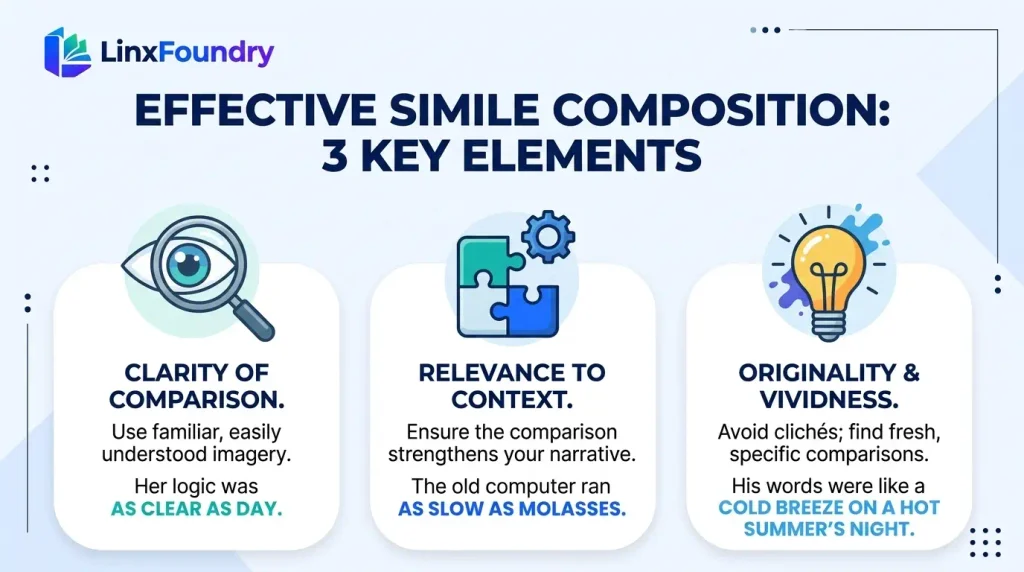
Choosing a good simile requires more than finding an interesting comparison. The comparison should match the meaning, tone, and setting of your sentence.
1. Match the simile to the feeling
Consider the difference between these descriptions:
- She was as calm as a still lake. This suggests peace and emotional control.
- Her excitement burst like fireworks in the sky. This suggests energy and intense happiness.
Both describe emotions, but they create very different impressions.
2. Choose a comparison that fits the scene
A nature-based simile can work beautifully in a landscape description, while a familiar everyday comparison may fit a school assignment or casual conversation better.
For example:
- Story: The forest stood like a silent army beneath the gray sky.
- Essay: The instructions were as clear as crystal.
- Poem: The stars shimmered like scattered diamonds.
The purpose of the writing should guide your choice.
3. Avoid using too many similes together
One effective comparison often has more impact than several competing images.
Overloaded: She was as bright as the sun, as fast as lightning, and as graceful as a swan.
More focused: She moved across the stage as gracefully as a swan.
The second sentence gives readers one clear image to remember.
4. Create your own similes
You can develop original similes by identifying a quality and finding something that shares it.
Try this simple process:
- Identify the quality you want to describe, such as silence, excitement, or determination.
- Think of a familiar object, natural event, or experience that demonstrates that quality.
- Connect the two with like or as.
- Read the sentence aloud to check that the comparison sounds natural.
For example, to describe persistent rain, you might write: The rain tapped at the roof like impatient fingers.
This comparison gives ordinary weather a sense of movement and personality.
Frequently Asked Questions
1. What is the best simile?
There is no single best simile for every situation. As brave as a lion works well for courage, while like a ray of sunshine suits a cheerful person or uplifting moment. The best choice is the one that communicates your intended meaning clearly.
2. What are five common examples of similes?
Five familiar similes are:
- As brave as a lion.
- As busy as a bee.
- As quiet as a mouse.
- As light as a feather.
- As fast as lightning.
Each uses a recognizable comparison to describe a particular quality.
3. What is a creative simile?
A creative simile makes a comparison that feels vivid and appropriate rather than predictable. For example, Her laughter scattered through the room like sunlight through leaves connects a sound with a visual image to create a cheerful atmosphere.
4. How do you write a simile in a sentence?
Choose two things that share a quality and connect them using like or as. For example, “The clouds drifted like ships across the sky.” The clouds and ships share a sense of slow movement across a wide space.
5. What is the difference between a simile and a metaphor?
A simile makes a comparison using words such as like or as. A metaphor describes one thing as another without using those comparison words.
- Simile: Her voice was like music.
- Metaphor: Her voice was music.
Both create imagery, but they express the comparison differently.
6. Can similes improve creative writing?
Yes. Similes can help readers imagine appearances, emotions, sounds, and movements. They are especially useful in stories, poems, and descriptive passages. However, a comparison should add meaning rather than distract readers from the main idea.
Final Thoughts
The best similes turn ordinary descriptions into clear, memorable images. Whether you want to describe a brave character, a peaceful morning, a sudden burst of excitement, or a difficult learning experience, choose a comparison that communicates the quality you want readers to notice. Familiar expressions are useful when clarity matters, while original comparisons can make creative writing more distinctive. Experiment with both like and as, and always consider your audience and context. Most importantly, use similes with purpose. A well-chosen comparison can make a single sentence more expressive without making it unnecessarily complicated.

Michael Bennett
creates educational content about English word meanings, related terms, synonyms, and usage in different contexts. His goal is to make vocabulary research easier by presenting clear explanations, useful examples, and reader-friendly guidance.