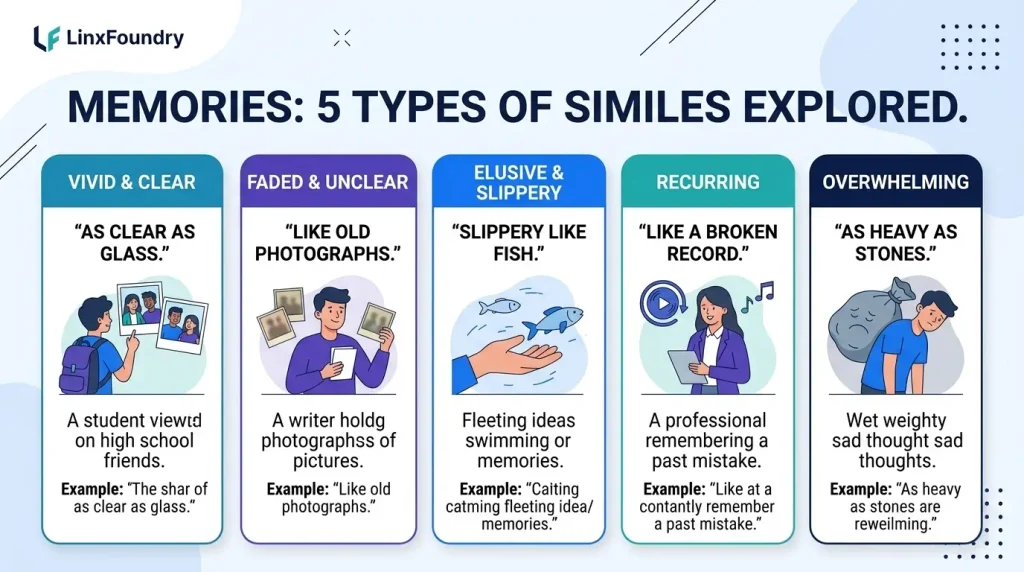
Memories can feel like treasured photographs, distant echoes, fading sunsets, or old songs that bring the past back to life. The best similes for memories help describe how we remember people, places, experiences, and moments that shaped us. Some comparisons express warmth and happiness, while others capture nostalgia, sadness, or the strange feeling of remembering something from long ago.
This collection features 45 similes for memories, each with a meaning and an example sentence. You will find simple comparisons for school assignments, creative expressions for poems, and vivid descriptions for stories and personal writing.
Quick Answer: What Are Some Good Similes for Memories?
Good similes for memories include memories like photographs in an old album, memories like echoes in an empty room, memories like stars in the night sky, and memories like leaves carried by the wind. These comparisons describe memories as lasting, distant, beautiful, or fleeting. The right simile depends on whether you want to express happiness, nostalgia, loss, or the passage of time.
45 Best Similes for Memories With Meanings and Examples
Beautiful and Cherished Memories
These similes work well when describing special moments, family experiences, friendships, and happy occasions.
1. Memories Like Photographs in an Old Album
Meaning: Memories preserve moments from the past, much like photographs capture scenes from earlier times.
Example: Her childhood memories were like photographs in an old album, each one holding a little piece of her family’s story.
2. Memories Like Stars in the Night Sky
Meaning: Precious memories stand out even when life feels dark or difficult.
Example: His happiest memories were like stars in the night sky, shining brightly during his loneliest evenings.
3. Memories Like Treasures in a Wooden Chest
Meaning: Special experiences are valuable and worth protecting.
Example: She kept her memories of summer holidays like treasures in a wooden chest.
4. Memories Like Sunlight Through a Window
Meaning: Warm recollections can bring comfort and happiness into the present.
Example: Memories of her grandmother were like sunlight through a window on a cold morning.
5. Memories Like Pearls on a Necklace
Meaning: Individual moments can connect to form something beautiful and meaningful.
Example: The memories of their friendship were like pearls on a necklace, linked together by years of laughter.
6. Memories Like Flowers Pressed Between Pages
Meaning: Memories preserve the beauty of moments that have already passed.
Example: Their first meeting remained in his mind like a flower pressed between the pages of an old book.
7. Memories Like Golden Threads in a Tapestry
Meaning: Important experiences connect different parts of a person’s life.
Example: Her memories of home were like golden threads in a tapestry, woven through every chapter of her life.
8. Memories Like Fireflies on a Summer Night
Meaning: Happy recollections appear as small, magical flashes of light in the mind.
Example: Memories of their childhood adventures were like fireflies on a summer night, brief but unforgettable.
9. Memories Like Seashells on a Beach
Meaning: Memories are scattered pieces of the past, each carrying its own story.
Example: After the family reunion, she gathered memories like seashells on a beach, keeping the smallest details close to her heart.
10. Memories Like a Warm Blanket on a Cold Night
Meaning: Familiar recollections can provide emotional comfort during difficult times.
Example: Thinking about his childhood home was like wrapping himself in a warm blanket on a cold night.
Nostalgic Similes for Memories
Use these comparisons to describe longing for the past, remembering childhood, or revisiting meaningful places.
11. Memories Like an Old Song on the Radio
Meaning: A familiar sound can bring back feelings and experiences from long ago.
Example: Hearing their favorite song was like finding an old melody on the radio that transported them to their teenage years.
12. Memories Like Footprints in Wet Sand
Meaning: Past experiences leave traces, even though time may eventually erase them.
Example: Her childhood memories were like footprints in wet sand, still visible but slowly fading with the years.
13. Memories Like Autumn Leaves
Meaning: Memories can represent change, the passage of time, and the beauty of letting go.
Example: His memories of university were like autumn leaves, colorful reminders of a season that had ended.
14. Memories Like an Old Letter in a Drawer
Meaning: Forgotten experiences can regain their emotional importance when rediscovered.
Example: Finding the letter was like opening a drawer filled with memories he had not visited in years.
15. Memories Like a Road Leading Home
Meaning: Recollections can guide people back to their roots and sense of belonging.
Example: Every story about her childhood was like a road leading home.
16. Memories Like a Familiar Smell in the Air
Meaning: A scent can unexpectedly awaken vivid recollections of a person or place.
Example: The smell of fresh bread was like a doorway to memories of mornings in his mother’s kitchen.
17. Memories Like Pages in a Well-Worn Diary
Meaning: Memories contain personal experiences that gradually form a life story.
Example: Their shared memories were like pages in a well-worn diary, filled with ordinary days that had become extraordinary.
18. Memories Like an Old Map
Meaning: Past experiences can help people understand where they have been and how they reached the present.
Example: Her memories of childhood were like an old map, showing the places and people that had shaped her.
19. Memories Like Waves Returning to Shore
Meaning: Thoughts of the past often return repeatedly, sometimes without warning.
Example: Memories of their final summer together came back like waves returning to shore.
20. Memories Like a Vintage Film
Meaning: Memories may feel like scenes from an earlier era, complete with imperfect details and a sense of distance.
Example: His memories of school were like a vintage film, flickering with laughter, friendships, and forgotten faces.
Fading and Fleeting Memories
These similes describe recollections that grow weaker, become unclear, or disappear with time.
21. Memories Like Mist at Sunrise
Meaning: Some memories gradually become less clear as time passes.
Example: The details of that distant vacation faded like mist at sunrise.
22. Memories Like Smoke Between Fingers
Meaning: Memories can be difficult to hold onto, even when we try hard to remember them.
Example: The exact sound of his father’s voice slipped away like smoke between his fingers.
23. Memories Like Footprints in Fresh Snow
Meaning: Memories may be clear at first but gradually disappear.
Example: The details of her first day at school were like footprints in fresh snow, becoming harder to distinguish with each passing year.
24. Memories Like Sand Slipping Through an Hourglass
Meaning: Memories and moments seem to move beyond our reach as time passes.
Example: His memories of their final holiday slipped away like sand through an hourglass.
25. Memories Like a Photograph Left in the Sun
Meaning: Memories can lose their clarity and color over time.
Example: The details of his childhood home faded like a photograph left in the sun.
26. Memories Like Clouds Drifting Across the Sky
Meaning: Thoughts of the past move through the mind, appearing and disappearing naturally.
Example: Her memories of that afternoon drifted through her mind like clouds across the sky.
27. Memories Like Ink Washed by Rain
Meaning: Memories can become blurred until only fragments remain.
Example: After decades apart, the details of their friendship seemed like ink washed by rain.
28. Memories Like Shadows at Dusk
Meaning: Old recollections may remain present but difficult to see clearly.
Example: His earliest memories were like shadows at dusk, familiar in shape but unclear in detail.
29. Memories Like Bubbles Floating in the Air
Meaning: Some memories are delicate, temporary, and difficult to preserve.
Example: The excitement of that afternoon floated through her mind like bubbles in the air.
30. Memories Like a Dream After Waking
Meaning: A past experience can feel distant, unreal, or difficult to reconstruct.
Example: His years abroad seemed like a dream after waking, vivid in feeling but uncertain in detail.
Emotional and Painful Memories
These similes help writers communicate grief, regret, heartbreak, and the complicated feelings attached to the past.
31. Memories Like Echoes in an Empty Room
Meaning: Memories of someone or something absent can continue to affect us.
Example: After her brother moved away, their childhood conversations returned like echoes in an empty room.
32. Memories Like a Photograph With a Missing Corner
Meaning: A memory may feel incomplete because an important detail is missing.
Example: His recollection of that final conversation was like a photograph with a missing corner.
33. Memories Like Rain on a Quiet Window
Meaning: Memories can create a gentle, melancholy feeling.
Example: Thoughts of her old friends fell over her mind like rain on a quiet window.
34. Memories Like Stones in a Backpack
Meaning: Difficult experiences can feel like burdens carried through life.
Example: He carried the memories of his mistakes like stones in a backpack, growing tired whenever he looked back.
35. Memories Like Thorns Beneath a Rose
Meaning: Beautiful experiences may contain painful details that still hurt.
Example: Her memories of their relationship were like thorns beneath a rose, mixing affection with regret.
36. Memories Like Thunder After Lightning
Meaning: The emotional effects of an experience may remain after the event itself has passed.
Example: Even years after the argument, the memories returned like thunder after lightning.
37. Memories Like Waves Against a Cliff
Meaning: Powerful recollections can repeatedly strike the mind with intense emotion.
Example: Memories of the accident crashed against his thoughts like waves against a cliff.
38. Memories Like a Wound That Leaves a Scar
Meaning: Painful experiences may heal over time but leave lasting effects.
Example: The betrayal remained in her memory like a wound that leaves a scar.
Creative and Poetic Similes for Memories
These more imaginative comparisons are useful in fiction, poetry, reflective essays, and descriptive writing.
39. Memories Like Lanterns Along a Dark Road
Meaning: Past experiences can provide guidance when the future feels uncertain.
Example: The lessons he learned from his failures were like lanterns along a dark road.
40. Memories Like Birds Returning at Dusk
Meaning: Thoughts of the past often return during quiet moments.
Example: As evening settled over the house, memories of his childhood returned like birds returning at dusk.
41. Memories Like Seeds Beneath the Soil
Meaning: Experiences can remain hidden for years before influencing thoughts or actions.
Example: The advice her teacher gave her rested in her mind like seeds beneath the soil, waiting for the right moment to grow.
42. Memories Like Music Behind a Closed Door
Meaning: Memories can remain emotionally present even when their details are distant.
Example: His memories of his hometown were like music behind a closed door, faint but still recognizable.
43. Memories Like Ink Beneath the Skin
Meaning: Certain experiences become a lasting part of a person’s identity.
Example: Her memories of growing up by the sea were like ink beneath the skin, impossible to separate from who she had become.
44. Memories Like Bridges Across Time
Meaning: Memories connect the present with people, places, and experiences from the past.
Example: Their family stories were like bridges across time, linking the youngest children with generations they had never met.
45. Memories Like Constellations in a Personal Sky
Meaning: Individual recollections form patterns that help people understand their lives.
Example: As she grew older, her memories became like constellations in a personal sky, revealing connections she had never noticed before.
Quick-Reference Table: Similes for Memories
| Simile | Meaning | Best Used For |
|---|---|---|
| Like photographs in an old album | Preserved moments | Family stories |
| Like stars in the night sky | Precious memories | Hope and comfort |
| Like an old song on the radio | Familiar recollections | Nostalgia |
| Like mist at sunrise | Fading memories | Time passing |
| Like echoes in an empty room | Memories of absence | Loss and longing |
| Like stones in a backpack | Emotional burdens | Regret |
| Like lanterns along a dark road | Lessons from the past | Personal growth |
| Like seeds beneath the soil | Hidden influences | Character development |
| Like bridges across time | Connection between generations | Family history |
| Like constellations in a personal sky | Connected life experiences | Reflective writing |
How to Use Similes for Memories in Writing
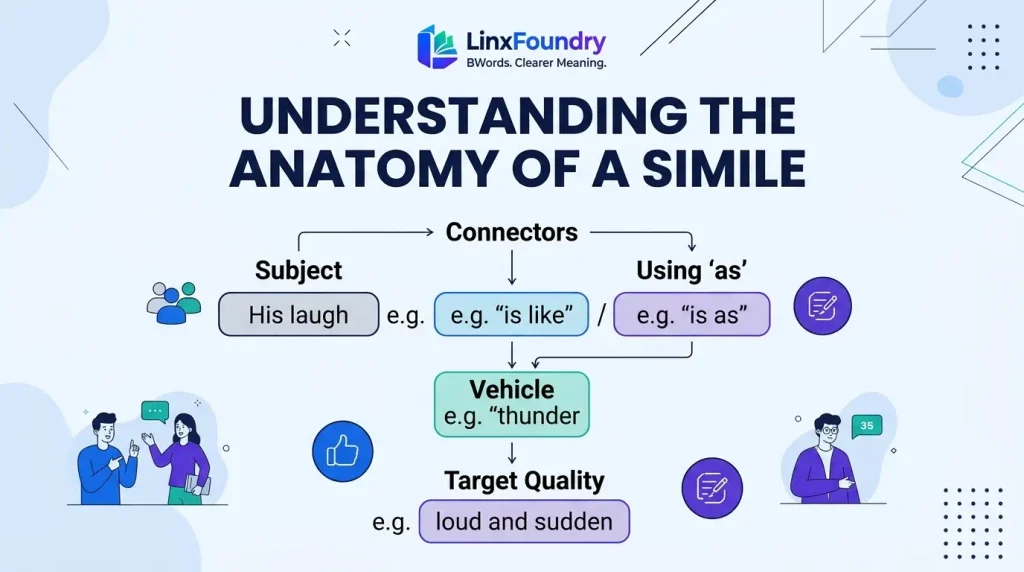
The strongest simile depends on what you want readers to feel. A comparison that works in a nostalgic poem might feel too emotional in an academic essay. Choose an image that supports the purpose of your writing.
1. For Stories
Use similes to show how a character remembers an important event rather than simply stating that the character remembers it.
Plain sentence: She remembered her childhood.
Improved sentence: Her childhood memories were like fireflies on a summer night, appearing in brief flashes of light.
The second sentence creates a visual image and suggests that the recollections are vivid but incomplete.
2. For Poems
Poetry benefits from comparisons that suggest emotion without explaining everything directly.
Example: Memories drifted like autumn leaves across the quiet landscape of my mind.
This comparison connects memories with seasonal change, suggesting that the past can be beautiful even when it is gone.
3. For School Essays
Choose clear, appropriate comparisons that strengthen the point you are making.
Example: Family memories are like photographs in an album because they preserve important moments and help people understand their history.
This simile works in a reflective essay because the comparison is easy to understand and explain.
4. For Personal Reflections
Use gentle imagery to describe how an experience continues to affect you.
Example: Memories of our final evening together return like waves reaching the shore.
The recurring waves suggest that the memory keeps returning, even when life moves forward.
5. For Character Descriptions
A simile can reveal a character’s attitude toward the past.
Example: To Daniel, memories of his hometown were like lanterns along a dark road, guiding him whenever he felt lost.
This comparison suggests that the character draws strength from his experiences.
How to Create Your Own Similes for Memories
You do not need to rely entirely on existing examples. You can create an original simile by identifying the feeling associated with a memory and comparing it with something readers can imagine.
Step 1: Identify the emotion. Is the memory comforting, painful, confusing, joyful, or distant?
Step 2: Choose a related image. Consider photographs, weather, music, light, water, seasons, or familiar objects.
Step 3: Connect the image to the memory. Decide whether the memory resembles the object because it fades, returns, comforts, or leaves a lasting impression.
Step 4: Write a natural sentence. Use like or as when the comparison sounds appropriate.
For example:
- Emotion: comfort
- Image: a warm fireplace
- Simile: Memories of our family gatherings were like a warm fireplace on a winter evening.
The comparison works because both the memories and the fireplace suggest warmth, safety, and belonging.
Avoid mixing unrelated images or making every memory sound beautiful. Memories can be complicated, and the best similes reflect that complexity.
Frequently Asked Questions
1. What is a good simile for memories?
A good simile is “memories are like photographs in an old album.” It suggests that memories preserve meaningful moments from the past. For a more emotional comparison, memories can be like echoes in an empty room, especially when describing someone who is no longer present.
2. What is a beautiful simile for memories?
“Memories are like stars in the night sky” is a beautiful simile because it suggests that precious moments can continue to shine even during difficult times. It works well in poems, personal reflections, and sentimental stories.
3. What is a simile for fading memories?
“Memories are like mist at sunrise” describes recollections that gradually become less clear. Other useful comparisons include photographs left in the sun and footprints disappearing in fresh snow.
4. What is a simile for painful memories?
“Memories are like stones in a backpack” suggests that painful experiences can feel like burdens. Another option is “memories are like thorns beneath a rose,” which describes experiences that combine beautiful moments with emotional pain.
5. How do you describe childhood memories using a simile?
You can describe childhood memories as “like fireflies on a summer night” to suggest brief, magical moments. Alternatively, “like pages in a well-worn diary” emphasizes the experiences that shaped a person’s early life.
6. Can I use similes for memories in poetry?
Yes. Similes are useful in poetry because they connect abstract feelings with concrete images. Comparisons involving stars, rain, music, seasons, and light can communicate nostalgia, grief, joy, or the passage of time without lengthy explanations.
7. What is the difference between a simile and a metaphor about memories?
A simile explicitly compares two different things using words such as like or as. For example, “Memories are like stars” is a simile. “Memories are stars in the night sky” is a metaphor because it presents the comparison directly without using like or as.
Practice Section: Test Your Understanding
Try these questions to practice recognizing and using similes for memories.
1. Identify the simile: “Her memories returned like waves reaching the shore.” Which two things are being compared?
2. Complete the simile: “His childhood memories were like photographs in an old ______.”
3. Choose the best comparison: Which simile best describes a memory that gradually becomes unclear?
- A. Like a lantern along a dark road
- B. Like mist at sunrise
- C. Like a pearl on a necklace
4. Match the meaning: Which simile suggests that difficult memories feel like a burden?
5. Identify the emotion: What feeling does “memories like stars in the night sky” suggest?
6. Rewrite the sentence: Change “She remembered her grandmother fondly” into a sentence using a simile.
7. Create your own simile: Compare a happy childhood memory to something found in nature.
Practice Answers
- The memories are compared to waves that repeatedly return to the shore.
- Album.
- B. Like mist at sunrise.
- Memories like stones in a backpack.
- Hope, comfort, or the lasting beauty of cherished moments.
- Sample answer: “Memories of her grandmother were like sunlight through a window on a cold morning.”
- Sample answer: “My childhood memories were like wildflowers growing in a sunny meadow.”
Other answers are possible when the comparison is logical and clearly expresses the intended feeling.
Suggested Internal Links
Link to these topics if the corresponding articles exist on your website. Use the actual published URLs rather than creating placeholder links.
- Similes for Nostalgia — useful for readers describing longing for the past and familiar places.
- Similes for Sadness — connects to painful recollections, regret, and loss.
- Similes for Happiness — complements the positive and cherished memories section.
- Similes for Time — supports comparisons about fading recollections and the passage of years.
- Similes for Dreams — connects to memories that feel distant, vivid, or dreamlike.
- Similes for Love — complements memories of relationships, family, and meaningful experiences.
Potential Keyword-Cluster or Cannibalization Notes
- Similes for Nostalgia: A separate page may be appropriate if it focuses on longing, familiar places, and the emotional experience of revisiting the past.
- Similes for Sadness: Keep this separate when the article addresses sadness broadly rather than memories specifically.
- Similes for Childhood Memories: Consider a separate article only if it provides distinct examples for childhood, family experiences, school days, and growing up.
- Similes for the Past: Review its search intent before creating another page. It may overlap substantially with memories and nostalgia.
- Metaphors for Memories: This can be a separate page because metaphors express comparisons differently from similes, although both topics can link to each other.
Prioritize meaningful differences in search intent over creating a new page for every keyword variation.
Final Thoughts
Similes make memories easier to picture and more meaningful to readers. Comparing memories to photographs can emphasize preserved moments, while echoes can suggest absence and mist can represent fading details. More imaginative comparisons, such as seeds beneath the soil or constellations in a personal sky, can reveal how past experiences continue to shape the present.
When choosing a simile, consider the emotion you want to communicate and the image that best expresses it. A simple, well-chosen comparison is often more effective than an elaborate one. You can also create original similes by connecting a personal memory with familiar objects, natural scenes, sounds, or sensations.

Emily Carter
Emily Carter specializes in word choice, writing clarity, vocabulary development, and practical English usage. Her articles explain similar words, highlight differences in meaning, and provide examples to help readers communicate more naturally and confidently.