
Similes for walked help writers describe how someone moves, whether they stroll peacefully, hurry toward a destination, drag their feet with exhaustion, or walk confidently into a room. Instead of simply writing “she walked across the garden,” you could say, “She walked like a breeze drifting through the flowers.” The comparison creates a clearer picture of her movement.
Below, you’ll find 35 similes for walked, organized by walking style and mood. Each example includes a meaning and a sentence to show how it works in context. Use these comparisons to make your stories, school assignments, poems, and descriptive paragraphs more engaging.
Quick Answer: What Are Some Similes for Walked?
Good similes for walked include “walked like a soldier on parade,” “walked as slowly as a snail,” “walked like a shadow across the room,” and “walked as lightly as a feather.” Each comparison describes a different type of movement, from confident and purposeful steps to slow, quiet, or graceful walking. Choose a simile that matches the character’s mood, pace, and surroundings.
What Does “Walked” Mean in a Simile?
In a simile, “walked” describes an action that is compared with another movement, object, animal, or experience using words such as like or as.

For example, “He walked like a soldier on parade” suggests disciplined, confident steps. In contrast, “He walked as slowly as a snail” emphasizes an extremely slow pace.
These comparisons help readers imagine not only how a person moves but also how that movement feels. A character’s walking style can suggest excitement, nervousness, exhaustion, sadness, confidence, or a sense of purpose.
35 Best Similes for Walked With Meanings and Examples
Simple Similes for Walked
These straightforward comparisons work well for school assignments, everyday descriptions, and beginner creative writing.
1. Walked as slowly as a snail
Meaning: Moved at an extremely slow pace.
Why it works: Snails are commonly associated with slow movement, making this comparison easy to understand.
Example: The tired student walked as slowly as a snail toward the classroom after lunch.
2. Walked like a soldier on parade
Meaning: Walked upright with discipline, confidence, and controlled steps.
Why it works: The image suggests an organized, purposeful stride.
Example: He walked like a soldier on parade as he entered the assembly hall.
3. Walked like a shadow across the room
Meaning: Moved quietly and almost unnoticed.
Why it works: A shadow can pass across a space without making a sound.
Example: She walked like a shadow across the room so she wouldn’t wake the sleeping baby.
4. Walked as lightly as a feather
Meaning: Moved with very little apparent weight or noise.
Why it works: A feather suggests lightness and gentleness.
Example: The dancer walked as lightly as a feather across the wooden stage.
5. Walked like a clock ticking steadily
Meaning: Walked at a regular, consistent pace.
Why it works: A clock’s steady ticking creates an image of predictable rhythm.
Example: The old man walked like a clock ticking steadily, taking one measured step after another.
Creative Similes for Walked
These comparisons add atmosphere and imagery to stories, poems, and descriptive paragraphs.
6. Walked like a breeze through the trees
Meaning: Moved gently and smoothly.
Why it works: A breeze passing through trees suggests soft, flowing movement.
Example: She walked like a breeze through the trees, barely disturbing the quiet garden.
7. Walked like a leaf drifting across a pond
Meaning: Moved slowly and gently, without an obvious sense of urgency.
Why it works: The drifting leaf creates a peaceful image of unhurried motion.
Example: He walked like a leaf drifting across a pond as he explored the empty courtyard.
8. Walked like a cat on a quiet floor
Meaning: Moved carefully and silently.
Why it works: Cats are known for their ability to move quietly when they want to avoid attention.
Example: The detective walked like a cat on a quiet floor, checking each doorway without making a sound.
9. Walked like a river finding its way
Meaning: Moved smoothly and continuously, adapting to the path ahead.
Why it works: A flowing river suggests movement that continues around obstacles.
Example: The hikers walked like a river finding its way through the winding mountain trail.
10. Walked like a flame dancing in the wind
Meaning: Moved with lively, shifting, or unpredictable steps.
Why it works: A dancing flame suggests movement that changes direction and shape.
Example: The little girl walked like a flame dancing in the wind as she skipped around the playground.
11. Walked like a brush painting the landscape
Meaning: Moved slowly and gracefully through a beautiful setting.
Why it works: The comparison makes the person’s movement seem like part of a painting.
Example: At sunrise, the poet walked like a brush painting the landscape along the golden hillside.
12. Walked as smoothly as silk sliding through fingers
Meaning: Moved with exceptional smoothness and ease.
Why it works: Silk slipping through fingers suggests movement without roughness or interruption.
Example: The figure skater walked as smoothly as silk sliding through fingers while crossing the polished floor.
Similes for Walked Slowly or Tiredly
Use these examples when a character is exhausted, reluctant, disappointed, or simply moving at a very slow pace.
13. Walked like someone carrying a mountain
Meaning: Walked as though weighed down by a heavy burden.
Why it works: A mountain represents an enormous weight, which can suggest physical exhaustion or emotional strain.
Example: After hearing the disappointing news, Daniel walked like someone carrying a mountain.
14. Walked as heavily as a loaded cart
Meaning: Moved with slow, weighty steps.
Why it works: A heavily loaded cart is difficult to move, creating an image of effort.
Example: After a long day at work, she walked as heavily as a loaded cart toward the bus stop.
15. Walked like a clock running out of power
Meaning: Moved slowly, with diminishing energy.
Why it works: A clock losing power suggests motion gradually fading away.
Example: The exhausted runner walked like a clock running out of power during the final stretch.
16. Walked as reluctantly as a child leaving a playground
Meaning: Walked slowly because the person did not want to leave or continue.
Why it works: The comparison captures the hesitation of someone leaving an enjoyable place.
Example: Marcus walked as reluctantly as a child leaving a playground when the party ended.
17. Walked like an old train climbing a hill
Meaning: Moved forward with difficulty and considerable effort.
Why it works: A train climbing a hill suggests slow, laborious progress.
Example: Carrying his heavy backpack, Amir walked like an old train climbing a hill.
18. Walked as slowly as melting ice
Meaning: Moved at an almost painfully slow pace.
Why it works: Melting ice changes gradually, creating an image of slow progress.
Example: The queue moved so slowly that we walked as slowly as melting ice toward the entrance.
Similes for Walked Quickly or Energetically
These comparisons are useful when describing urgency, excitement, determination, or someone rushing toward a destination.
19. Walked like a runner leaving the starting line
Meaning: Moved forward with sudden energy and determination.
Why it works: The starting line suggests readiness and immediate action.
Example: She walked like a runner leaving the starting line when she heard her name called.
20. Walked as fast as a deer through the forest
Meaning: Moved quickly and nimbly.
Why it works: A deer suggests speed and agility.
Example: The boy walked as fast as a deer through the forest to catch up with his friends.
21. Walked like a train gathering speed
Meaning: Began moving steadily and became increasingly energetic or purposeful.
Why it works: A train gathering speed suggests growing momentum.
Example: Once he knew the right direction, he walked like a train gathering speed toward the finish.
22. Walked like a messenger racing against time
Meaning: Walked urgently because something important needed to happen quickly.
Why it works: The messenger suggests a pressing task and a limited amount of time.
Example: Carrying the important letter, she walked like a messenger racing against time.
23. Walked as eagerly as a child approaching a birthday cake
Meaning: Moved with excitement and anticipation.
Why it works: The birthday cake creates an image of someone eager to reach something enjoyable.
Example: He walked as eagerly as a child approaching a birthday cake when he spotted his favorite author.
24. Walked like a wave rushing toward the shore
Meaning: Moved forward with strong, continuous momentum.
Why it works: A wave rushing toward shore suggests energetic forward movement.
Example: The crowd walked like a wave rushing toward the shore as the stadium gates opened.
Similes for Walked Confidently or Proudly
These comparisons help portray characters who feel self-assured, dignified, determined, or pleased with themselves.
25. Walked like a king entering his palace
Meaning: Walked with pride, authority, and confidence.
Why it works: The image of a king entering a palace suggests someone who feels important and in control.
Example: After winning the competition, Ravi walked like a king entering his palace.
26. Walked as proudly as a peacock displaying its feathers
Meaning: Walked with visible pride and a desire to be noticed.
Why it works: A peacock displaying its feathers is a familiar image of showiness and pride.
Example: The actor walked as proudly as a peacock displaying its feathers along the red carpet.
27. Walked like a captain leading a ship
Meaning: Moved with confidence and a clear sense of direction.
Why it works: A captain suggests leadership, responsibility, and purposeful action.
Example: The team leader walked like a captain leading a ship through unfamiliar waters.
28. Walked as steadily as a lighthouse standing against the storm
Meaning: Walked with composure and determination despite difficulties.
Why it works: A lighthouse represents steadiness in challenging conditions.
Example: Despite the criticism, she walked as steadily as a lighthouse standing against the storm.
29. Walked like a champion returning home
Meaning: Walked with satisfaction, pride, and a sense of achievement.
Why it works: A returning champion suggests success and earned confidence.
Example: He walked like a champion returning home after completing his first marathon.
Similes for Walked Nervously or Carefully
These examples are especially useful for suspense, emotional scenes, and character descriptions.
30. Walked like someone crossing a frozen lake
Meaning: Moved cautiously, afraid of making a mistake.
Why it works: Crossing a frozen lake suggests uncertainty about whether each step is safe.
Example: She walked like someone crossing a frozen lake as she approached the unfamiliar doorway.
31. Walked as cautiously as a mouse near a sleeping cat
Meaning: Moved with extreme care to avoid attracting attention or causing trouble.
Why it works: The mouse and sleeping cat create a clear image of vulnerability and caution.
Example: The children walked as cautiously as mice near a sleeping cat while their father rested.
32. Walked like a tightrope performer in a strong wind
Meaning: Moved with tension and uncertainty, carefully trying to maintain balance.
Why it works: A tightrope performer in strong wind suggests a difficult situation requiring concentration.
Example: During his first presentation, he walked like a tightrope performer in a strong wind toward the stage.
33. Walked as hesitantly as someone entering a dark room
Meaning: Moved forward with uncertainty or fear of the unknown.
Why it works: Entering a dark room creates suspense because the person cannot see what lies ahead.
Example: She walked as hesitantly as someone entering a dark room when she heard a strange noise upstairs.
34. Walked like a bird testing a new branch
Meaning: Moved tentatively, checking each step before trusting it.
Why it works: The image suggests careful movement and uncertainty about stability.
Example: The injured hiker walked like a bird testing a new branch along the uneven path.
Gentle Similes for Walked Quietly or Gracefully
35. Walked like moonlight spreading across the floor
Meaning: Moved softly and gracefully, creating a peaceful atmosphere.
Why it works: Moonlight spreading across a room suggests a gentle, almost effortless presence.
Example: In the quiet house, she walked like moonlight spreading across the floor, careful not to disturb anyone.
Quick-Reference Table: Choosing the Right Simile for Walked
| Simile | Meaning | Best Used For |
|---|---|---|
| As slowly as a snail | Extremely slow movement | Simple descriptions |
| Like a soldier on parade | Disciplined, upright steps | Confident characters |
| Like a shadow across the room | Quiet, unnoticed movement | Suspenseful scenes |
| Like a leaf drifting across a pond | Gentle, unhurried movement | Peaceful settings |
| Like someone carrying a mountain | Heavy, burdened steps | Exhaustion or sadness |
| Like a train gathering speed | Increasing momentum | Determined action |
| Like a king entering his palace | Proud, confident movement | Victorious characters |
| Like a mouse near a sleeping cat | Extremely cautious movement | Nervous situations |
| Like a wave rushing toward the shore | Powerful forward movement | Crowds or energetic scenes |
| Like moonlight spreading across the floor | Soft, graceful movement | Quiet, poetic scenes |
How to Use Similes for Walked in Your Writing
A strong simile does more than describe movement. It helps readers understand the character, mood, and atmosphere of a scene.
1. Match the simile to the character’s emotion
Choose a comparison that reflects how the character feels.
- Nervous: She walked like someone crossing a frozen lake.
- Confident: She walked like a captain leading a ship.
- Exhausted: He walked like someone carrying a mountain.
- Excited: He walked as eagerly as a child approaching a birthday cake.
The comparison gives readers clues about the character without directly naming every emotion.
2. Consider the speed and rhythm
Some similes emphasize pace, while others describe the quality of movement.
For slow movement, try “as slowly as a snail.” For steady steps, use “like a clock ticking steadily.” To suggest growing momentum, choose “like a train gathering speed.”
This distinction helps you avoid using the same comparison for every walking scene.
3. Use sensory details to strengthen the image
A simile becomes more effective when it fits the setting.
Basic sentence: The old man walked slowly down the street.
Improved sentence: The old man walked like an old train climbing a hill, his shoes scraping against the uneven pavement.
The added detail makes the movement easier to imagine and gives the sentence a more specific atmosphere.
4. Avoid mixing too many comparisons
One clear simile usually works better than several competing images.
Overloaded: She walked like a feather, a train, and a storm across the hallway.
Better: She walked like a shadow across the hallway, leaving the sleeping house undisturbed.
Choose the single image that best communicates your intended meaning.
Similes Using “Like” and “As” for Walked
Similes commonly use two structures. Both can work well when describing walking, but the sentence should sound natural.
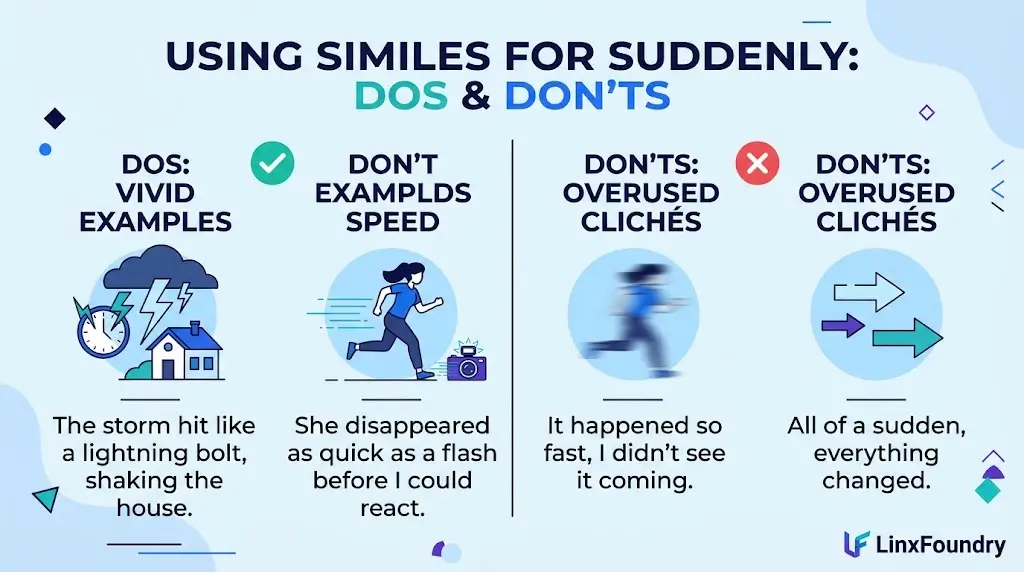
Using “like”
Use like to compare someone’s movement with another object, person, animal, or event.
- He walked like a soldier on parade.
- She walked like a leaf drifting across a pond.
- The detective walked like a cat on a quiet floor.
- The crowd walked like a wave rushing toward the shore.
Using “as”
Use as in comparisons that describe a quality or degree of movement.
- He walked as slowly as a snail.
- She walked as lightly as a feather.
- The actor walked as proudly as a peacock displaying its feathers.
- The hikers moved as steadily as a clock ticking.
Both structures can make a sentence more descriptive. However, a comparison should communicate a recognizable quality rather than merely combine two unrelated images.
7. Frequently Asked Questions
What is a good simile for walked?
A good simile for walked is “walked like a soldier on parade.” It describes someone moving with discipline, confidence, and deliberate steps. For a quieter scene, “walked like a shadow across the room” is another useful option.
What is a simile for walking slowly?
“Walked as slowly as a snail” is a simple, familiar simile for very slow movement. For a more expressive description, “walked like someone carrying a mountain” suggests that the person is struggling with exhaustion or a heavy emotional burden.
What is a creative simile for walked?
“Walked like a leaf drifting across a pond” creates a gentle, peaceful image. For a more poetic description, “walked like moonlight spreading across the floor” suggests soft, graceful movement through a quiet setting.
How do you describe someone walking confidently using a simile?
You could write, “He walked like a king entering his palace.” This comparison suggests pride, authority, and self-assurance. Alternatively, “She walked like a captain leading a ship” conveys confidence combined with direction and leadership.
What is a simile for someone walking nervously?
“She walked like someone crossing a frozen lake” is a useful comparison for nervous, cautious movement. It suggests that the person is afraid of making a mistake and carefully considers each step.
Can I use similes for walked in a poem or story?
Yes. Similes can make movement more vivid in poems, short stories, novels, and descriptive essays. Choose a comparison that suits the tone of the scene. Gentle images can create a peaceful atmosphere, while comparisons involving storms, heavy loads, or unstable surfaces can suggest tension or difficulty.

Daniel Brooks
Daniel Brooks writes about English vocabulary, synonyms, antonyms, word meanings, and everyday language. He focuses on helping students, writers, and English learners choose the right words for clear and effective communication.