Similes for contrast compare two things with noticeably different qualities, helping readers recognize differences in appearance, personality, mood, behavior, or meaning. Examples include “as different as night and day,” “like fire and ice,” and “as bright as sunshine against a stormy sky.” These comparisons make differences easier to imagine and help writers create stronger descriptions. Whether you are writing a school assignment, a poem, a story, or an essay, the right simile can turn an ordinary statement into a vivid comparison.
Quick Answer: What Are Some Similes for Contrast?
Some useful similes for contrast are “as different as night and day,” “like fire and ice,” “as quiet as a whisper beside a thunderclap,” and “like a single candle against a blazing sun.” These comparisons emphasize differences in behavior, intensity, appearance, or atmosphere. Writers can use them to make contrasting characters, settings, emotions, and ideas more memorable.
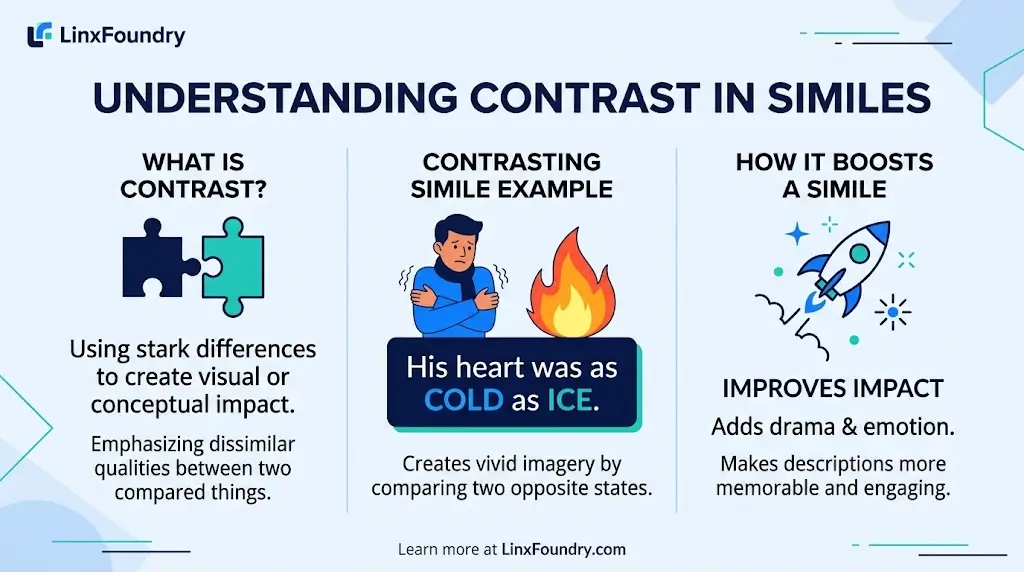
What Does Contrast Mean in a Simile?
Contrast means showing how two things differ. A simile uses words such as like or as to compare one thing with another, often highlighting a shared feature or a noticeable difference.
For example, “Her calm voice was like a quiet stream beside his roaring temper” contrasts a peaceful personality with an intense one.
A useful contrast simile does more than name two different things. It helps readers understand the nature of the difference, whether it involves light and darkness, warmth and cold, silence and noise, or confidence and uncertainty.
Best Similes for Contrast
These similes are suitable for descriptive writing, schoolwork, storytelling, and poetry. Some are familiar expressions, while others are original comparisons that you can adapt to your own writing.
1. Simple and Familiar Similes for Contrast
1. As different as night and day
Meaning: Two things are extremely different.
Example: Their approaches to solving problems were as different as night and day.
Best for: Opposing personalities, opinions, habits, or situations.
2. Like fire and ice
Meaning: Two people or things have sharply opposing qualities, such as passion and coldness.
Example: The siblings were like fire and ice: one reacted with intense emotion, while the other remained detached.
Best for: Character descriptions and emotional differences.
3. Like a candle beside a spotlight
Meaning: One thing appears much less noticeable than another.
Example: My small presentation seemed like a candle beside a spotlight when the expert began speaking.
Best for: Differences in attention, influence, or visibility.
4. Like a stream beside a raging ocean
Meaning: A gentle or limited quality contrasts with something powerful and overwhelming.
Example: His quiet response sounded like a stream beside a raging ocean of angry accusations.
Best for: Contrasting emotions, reactions, and levels of intensity.
5. Like a seedling beside an ancient tree
Meaning: One thing seems young or inexperienced beside something mature or established.
Example: Beside the veteran architect, the new designer felt like a seedling beside an ancient tree.
Best for: Differences in experience, maturity, and development.
6. Like a white cloud against a stormy sky
Meaning: Something peaceful or hopeful stands out against a troubled background.
Example: Her reassuring smile was like a white cloud against a stormy sky during the difficult meeting.
Best for: Contrasting moods, events, and circumstances.
2. Similes for Contrasting Personalities
These comparisons are useful when two characters behave differently or have opposing temperaments.
7. As quiet as a mouse beside a roaring lion
Meaning: One person is reserved while another is loud or commanding.
Example: During class discussions, Ben was as quiet as a mouse beside a roaring lion of a classmate.
8. Like a locked door beside an open window
Meaning: One person is guarded, while another is welcoming and approachable.
Example: Maya shared her feelings freely, but her brother was like a locked door beside an open window.
9. As steady as a mountain beside a flickering flame
Meaning: One person remains dependable, while another changes quickly.
Example: Her patience was as steady as a mountain beside his flickering flame of enthusiasm.
10. Like a compass beside a spinning weather vane
Meaning: One person has a clear direction, while another frequently changes their mind.
Example: The project leader was like a compass beside a spinning weather vane, keeping the team focused while everyone else reconsidered the plan.
11. As bold as a drumbeat beside a hesitant whisper
Meaning: One personality is confident and expressive, while the other is cautious and uncertain.
Example: His confident introduction was as bold as a drumbeat beside his partner’s hesitant whisper.
12. Like a mirror beside a mask
Meaning: One person is honest and transparent, while another hides their true feelings.
Example: Her sincerity made her seem like a mirror beside his carefully maintained mask.
3. Similes for Contrasting Emotions and Moods
Use these comparisons to show changes in atmosphere, emotional intensity, or the relationship between opposing feelings.
13. Like sunshine beside a shadow
Meaning: Happiness or hope contrasts with sadness or uncertainty.
Example: Her excitement was like sunshine beside a shadow of disappointment.
14. As peaceful as a sleeping garden beside a crowded marketplace
Meaning: One setting feels calm while another feels busy and noisy.
Example: The library was as peaceful as a sleeping garden beside the crowded marketplace outside.
15. Like a gentle breeze beside a winter gale
Meaning: A mild feeling or response contrasts with something harsh or forceful.
Example: His polite disagreement was like a gentle breeze beside her furious objection.
16. As bright as a festival beside a dimly lit hallway
Meaning: One experience feels lively and joyful compared with another that feels dull or gloomy.
Example: The celebration was as bright as a festival beside the dimly lit hallway of their otherwise quiet evening.
17. Like a warm hearth beside a frozen window
Meaning: Comfort and emotional warmth contrast with coldness or isolation.
Example: Their welcoming home felt like a warm hearth beside the frozen window of an unfamiliar city.
18. As calm as still water beside a storm-tossed sea
Meaning: One person or situation remains composed while another is unsettled.
Example: The mediator was as calm as still water beside the storm-tossed sea of competing arguments.
4. Creative Similes for Contrast in Descriptive Writing
These comparisons can add visual detail and stronger imagery to fiction, poetry, and descriptive paragraphs.
19. Like a silver thread across a black cloth
Meaning: A small bright feature stands out against a dark background.
Example: The moonlit river looked like a silver thread across a black cloth of forest.
20. As delicate as a feather beside a sheet of iron
Meaning: One thing is fragile compared with something heavy or strong.
Example: The old paper was as delicate as a feather beside a sheet of iron.
21. Like a single star beside a blazing constellation
Meaning: Something small or individual contrasts with a much larger display.
Example: Her modest achievement seemed like a single star beside a blazing constellation of awards.
22. As sharp as a winter wind beside a summer breeze
Meaning: One sensation is harsh and intense, while the other is gentle and pleasant.
Example: His criticism felt as sharp as a winter wind beside the summer breeze of his colleague’s encouragement.
23. Like a blank canvas beside a crowded mural
Meaning: Simplicity contrasts with complexity or abundant detail.
Example: The minimalist website looked like a blank canvas beside the competitor’s crowded mural of colors and features.
24. As weightless as mist beside a falling boulder
Meaning: Something feels light and insignificant compared with something heavy or powerful.
Example: Her brief objection seemed as weightless as mist beside the overwhelming evidence.
25. Like a whisper of dawn beside the blaze of noon
Meaning: A subtle beginning contrasts with full intensity or brilliance.
Example: The first hint of excitement was like a whisper of dawn beside the blaze of noon that followed the announcement.
5. Similes for Contrasting Ideas and Situations
These examples help explain differences in arguments, decisions, resources, or outcomes.
26. Like a handwritten note beside a printed encyclopedia
Meaning: A small amount of information contrasts with a much larger body of knowledge.
Example: My brief research notes were like a handwritten note beside a printed encyclopedia compared with the professor’s extensive references.
27. As simple as a straight line beside a tangled knot
Meaning: One solution is straightforward, while another is complicated.
Example: The revised process was as simple as a straight line beside a tangled knot of unnecessary steps.
28. Like a paper boat beside a steel ship
Meaning: Something fragile or poorly equipped contrasts with something powerful or durable.
Example: Without proper preparation, our small project seemed like a paper boat beside a steel ship competing against established companies.
29. As clear as a glass window beside a fogged mirror
Meaning: One explanation is easy to understand, while another is confusing.
Example: The teacher’s explanation was as clear as a glass window beside a fogged mirror compared with the complicated textbook passage.
30. Like a small bridge beside a vast canyon
Meaning: A limited connection or solution contrasts with a much larger divide.
Example: Their brief conversation was like a small bridge beside a vast canyon between their opposing beliefs.
Quick-Reference Table: Similes for Contrast
| Simile | Meaning | Best Used For |
|---|---|---|
| As different as night and day | Extreme difference | People and ideas |
| Like fire and ice | Opposing temperaments | Characters |
| Like a candle beside a spotlight | Unequal visibility | Achievements |
| Like a seedling beside an ancient tree | Different levels of maturity | Growth and experience |
| Like a mirror beside a mask | Honesty versus concealment | Character development |
| Like sunshine beside a shadow | Hope versus sadness | Emotional writing |
| Like a blank canvas beside a crowded mural | Simplicity versus complexity | Art and design |
| Like a paper boat beside a steel ship | Fragility versus strength | Competition |
| As clear as a glass window beside a fogged mirror | Clarity versus confusion | Explanations |
| Like a small bridge beside a vast canyon | A small connection across a large divide | Relationships and disagreements |
How to Use Similes for Contrast in Writing
The best contrast simile depends on the difference you want readers to notice. Choose a comparison that reflects the specific qualities of your subject rather than selecting two things merely because they are opposites.
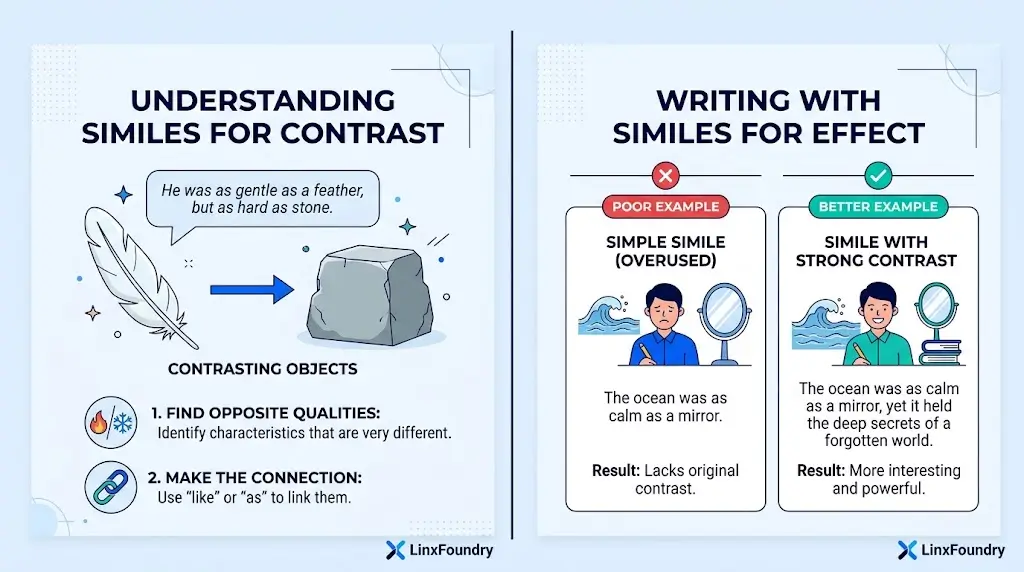
1. In Stories and Character Descriptions
Contrast can make fictional characters more distinct.
Plain sentence: Lena was confident, but her brother was shy.
Improved sentence: Lena was as bold as a drumbeat beside her brother’s hesitant whisper.
The revised sentence gives readers an audible image of their different personalities.
2. In Poems and Descriptive Paragraphs
Poetry often benefits from comparisons that create a strong visual or emotional image.
Plain sentence: A bright moon appeared above the dark forest.
Improved sentence: The moon shone like a silver thread across a black cloth of forest.
The second version emphasizes the contrast between the moonlight and the surrounding darkness.
3. In Essays and Academic Writing
Use clear, restrained comparisons when explaining opposing concepts. Avoid elaborate imagery if it distracts from your argument.
Plain sentence: The two methods differed greatly in complexity.
Improved sentence: The first method was as simple as a straight line beside a tangled knot.
This comparison makes the difference easier to visualize, although a direct explanation may be preferable in a formal research paper.
4. In Speeches and Presentations
A concise simile can help an audience remember a difference.
Plain sentence: The old process was confusing, but the new process was straightforward.
Improved sentence: The old process was like a tangled knot beside the straight line of the new system.
The comparison makes the benefit of the new process more concrete.
Using “Like” and “As” to Show Contrast
Both structures can introduce similes, but they work slightly differently in a sentence.
Similes Using “Like”
- Her patience was like a quiet lake beside a restless sea.
- The tiny cottage looked like a candle beside a mountain.
- His brief explanation was like a sketch beside a detailed portrait.
These examples compare one thing with another to highlight a difference in calmness, scale, or detail.
Similes Using “As”
- She was as composed as still water beside his stormy temper.
- The new design was as simple as a straight line beside the old design’s tangled knot.
- The room felt as bright as morning beside the gloomy corridor.
When writing your own similes, make sure the comparison sounds natural. You do not need to use both structures in every paragraph.
How to Create Your Own Contrast Similes
You can develop original comparisons by following three simple steps.
- Identify the difference. Decide whether you want to compare size, strength, mood, personality, complexity, or another quality.
- Choose recognizable images. Select two things that make the difference easy to picture, such as a candle and a spotlight.
- Build a natural comparison. Connect the images using like or as and place the simile in a sentence.
For example, suppose you want to describe two different approaches to leadership. One leader gives clear instructions, while the other constantly changes direction.
You might write: The first leader was like a compass beside a spinning weather vane.
The comparison works because both objects suggest direction, but one is dependable while the other changes with the wind.
A useful test is to ask yourself whether readers can understand the exact difference you intend to show. If the connection is unclear, choose a more familiar image.
Frequently Asked Questions
1. What Is a Good Simile for Contrast?
“As different as night and day” is a strong, familiar choice for describing two things that differ greatly. For a more creative option, try “like a candle beside a spotlight” when one thing appears much less noticeable than another.
2. What Is a Powerful Simile for Contrast?
“Like a paper boat beside a steel ship” is a powerful comparison for highlighting fragility against strength. It works particularly well when describing unequal resources, preparation, or competitive ability.
3. What Is a Simple Simile for Contrast for Students?
“Like fire and ice” is easy to understand and remember. It can describe people with opposite personalities or situations that differ in emotional intensity.
4. Can a Simile Compare Opposite Things?
Yes. A simile can highlight opposing qualities, such as warmth and coldness or calmness and anger. For example, “Her voice was like a gentle breeze beside a winter gale” contrasts a mild response with a harsh one.
5. What Is the Difference Between a Contrast Simile and a Metaphor?
A simile makes a comparison using words such as like or as, as in “His temper was like a storm.” A metaphor describes something directly as another thing, as in “His temper was a storm.” Both can emphasize differences, but they express the comparison differently.
6. How Can I Use Contrast Similes in Poetry?
Choose images that reinforce the poem’s mood and meaning. For example, “like a whisper of dawn beside the blaze of noon” can suggest a quiet beginning followed by overwhelming intensity. Keep the comparison relevant to the poem’s central idea.
7. Are All Comparisons Between Opposites Similes?
No. A comparison between opposites is not automatically a simile. To qualify as a simile, the expression must make a comparison, typically using like or as. A phrase such as “hot and cold” simply names contrasting qualities unless it forms part of a simile.
Practice: Test Your Understanding
- Which simile best describes two people with completely different personalities?
- What does “like a paper boat beside a steel ship” suggest?
- Complete the simile: “Her calm response was like a quiet lake beside a _____.”
- Rewrite this sentence using a contrast simile: “The old website was complicated, but the new website was simple.”
- Create your own simile comparing a small light with a much brighter light.
Practice Answers
- “As different as night and day” or “like fire and ice,” depending on the personalities.
- It suggests a contrast between fragility and strength.
- “Restless sea” is one suitable answer.
- Example: “The old website was like a tangled knot beside the straight line of the new design.”
- Example: “The candle looked like a firefly beside a stadium floodlight.”
Final Thoughts
Similes for contrast help writers make differences visible, memorable, and meaningful. Whether you are describing opposing personalities, contrasting settings, competing ideas, or changes in emotion, choose images that reveal the specific quality you want readers to notice. Familiar comparisons such as “as different as night and day” work well when clarity matters, while more imaginative expressions can create stronger imagery in stories and poems. To create your own, identify the difference first, choose two recognizable images, and connect them naturally. The most effective simile is not necessarily the most elaborate; it is the one that communicates the contrast clearly.

Emily Carter
Emily Carter specializes in word choice, writing clarity, vocabulary development, and practical English usage. Her articles explain similar words, highlight differences in meaning, and provide examples to help readers communicate more naturally and confidently.