Similes for a forest help readers imagine towering trees, tangled branches, whispering leaves, and mysterious paths hidden beneath a thick canopy. A forest can feel as peaceful as a sleeping child, as dark as a moonless night, or as crowded as a city filled with people. The right comparison turns an ordinary description into a vivid picture.
This collection features 35 similes for a forest, complete with meanings and example sentences. You will find simple comparisons for school assignments, imaginative descriptions for stories, and atmospheric phrases for poetry. Whether you want to describe a bright woodland on a summer morning or a shadowy forest in a fantasy adventure, these examples can help you find the right words.
What Is a Simile for a Forest?
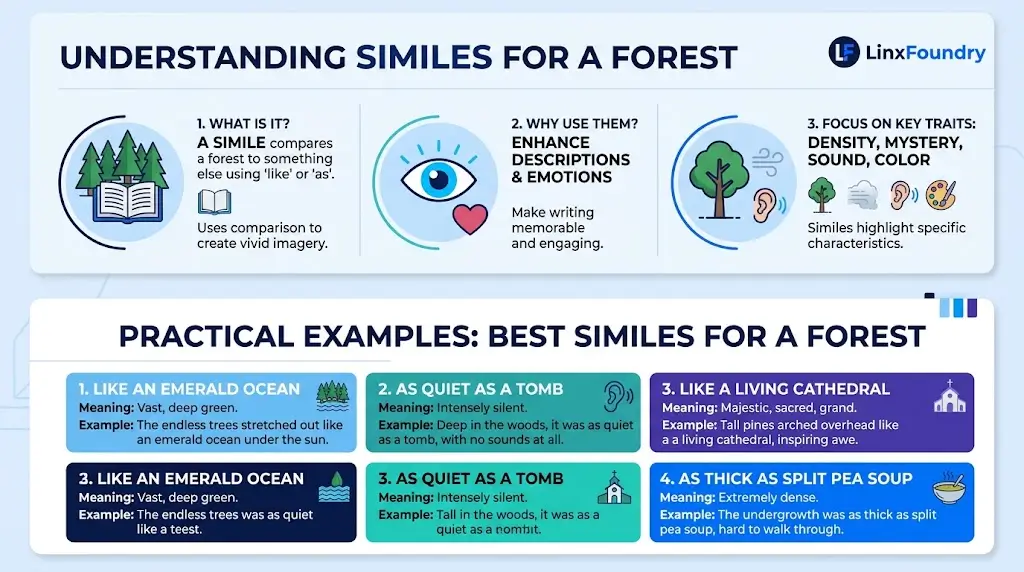
A simile for a forest compares a forest or one of its features to something different using words such as like or as. It helps readers picture the setting by connecting trees, sounds, shadows, and natural surroundings to familiar images.
For example, “The forest stood like a green cathedral” compares the tall trees to the pillars and high ceilings of a cathedral. This comparison emphasizes the forest’s height, grandeur, and peaceful atmosphere.
35 Best Similes for a Forest With Meanings and Examples
These forest similes cover different moods and settings. Some emphasize beauty and calmness, while others capture darkness, mystery, and the wild energy of nature.
Beautiful and Peaceful Similes for a Forest
Use these comparisons for gentle woodland scenes, nature essays, and peaceful descriptions.
1. A forest like a green cathedral
Meaning: A forest with tall trees and a grand, peaceful atmosphere.
Why it works: The trees resemble towering pillars, while the canopy creates a high ceiling of leaves.
Example: Sunlight filtered through the branches, making the forest look like a green cathedral.
2. A forest like a sea of green
Meaning: A vast area of trees that stretches across the landscape.
Why it works: The tops of countless trees resemble waves spreading across a green sea.
Example: From the hillside, the forest looked like a sea of green rolling toward the horizon.
3. A forest as peaceful as a sleeping child
Meaning: A quiet forest that feels gentle and undisturbed.
Why it works: The comparison suggests stillness, softness, and a sense of safety.
Example: At dawn, the forest was as peaceful as a sleeping child, with barely a leaf moving.
4. A forest like a painted landscape
Meaning: A forest so colorful and beautiful that it resembles a painting.
Why it works: It highlights the arrangement of colors, light, and natural scenery.
Example: The autumn forest looked like a painted landscape, with golden leaves scattered among red and orange trees.
5. A forest as refreshing as a cool breeze
Meaning: A forest that offers relief from heat, noise, or the stress of everyday life.
Why it works: The comparison connects the experience of entering a woodland with the comfort of cool, fresh air.
Example: After hours in the busy city, the shaded forest felt as refreshing as a cool breeze.
6. A forest like a green blanket over the hills
Meaning: A thick covering of trees spreading across hillsides.
Why it works: A blanket suggests coverage, softness, and continuity.
Example: From the airplane window, the forest lay like a green blanket over the rolling hills.
7. A forest as magical as a fairy tale
Meaning: A woodland that feels enchanted, wonderful, or full of possibility.
Why it works: The comparison creates an atmosphere associated with magical stories and imaginary worlds.
Example: With tiny flowers along the path and golden light between the trees, the forest seemed as magical as a fairy tale.
8. A forest like a living painting
Meaning: A forest filled with natural colors, textures, and changing scenery.
Why it works: Unlike a still picture, a living painting suggests that the scene changes as birds fly and leaves move.
Example: Butterflies drifted between the flowers, and the forest looked like a living painting.
Mysterious and Dark Similes for a Forest
These similes suit suspenseful stories, fantasy adventures, and scenes where the forest feels unfamiliar.
9. A forest as dark as a moonless night
Meaning: A forest with very little visible light.
Why it works: A moonless night is a familiar image of darkness and limited visibility.
Example: Without a flashlight, the forest was as dark as a moonless night.
10. A forest like a maze of shadows
Meaning: A forest where trees, branches, and patches of darkness make the way difficult to follow.
Why it works: A maze suggests confusion, winding routes, and uncertainty.
Example: The narrow trail disappeared into a maze of shadows as the sun sank behind the trees.
11. A forest like a sleeping giant
Meaning: A vast, powerful forest that appears still and imposing.
Why it works: A giant suggests enormous size and hidden strength, while sleeping suggests quietness.
Example: Beneath the gray morning sky, the ancient forest lay like a sleeping giant.
12. A forest as silent as an empty church
Meaning: A forest that feels unusually quiet and solemn.
Why it works: An empty church evokes stillness and an atmosphere of reverence.
Example: After the birds stopped calling, the forest became as silent as an empty church.
13. A forest like a maze of tangled threads
Meaning: A dense woodland filled with crossing branches, vines, and confusing paths.
Why it works: Tangled threads suggest a complicated network that is difficult to untangle.
Example: Beyond the old trail, the undergrowth spread like a maze of tangled threads.
14. A forest as mysterious as a locked door
Meaning: A forest that hides secrets and makes visitors curious about what lies beyond.
Why it works: A locked door represents something concealed that cannot easily be explored.
Example: The unexplored woodland seemed as mysterious as a locked door waiting for the right key.
15. A forest like a sea of shadows
Meaning: A dark woodland where shadows spread between the trees.
Why it works: The image of a sea suggests that the shadows cover a wide area.
Example: As evening approached, the forest became a sea of shadows beneath the fading sky.
16. A forest as watchful as a guard
Meaning: A forest that seems to observe everyone who enters it.
Why it works: The comparison creates suspense by making the surrounding trees feel imposing and alert.
Example: He walked carefully beneath the branches, feeling that the forest was as watchful as a guard.
Similes for the Sounds and Movement of a Forest
Use these comparisons to make nature descriptions more active and sensory.
17. Leaves whispering like old friends
Meaning: Leaves rustling softly in the breeze.
Why it works: Quiet conversation creates a gentle, familiar image for the sound of moving leaves.
Example: Above the narrow path, the leaves whispered like old friends sharing a secret.
18. Branches swaying like dancers
Meaning: Tree branches moving gracefully in the wind.
Why it works: Dancers suggest rhythm, fluid movement, and coordination.
Example: The tall branches swayed like dancers beneath the afternoon breeze.
19. Birds singing like a morning choir
Meaning: Several birds calling and singing together.
Why it works: A choir suggests a collection of voices blending into a lively sound.
Example: At sunrise, the birds sang like a morning choir throughout the forest.
20. A stream running like a silver ribbon
Meaning: A narrow stream winding through the woodland.
Why it works: A ribbon suggests a long, graceful line, while silver evokes the water’s reflected light.
Example: A clear stream ran like a silver ribbon between moss-covered stones.
21. Wind moving through the trees like waves across water
Meaning: Wind passing through a forest in rolling, visible movements.
Why it works: Waves provide a familiar way to imagine a continuous motion traveling across a surface.
Example: The treetops bent in sequence as the wind moved through the forest like waves across water.
22. Falling leaves like drifting boats
Meaning: Leaves floating slowly toward the ground.
Why it works: Small boats suggest gentle drifting and a lack of control over the direction of movement.
Example: Golden leaves floated from the branches like drifting boats on an invisible current.
23. Raindrops tapping like tiny drums
Meaning: Rain striking leaves, branches, or the forest floor.
Why it works: The comparison emphasizes the repeated, rhythmic sound of rainfall.
Example: During the storm, raindrops tapped against the broad leaves like tiny drums.
24. Tree trunks standing like rows of pillars
Meaning: Trees growing upright in a way that creates a tall, structured appearance.
Why it works: Pillars emphasize height, strength, and the vertical arrangement of trunks.
Example: The old trees stood like rows of pillars, supporting a roof of interlocking branches.
Creative and Powerful Similes for a Forest
These comparisons are useful for descriptive essays, fantasy settings, and more imaginative prose.
25. A forest like a natural fortress
Meaning: A dense woodland that seems difficult to enter or cross.
Why it works: A fortress suggests protection, strength, and barriers.
Example: Thick thorny bushes surrounded the forest like a natural fortress.
26. A forest as old as a forgotten kingdom
Meaning: A forest that appears ancient and filled with history.
Why it works: A forgotten kingdom suggests age, lost stories, and traces of a distant past.
Example: Beneath the twisted branches, the woodland felt as old as a forgotten kingdom.
27. A forest like a green ocean swallowing the road
Meaning: Trees and vegetation appearing to surround and hide a road.
Why it works: An ocean suggests something vast that can engulf smaller objects.
Example: Beyond the last village, a green ocean of trees seemed to swallow the road.
28. A forest as wild as a rushing river
Meaning: A forest that feels untamed, energetic, and full of movement.
Why it works: A rushing river conveys force and restless motion.
Example: With branches bending and leaves swirling, the forest seemed as wild as a rushing river.
29. A forest like a library of ancient stories
Meaning: A woodland that seems to contain countless untold histories.
Why it works: A library symbolizes accumulated knowledge, while the forest’s old trees suggest the passage of time.
Example: Each weathered trunk stood like a page in a library of ancient stories.
30. A forest as endless as the open sea
Meaning: A forest that appears to continue far beyond what the eye can see.
Why it works: The open sea is a familiar image of immense distance and scale.
Example: From the mountain ridge, the forest looked as endless as the open sea.
31. A forest like a tangled green web
Meaning: A dense woodland where branches, vines, and plants overlap.
Why it works: A web suggests an interconnected network with many crossing lines.
Example: Vines stretched between the trunks like a tangled green web.
32. A forest as bright as a field of stars
Meaning: A forest filled with scattered points of light, such as sunlight shining through the canopy or fireflies glowing at dusk.
Why it works: Stars suggest many small lights spread across a dark background.
Example: At twilight, fireflies flickered between the trees, making the forest as bright as a field of stars.
33. A forest like a giant green umbrella
Meaning: A woodland whose leafy canopy provides shade beneath it.
Why it works: An umbrella provides a clear image of overhead cover.
Example: The thick canopy spread over the trail like a giant green umbrella.
34. A forest as lively as a busy marketplace
Meaning: A forest full of animal calls, insect sounds, bird activity, and movement.
Why it works: A busy marketplace evokes a place where many different activities happen at once.
Example: At sunrise, the forest was as lively as a busy marketplace, with birds calling and squirrels darting between the trees.
35. A forest like a world hidden inside another world
Meaning: A forest that feels separate from ordinary life, with its own sights, sounds, and discoveries.
Why it works: The comparison captures the sense of entering a distinct environment when stepping away from familiar surroundings.
Example: Once she crossed the old wooden bridge, the forest felt like a world hidden inside another world.
Quick-Reference Table: Forest Similes and Their Meanings
| Simile | Meaning | Best used for |
|---|---|---|
| Like a green cathedral | Grand and peaceful | Nature essays |
| Like a sea of green | Vast and expansive | Landscape descriptions |
| As dark as a moonless night | Very dark | Suspense and horror |
| Like a maze of shadows | Confusing and mysterious | Adventure stories |
| Like a sleeping giant | Huge and still | Fantasy writing |
| Like a morning choir | Full of birdsong | Morning scenes |
| Like dancers in the wind | Graceful movement | Poetry |
| Like a natural fortress | Dense and difficult to enter | Adventure fiction |
| Like a library of ancient stories | Rich with imagined history | Fantasy and descriptive prose |
| Like a giant green umbrella | Shady and sheltered | Simple descriptions |
How to Use Forest Similes in Creative Writing
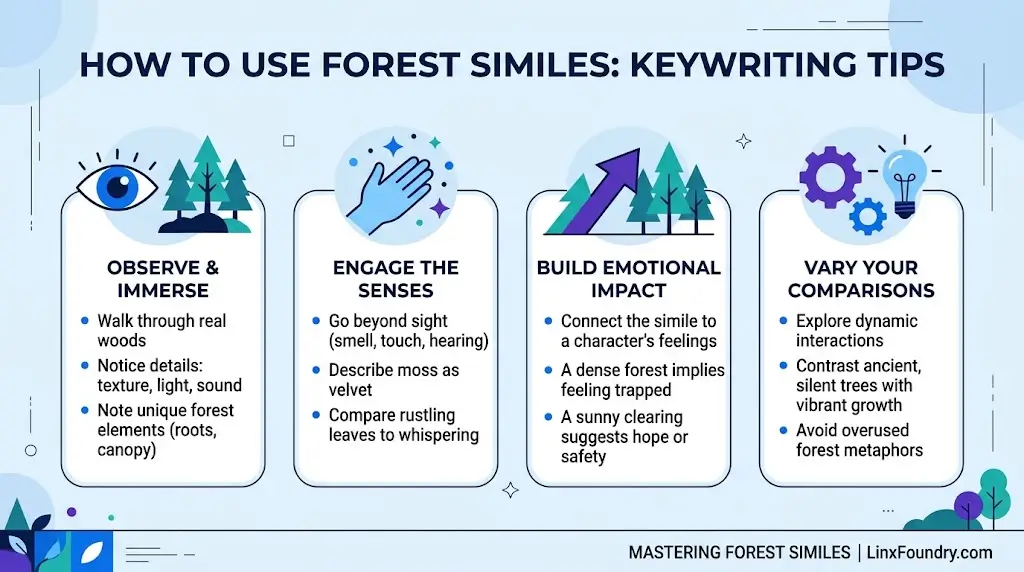
A strong forest simile does more than describe trees. It helps establish the mood, guide the reader’s imagination, and make a setting feel real.
1. Choose a simile that matches the mood
The same forest can feel welcoming or threatening depending on the comparison you choose.
- Peaceful: The forest rested like a sleeping child beneath the morning sun.
- Mysterious: The trees rose like silent guards along the winding path.
- Frightening: The forest stretched ahead like a maze of shadows.
- Magical: The woodland shimmered like a hidden kingdom beneath the stars.
Choose a comparison that supports the emotion you want readers to experience.
2. Describe one clear feature at a time
Avoid combining too many unrelated comparisons in a single sentence. Focus on a specific feature, such as the canopy, sound, light, or density of the trees.
Weak: The forest was like an ocean, a castle, a blanket, and a giant.
Better: The forest spread across the valley like a sea of green.
The improved sentence gives readers one clear image to picture.
3. Combine similes with sensory details
A simile becomes more effective when it works alongside other descriptive details.
For example:
The forest was as silent as an empty church. Damp leaves covered the path, and a cool breeze carried the scent of wet earth.
The simile establishes the mood, while the physical details help readers imagine the scene.
4. Adapt the comparison to your writing purpose
| Writing purpose | Useful approach | Example |
|---|---|---|
| School essay | Clear and direct | The forest looked like a green blanket over the hills. |
| Fantasy story | Mysterious and imaginative | The forest stood like a sleeping giant beneath the mist. |
| Nature poem | Musical and sensory | Leaves whispered like old friends. |
| Adventure story | Suggest danger or uncertainty | The trail wound through a maze of shadows. |
| Children’s story | Familiar and memorable | The treetops waved like dancers in the wind. |
5. Create your own forest similes
You can develop original comparisons by observing the forest’s features and connecting them to familiar objects or experiences.
Try this simple method:
- Choose a feature, such as tall trees, rustling leaves, tangled vines, or moving shadows.
- Think of something with a similar appearance, sound, movement, or feeling.
- Connect the two using like or as.
- Read the sentence aloud to check whether the image feels natural.
For example, if the treetops bend in a strong wind, you might write, “The treetops bowed like a crowd greeting a king.”
The comparison creates a clear image of coordinated movement without needing a long explanation.
Simple Similes for a Forest for Kids
Children often benefit from familiar comparisons that are easy to picture.
- A forest like a green blanket: The trees covered the hills like a green blanket.
- Trees like tall towers: The trees stood like tall towers above the path.
- Leaves like tiny boats: The leaves floated down like tiny boats.
- Birds like a choir: The birds sang like a cheerful choir.
- Branches like dancing arms: The branches moved like dancing arms in the wind.
- A forest like a giant garden: We explored the forest like a giant garden full of surprises.
These examples use recognizable objects and movements, making them suitable for elementary writing activities and descriptive paragraphs.
7. FAQ Section
What is a good simile for a forest?
A good simile for a forest is “The forest spread like a sea of green across the hills.” It conveys the woodland’s size and creates a vivid picture of trees stretching into the distance. For a peaceful scene, “a green cathedral” is another effective choice.
What is a creative simile for a dark forest?
A creative simile for a dark forest is “The forest twisted like a maze of shadows beneath the moonless sky.” It suggests confusing paths, limited visibility, and an atmosphere of uncertainty, making it useful for suspense and fantasy stories.
How do you describe a forest using a simile?
Choose one noticeable feature of the forest and compare it to something familiar. For example, you could describe tall trees as pillars, a leafy canopy as an umbrella, or the sound of birds as a choir. Use a comparison that matches the mood of your scene.
What is a simile for a peaceful forest?
“A forest as peaceful as a sleeping child” describes a quiet woodland with a gentle atmosphere. You could also write, “The forest rested like a quiet garden at dawn.” Both comparisons emphasize calmness rather than danger or excitement.
What is a simile for a mysterious forest?
“A forest as mysterious as a locked door” suggests a place hiding secrets and inviting exploration. Another option is “The forest stood like a sleeping giant,” which emphasizes its size, stillness, and the possibility of hidden power.
Can I use forest similes in poems and stories?
Yes. Forest similes work well in poems, short stories, fantasy novels, school essays, and descriptive writing. Poets may favor musical images, while fiction writers may choose comparisons that build atmosphere, establish a setting, or hint at danger.
What is the difference between a forest simile and a forest metaphor?
A simile makes a comparison using words such as like or as, as in “The forest was like a green ocean.” A metaphor makes a direct comparison, as in “The forest was a green ocean.” Both create imagery, but they express the comparison differently.

Emily Carter
Emily Carter specializes in word choice, writing clarity, vocabulary development, and practical English usage. Her articles explain similar words, highlight differences in meaning, and provide examples to help readers communicate more naturally and confidently.