Looking for similes for believe? You can describe belief by comparing it to a seed taking root, a light shining through darkness, or an anchor holding firm during a storm. These comparisons help readers understand what it feels like to trust someone, have faith in an idea, or remain confident when doubts arise. Although believe is an action or state of mind rather than a physical object, imaginative comparisons can make it easier to describe. Below, you’ll find simple and creative similes, their meanings, and example sentences to help you express belief naturally in stories, poems, essays, and everyday writing.
Quick Answer: What Is a Simile for Believe?
A simile for believe compares believing or having faith to something familiar using like or as. For example, “Her belief was like a seed taking root in the soil” suggests that her confidence gradually became stronger. Other useful comparisons include belief like an anchor in a storm, trust like a bridge between people, and faith like a light in the darkness.
What Does Believe Mean in Figurative Language?
To believe means to accept something as true, trust someone, or have confidence in an idea or possibility. In figurative language, belief can be compared to objects, natural processes, or experiences that communicate certainty, hope, trust, or uncertainty.
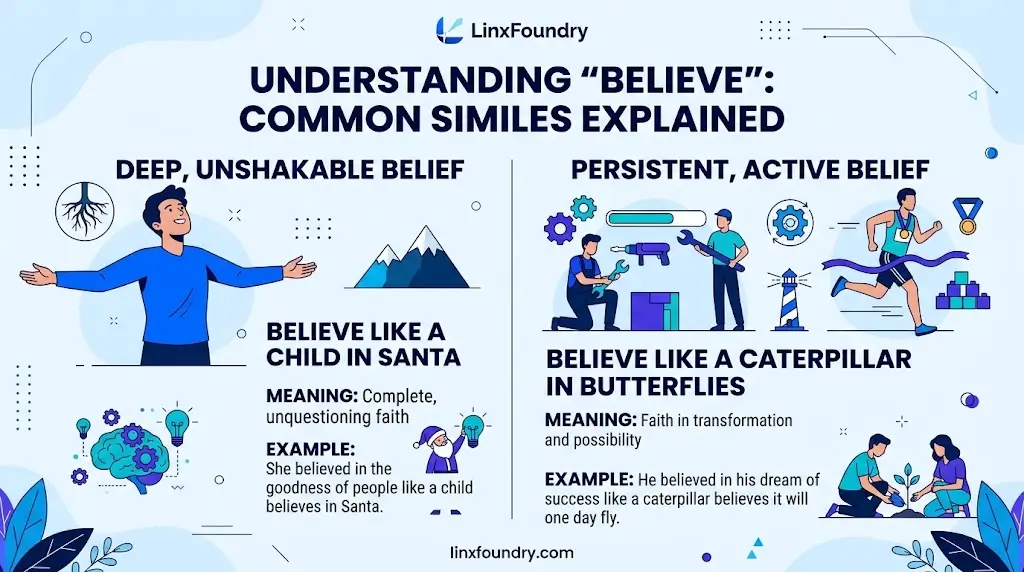
For example, comparing belief to an anchor suggests stability. Comparing it to a growing seed suggests that confidence develops over time.
A simile uses like or as to make a comparison between different things. The comparison does not need to be literally true; it needs to create a clear and meaningful image.
20 Best Similes for Believe With Meanings and Examples
These similes explore different kinds of belief, from quiet confidence to strong faith and uncertain trust.
1. Believe Like a Seed Taking Root
Meaning: To develop a belief gradually until it becomes firmly established.
Why it works: A seed begins small but grows stronger as its roots spread. Similarly, an idea can become more convincing over time.
Example: Her belief in his honesty grew like a seed taking root in fertile soil.
2. Believe Like an Anchor in a Storm
Meaning: To hold firmly to a belief despite difficulties or challenges.
Why it works: An anchor helps keep a boat steady in rough water, just as a strong conviction can provide stability during uncertain times.
Example: He held on to his belief like an anchor in a storm, even when everyone around him disagreed.
3. Believe Like a Light in the Darkness
Meaning: To maintain hope or confidence when circumstances seem uncertain.
Why it works: Light helps people see through darkness. Likewise, belief can give someone direction when the future is unclear.
Example: Her belief in a better future shone like a light in the darkness.
4. Believe Like a Bridge Across a River
Meaning: To trust enough to connect with another person or accept a different perspective.
Why it works: A bridge connects two sides that would otherwise remain separated.
Example: Their shared belief became like a bridge across a river, bringing two communities closer together.
5. Believe Like a Mountain Standing Tall
Meaning: To maintain a strong, unwavering conviction.
Why it works: Mountains suggest strength, endurance, and resistance to change.
Example: She believed in her principles like a mountain standing tall against the wind.
6. Believe Like Rain Feeding the Earth
Meaning: To nurture hope or confidence so that it can grow.
Why it works: Rain nourishes plants and supports new growth. In the same way, encouraging words and positive experiences can strengthen belief.
Example: His teacher’s encouragement strengthened his belief in himself like rain feeding the earth.
7. Believe Like a Compass Pointing North
Meaning: To follow a clear conviction that provides direction.
Why it works: A compass helps travelers find their way, just as deeply held values can guide decisions.
Example: Her belief in fairness guided every decision like a compass pointing north.
8. Believe Like a Flame That Refuses to Die
Meaning: To continue believing even when faced with repeated setbacks.
Why it works: A persistent flame represents determination and hope that survive difficult conditions.
Example: His belief in his dream burned like a flame that refused to die.
9. Believe Like Roots Holding a Tree
Meaning: To have a deep and stable belief that supports a person’s actions.
Why it works: Roots anchor a tree and help it remain upright. Strong convictions can similarly shape someone’s choices.
Example: Her belief in honesty ran deep like roots holding an ancient tree.
10. Believe Like a River Finding Its Way
Meaning: To develop confidence gradually while moving through uncertainty.
Why it works: A river continues along its course, adjusting to the landscape. Belief can also develop as people learn from experience.
Example: His belief in the project grew like a river finding its way through unfamiliar land.
11. Believe Like a Lock Clicking Into Place
Meaning: To become suddenly convinced that something is true.
Why it works: The sound of a lock clicking suggests that something has finally fitted together.
Example: When she saw the final piece of evidence, her belief settled into place like a lock clicking shut.
12. Believe Like the Sun Rising Each Morning
Meaning: To trust something with a strong sense of certainty.
Why it works: The sunrise is a familiar and dependable natural event, making it a useful image for confidence.
Example: He believed his friend would keep her promise like the sun rising each morning.
13. Believe Like a Candle Guarded From the Wind
Meaning: To protect a fragile belief from outside pressure.
Why it works: A candle can easily go out when exposed to strong wind. The image suggests that belief sometimes needs care and protection.
Example: She guarded her belief in the team’s ability like a candle sheltered from the wind.
14. Believe Like a Puzzle Coming Together
Meaning: To gradually accept an explanation as different facts become clear.
Why it works: Individual puzzle pieces make sense when they fit together into a complete picture.
Example: As the evidence emerged, he began to believe the explanation like a puzzle coming together.
15. Believe Like a Star Guiding a Traveler
Meaning: To rely on a conviction for direction during uncertain times.
Why it works: A guiding star represents a point of reference when the way forward is difficult to see.
Example: Her belief in doing what was right guided her like a star leading a traveler through the night.
16. Believe Like Ice Beneath Your Feet
Meaning: To hold a belief that feels uncertain or potentially unreliable.
Why it works: Ice can appear solid but may be slippery or fragile. The comparison communicates insecurity and doubt.
Example: After discovering the contradiction, his belief in the story felt like ice beneath his feet.
17. Believe Like a Door Slowly Opening
Meaning: To become increasingly willing to accept a new idea.
Why it works: An opening door represents access to a new possibility or perspective.
Example: After listening to her explanation, he began to believe her like a door slowly opening to the morning light.
18. Believe Like a Bell Ringing Clearly
Meaning: To express a conviction with clarity and confidence.
Why it works: A clear bell sound is easy to recognize, making it a useful image for certainty that leaves little room for confusion.
Example: She spoke about her belief in equal opportunity like a bell ringing clearly across a quiet hall.
19. Believe Like a Thread Holding Fabric Together
Meaning: To have a belief that connects people or holds a shared purpose together.
Why it works: Threads keep pieces of fabric connected. Shared beliefs can similarly strengthen relationships and communities.
Example: Their belief in helping others held the group together like a thread stitching pieces of fabric into one whole.
20. Believe Like a Seed Reaching for the Sun
Meaning: To maintain hope and keep moving toward a possibility despite uncertainty.
Why it works: A growing seed reaches toward light, suggesting optimism, effort, and the desire for something better.
Example: She believed in her future like a seed reaching for the sun, even when progress seemed slow.
Simple Similes for Believe
If you need an easy comparison for a school assignment or a short piece of writing, these options are straightforward and memorable.
| Simile | Meaning | Best Used For |
|---|---|---|
| Believe like a seed growing | Belief develops over time | Learning and personal growth |
| Believe like a rock standing firm | Strong conviction | Determination |
| Believe like a light in the dark | Hope during uncertainty | Stories and speeches |
| Believe like a compass finding north | Clear direction | Values and decisions |
| Believe like a door opening | Becoming receptive to an idea | Changing opinions |
These comparisons are especially useful when you want to explain belief without using complicated vocabulary.
Creative Similes for Believe
Creative similes work best when they match the situation and the feeling you want to communicate. Consider these more imaginative alternatives.
- Believe like a lighthouse guiding ships through fog: To trust a source of guidance when the way ahead is unclear.
- Believe like a drumbeat beneath a marching crowd: To maintain a steady conviction that motivates action.
- Believe like a thread of gold through a dark tapestry: To preserve hope within a difficult experience.
- Believe like a key turning in a hidden lock: To accept an idea that suddenly makes sense.
- Believe like a tree bending without breaking: To keep faith while adapting to challenges.
- Believe like an ember glowing beneath the ashes: To retain a small amount of hope when confidence seems almost lost.
For creative writing, choose an image that fits the scene. A lighthouse may suit a story about guidance, while an ember may better express a belief that survives disappointment.
Positive Similes for Believe
Positive similes communicate confidence, trust, and hope. They are useful for motivational writing, personal reflections, speeches, and encouraging messages.
- Believe like sunshine breaking through clouds: To regain hope after a difficult period.
- Believe like a strong tree reaching toward the sky: To trust in your potential for growth.
- Believe like a river flowing toward the sea: To remain confident about a long-term goal.
- Believe like a garden blooming in spring: To expect growth after patience and effort.
- Believe like a steady heartbeat: To hold a quiet, dependable confidence.
Example sentence: She believed in her ability to succeed like sunshine breaking through the clouds after a long storm.
These comparisons emphasize hope without suggesting that confidence guarantees success.
Similes for Doubt and Uncertain Belief
Belief is not always strong. Sometimes people question an explanation, struggle to trust someone, or feel uncertain about what they once accepted as true.
These similes help express that uncertainty.
- Believe like a shadow fading at sunset: To feel a belief gradually weakening.
- Believe like a bridge covered in mist: To be unsure whether a connection or explanation is reliable.
- Believe like a candle flickering in a draft: To have a conviction that is easily shaken.
- Believe like footprints disappearing in sand: To feel confidence fading as evidence changes.
- Believe like a reflection rippling on water: To struggle to distinguish what is real from what merely appears true.
Example sentence: After hearing the conflicting accounts, her belief in the rumor flickered like a candle in a draft.
Use these expressions when the scene requires hesitation rather than certainty. They can make a character’s changing thoughts easier for readers to understand.
Similes for Believe in Stories, Poems, and Essays
A simile should fit the type of writing you’re producing. The same comparison can feel powerful in a poem but overly dramatic in a formal essay.
In stories
Use a concrete image to show how a character’s beliefs change.
At first, Daniel doubted every promise, but his trust grew like a seed taking root.
In poetry
Choose an image that creates atmosphere or emotional depth.
Her faith glowed like an ember beneath the ashes of yesterday.
In essays
Prefer clear comparisons that explain an argument without distracting from it.
Public confidence in the proposal grew like a bridge connecting two previously divided groups.
In speeches
Choose memorable images that an audience can understand immediately.
Believe in your ability like a lighthouse standing firm against the waves.
In personal writing
Use gentle, honest comparisons that reflect your own experience.
My confidence returned like sunlight entering a room after a storm.
How to Choose the Right Simile for Believe
The best simile depends on what you mean by believe. The word can describe trust in another person, certainty about a fact, confidence in yourself, or hope for the future.
Use these guidelines when selecting a comparison:
- For strong conviction: Choose a mountain, anchor, or deeply rooted tree.
- For growing belief: Choose a seed, river, or opening door.
- For trust between people: Choose a bridge or a thread connecting pieces of fabric.
- For hope: Choose a sunrise, lighthouse, or light in darkness.
- For doubt: Choose flickering candles, mist, or unstable ice.
- For sudden understanding: Choose a puzzle coming together or a lock clicking into place.
Avoid choosing a comparison only because it sounds poetic. Make sure the image reflects the character’s feelings, the evidence available, or the message you want readers to understand.
Using “Like” and “As” in Similes About Belief
Similes commonly use like or as to connect two different things. Both structures can work when describing belief, but the sentence must remain natural.
Using “like”
The word like introduces a comparison.
- Her belief grew like a seed taking root.
- He trusted the promise like a traveler trusting a compass.
- Their shared conviction held firm like an anchor in rough water.
Using “as”
The word as often appears in the structure as + adjective + as.
- Her belief was as steady as a mountain.
- His confidence was as fragile as thin ice.
- Their trust was as bright as a lamp in a dark room.
Notice the difference between comparing an action and describing a quality. “She believed like a traveler following a compass” describes how she acted, while “Her belief was as steady as a mountain” describes the strength of her conviction.
Common Mistakes When Writing Similes for Believe
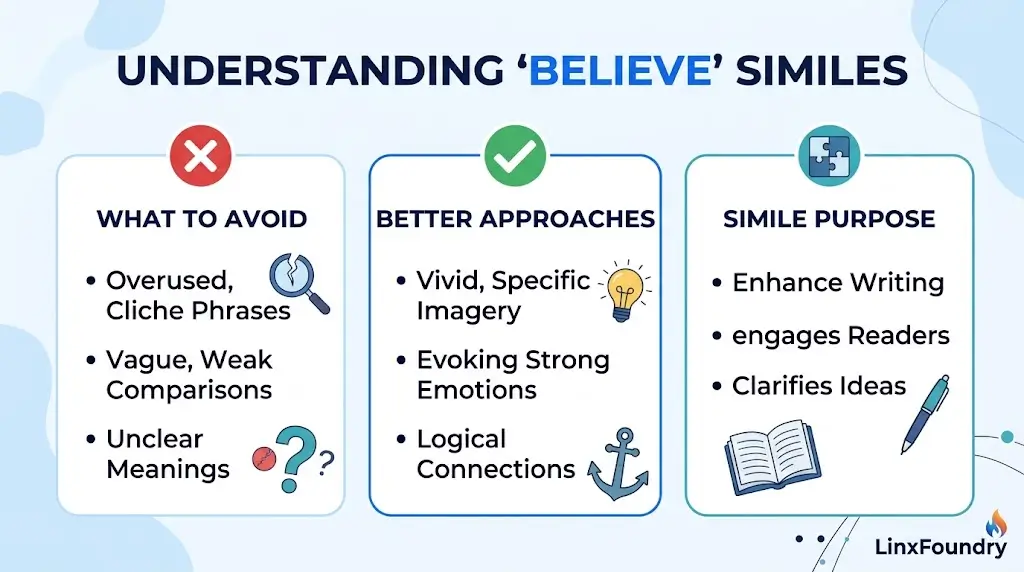
A useful simile should clarify an idea rather than make the sentence harder to understand.
1. Choosing an unrelated comparison
A comparison should have a clear connection to belief. An anchor suggests stability, but an unrelated object may not communicate anything meaningful about trust or conviction.
2. Making every belief sound positive
Not every belief is reliable or beneficial. Sometimes a person believes a false claim or trusts someone who has been dishonest. Include uncertainty when the context requires it.
3. Overloading a sentence with imagery
One clear comparison is often stronger than several competing images.
Instead of: Her belief was like a lighthouse, a mountain, a river, and a burning flame.
Write: Her belief stood firm like a lighthouse in a storm.
4. Confusing similes with metaphors
A simile uses like or as to make a comparison. A metaphor makes a direct comparison, such as “Her belief was an anchor.” Both can be effective, but they are different forms of figurative language.
Frequently Asked Questions
1. What is a good simile for believe?
A good simile is “Her belief was like a seed taking root.” It suggests that confidence or trust can develop gradually and become stronger over time.
2. What is a strong simile for believe?
“His belief was like an anchor in a storm” is a strong simile because it communicates stability and determination despite challenges.
3. What is an easy simile for believe?
“Believe like a seed growing” is an easy comparison. It describes how a person’s confidence in an idea can develop gradually.
4. What is a creative simile for believing in yourself?
“Believing in yourself is like a lighthouse guiding a ship through fog” suggests that self-confidence can help you find direction when the future feels uncertain.
5. Can I use similes for believe in a poem?
Yes. Similes can express faith, trust, uncertainty, or hope through vivid imagery. For example, “My belief glowed like an ember beneath the ashes” suggests that hope survives even when circumstances are difficult.
6. What is the difference between a simile for belief and a simile for trust?
A simile for belief often focuses on accepting an idea as true or feeling confident about a possibility. A simile for trust focuses more on relying on another person or expecting them to act dependably. The two concepts overlap, so some comparisons can work for both.

Daniel Brooks
Daniel Brooks writes about English vocabulary, synonyms, antonyms, word meanings, and everyday language. He focuses on helping students, writers, and English learners choose the right words for clear and effective communication.