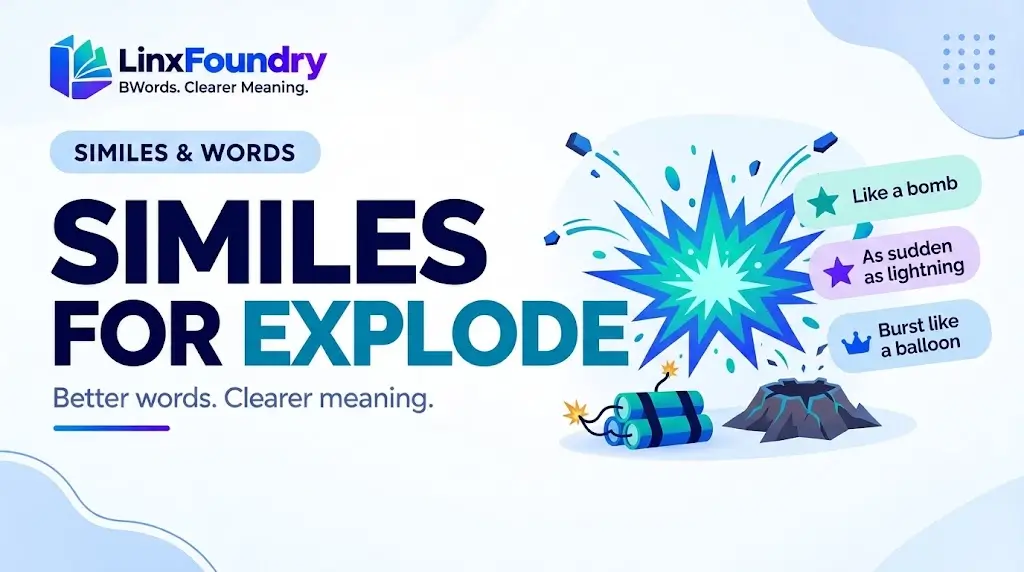
Similes for explode describe something bursting suddenly, releasing tremendous energy, or erupting with intense emotion. You can compare an explosion to fireworks lighting up the sky, a balloon popping, thunder cracking overhead, or a volcano releasing pressure. These comparisons help readers imagine the speed, sound, force, or emotional intensity of a moment.
The best simile depends on what you want to describe. A story about an actual explosion may need a powerful, dramatic comparison, while a sentence about someone losing their temper might work better with a volcano or a shaken bottle of soda. Below are 30 similes for explode, complete with meanings, example sentences, and practical advice for using them in creative writing.
Quick Answer: What Is a Good Simile for Explode?
A good simile for explode is “like a firework bursting across the night sky.” It describes a sudden, dramatic release of energy that fills the surroundings with light and sound. For anger, try “like a volcano erupting.” For a quick, sharp burst, use “like a balloon popping.” Choose a comparison that matches the intensity and context of your sentence.
30 Similes for Explode With Meanings and Examples
These comparisons cover literal explosions, sudden bursts of sound or movement, and figurative explosions of emotion. Some are familiar expressions, while others are original comparisons designed for descriptive writing.

1. Similes for Sudden and Powerful Explosions
Use these comparisons when a scene needs speed, force, surprise, or a dramatic release of energy.
1. Like a firework bursting across the night sky
Meaning: Something suddenly releases energy in a bright, dramatic display.
Example: The mysterious object burst like a firework across the night sky, filling the darkness with flashes of light.
Best for: Fiction, action scenes, and vivid descriptions of light.
2. Like a balloon popping without warning
Meaning: Something happens suddenly and unexpectedly, often with a sharp sound.
Example: The silence broke like a balloon popping without warning.
Best for: Surprise, sudden noises, and abrupt changes.
3. Like a thunderclap splitting the sky
Meaning: An explosive sound or event arrives with tremendous force.
Example: The blast sounded like a thunderclap splitting the sky, startling everyone nearby.
Best for: Dramatic scenes, powerful sounds, and suspense.
4. Like a volcano bursting through its crust
Meaning: A powerful release of energy breaks through a barrier.
Example: His frustration erupted like a volcano bursting through its crust.
Best for: Intense anger, dramatic releases of emotion, and powerful fictional events.
5. Like a pressure cooker releasing steam
Meaning: Built-up pressure suddenly escapes after increasing for some time.
Example: After weeks of tension, the argument erupted like a pressure cooker releasing steam.
Best for: Family conflicts, workplace tension, and emotional climaxes.
6. Like a drum struck with all its force
Meaning: A sudden impact produces a strong, resonant sound.
Example: The noise hit the empty hall like a drum struck with all its force.
Best for: Sound descriptions and dramatic moments.
7. Like a wave crashing against a seawall
Meaning: A powerful force arrives suddenly and strikes with overwhelming energy.
Example: The crowd’s excitement surged like a wave crashing against a seawall.
Best for: Powerful emotions, crowds, and dramatic action.
8. Like a spark igniting a dry field
Meaning: A small trigger causes a much larger and faster reaction.
Example: One careless remark spread through the meeting like a spark igniting a dry field.
Best for: Arguments, rumors, escalating conflicts, and chain reactions.
2. Similes for Anger Exploding
When people say someone “exploded,” they often mean that the person suddenly became extremely angry. These comparisons help communicate the buildup, intensity, and release of frustration.
9. Like a volcano erupting
Meaning: Anger bursts out with great intensity after pressure has accumulated.
Example: When he discovered the damage, he erupted like a volcano.
Best for: Sudden, intense anger after prolonged frustration.
10. Like a shaken bottle of soda finally opened
Meaning: Suppressed feelings escape suddenly after growing under pressure.
Example: After holding back her complaints for months, she reacted like a shaken bottle of soda finally opened.
Best for: Stories about bottled-up emotions and long-running disagreements.
11. Like a match flaring in the wind
Meaning: Anger ignites quickly, often in response to a small trigger.
Example: His temper flared like a match in the wind when his work was criticized.
Best for: Quick irritation and impulsive reactions.
12. Like a dam giving way
Meaning: Emotions that have been held back suddenly pour out.
Example: When she finally spoke about her disappointment, her words came like a dam giving way.
Best for: Emotional confrontations, grief, frustration, and dramatic dialogue.
13. Like a furnace suddenly opening
Meaning: A powerful wave of heat or anger emerges all at once.
Example: His face reddened, and his anger surged like a furnace suddenly opening.
Best for: Describing heated arguments and visible anger.
14. Like a storm breaking over the hills
Meaning: Strong emotions arrive suddenly and dramatically.
Example: Her carefully controlled frustration broke loose like a storm over the hills.
Best for: Literary writing and scenes involving a dramatic change in mood.
15. Like a pressure valve snapping open
Meaning: Accumulated tension releases suddenly and forcefully.
Example: His laughter turned into a furious outburst like a pressure valve snapping open.
Best for: Stress, frustration, and emotional turning points.
3. Similes for Exploding With Laughter
The word explode can also describe laughter that starts suddenly and becomes difficult to control. These similes help make humorous scenes feel energetic and believable.
16. Like a firecracker going off
Meaning: Laughter bursts out quickly and loudly.
Example: The class erupted in laughter like a firecracker going off.
Best for: Comedy, school stories, and sudden group laughter.
17. Like popcorn popping in a hot pan
Meaning: Laughter spreads in quick, irregular bursts.
Example: Giggles traveled around the table like popcorn popping in a hot pan.
Best for: Playful scenes and laughter that spreads through a group.
18. Like a burst of bubbles from a shaken bottle
Meaning: Laughter escapes in a lively rush of little bursts.
Example: Her laughter bubbled out like a burst of bubbles from a shaken bottle.
Best for: Lighthearted scenes and cheerful characters.
19. Like a dam of giggles breaking loose
Meaning: Suppressed laughter suddenly becomes impossible to contain.
Example: The students tried to stay quiet, but their giggles broke loose like a dam giving way.
Best for: Classroom stories, awkward moments, and shared jokes.
20. Like a party popper bursting open
Meaning: A sudden, cheerful burst of laughter fills a moment with energy.
Example: When he revealed the ridiculous costume, his friends laughed like a party popper bursting open.
Best for: Funny stories and light, celebratory scenes.
4. Similes for Exploding With Excitement or Joy
These comparisons are useful when someone reacts to wonderful news, a surprise, a victory, or an eagerly awaited event.
21. Like fireworks lighting up the horizon
Meaning: Excitement appears suddenly and spreads with dazzling energy.
Example: When she heard that she had won the competition, happiness burst through her like fireworks lighting up the horizon.
Best for: Celebrations, victories, and joyful revelations.
22. Like a shaken bottle of sparkling water
Meaning: Excitement builds until it can barely be contained.
Example: The children bounced around like a shaken bottle of sparkling water as they waited for the surprise.
Best for: Anticipation, celebrations, and energetic characters.
23. Like a confetti cannon going off
Meaning: Joy bursts out in a colorful, enthusiastic display.
Example: His face lit up like a confetti cannon going off when he saw his birthday decorations.
Best for: Parties, happy surprises, and festive scenes.
24. Like a spring released from a tight coil
Meaning: Stored energy suddenly turns into movement or action.
Example: The runner shot forward like a spring released from a tight coil when the starting signal sounded.
Best for: Sports, sudden movement, and pent-up excitement.
25. Like sunlight breaking through heavy clouds
Meaning: A sudden positive feeling replaces gloom or uncertainty.
Example: Relief spread through the room like sunlight breaking through heavy clouds when the good news arrived.
Best for: Emotional relief, hope, and uplifting stories.
5. Similes for Sudden Movement and Rapid Change
Sometimes explode describes something spreading, appearing, or moving outward with remarkable speed. These comparisons focus on the rapid change rather than physical destruction.
26. Like seeds bursting from a ripe pod
Meaning: Something suddenly spreads outward from a contained space.
Example: The ideas burst from her imagination like seeds bursting from a ripe pod.
Best for: Creativity, growth, and sudden expansion.
27. Like a flock of birds scattering at a clap
Meaning: People or objects move away quickly in different directions.
Example: At the unexpected noise, the children scattered like a flock of birds startled by a clap.
Best for: Crowds, sudden movement, and scenes of surprise.
28. Like a dropped bag of marbles scattering across the floor
Meaning: Small objects spread rapidly and unpredictably in multiple directions.
Example: The loose beads flew across the table like marbles scattering across a floor.
Best for: Physical comedy, accidents, and descriptions of scattered objects.
29. Like a match touching a trail of dry leaves
Meaning: A small event triggers a rapid spread or escalation.
Example: The rumor spread through the office like a match touching a trail of dry leaves.
Best for: Rumors, fast-growing problems, and escalating situations.
30. Like a wave of lights switching on across a city
Meaning: A change spreads quickly across a large area.
Example: As the stadium celebrated, excitement spread through the crowd like lights switching on across a city.
Best for: Large crowds, collective excitement, and scenes of widespread change.
Best Similes for Explode at a Glance
| Simile | Meaning | Best used for |
|---|---|---|
| Like a firework bursting across the sky | A dramatic release of energy | Action and visual description |
| Like a balloon popping | A sudden, unexpected event | Surprise and sharp sounds |
| Like a volcano erupting | Intense, released emotion | Anger and frustration |
| Like a shaken bottle of soda opening | Pressure suddenly escapes | Suppressed feelings |
| Like a firecracker going off | Sudden, loud laughter | Comedy |
| Like a confetti cannon bursting open | Joyful energy appears suddenly | Celebrations |
| Like a spring released from a tight coil | Stored energy becomes movement | Sports and action |
| Like a dam giving way | Emotions spill out | Emotional scenes |
| Like a spark igniting a dry field | A small trigger causes rapid escalation | Conflict and rumors |
| Like a wave crashing against a seawall | A powerful force arrives suddenly | Dramatic action |
What Does “Explode” Mean in Figurative Language?
In figurative language, explode often describes a sudden, intense change rather than a literal physical blast. Someone can explode with anger, a room can explode with laughter, or an idea can explode into a burst of creativity.
The word usually suggests three qualities:
- Suddenness: The event happens quickly, often without warning.
- Intensity: The reaction feels stronger than an ordinary response.
- Release or expansion: Something spreads outward or escapes after being contained.
A simile adds a recognizable image to one or more of these qualities. Comparing anger to a volcano emphasizes force, while comparing excitement to fireworks highlights brightness, movement, and celebration.
Choose the image that matches your intended meaning instead of treating every explosion as destructive.
How to Use Similes for Explode in Writing
A strong simile should make the sentence more vivid without distracting the reader. Consider the situation, the intensity of the action, and the tone of the passage.
1. For stories
Use a powerful image when a scene changes suddenly.
Plain sentence: The noise was very loud.
Improved sentence: The noise cracked through the abandoned building like a thunderclap splitting the sky.
The comparison makes the sound feel sharp and dramatic.
2. For describing anger
Choose an image that explains how the emotion develops.
Plain sentence: Mark became angry after the argument.
Improved sentence: Mark’s temper erupted like a volcano after the final accusation.
The volcano suggests intense anger that has finally broken through.
3. For poems
Choose comparisons that fit the mood and rhythm of your lines.
Example:
Her laughter burst like fireworks in the rain,
Then faded softly into silence again.
This comparison creates a vivid image while contrasting lively emotion with a quiet ending.
4. For school assignments
Use a clear, familiar comparison that directly explains the action.
Example: The balloon popped like a tiny firecracker.
This is easy to understand because both events suggest a sudden, sharp burst.
5. For humorous writing
Use an unexpected but understandable image.
Example: When Dad saw the enormous bill, his temper popped like a balloon at a birthday party.
The familiar image makes the sentence more playful than a serious comparison with a volcano.
Using “Like” and “As” to Describe an Explosion
Most of the examples above use like, which creates a direct comparison between an event and a familiar image.
- Using like: The crowd erupted like a firecracker going off.
- Using as: The room grew as loud as a thunderclap when the audience shouted.
The second example uses the as + adjective + as structure. It compares loudness rather than claiming that the room literally exploded.
You can also use other grammatical structures when they sound more natural. For example, “Her anger burst out like steam from a kettle” clearly describes an emotional release.
Remember that a simile must make a comparison. “The volcano exploded” is a literal or direct statement, not a simile by itself.
How to Choose the Right Simile
Use this quick guide when deciding which comparison fits your sentence.
- For suddenness: Choose a balloon popping or a firecracker going off.
- For tremendous force: Choose a thunderclap or a powerful wave.
- For anger: Choose a volcano erupting or a pressure valve snapping open.
- For bottled-up feelings: Choose a shaken bottle of soda or a dam giving way.
- For laughter: Choose popcorn popping or a burst of giggles.
- For happiness: Choose fireworks or a confetti cannon.
- For rapid movement: Choose a released spring or a flock of birds scattering.
- For a small trigger causing a large reaction: Choose a spark igniting dry leaves.
Avoid using the strongest comparison in every sentence. If each moment sounds explosive, the reader has little room to recognize which moment matters most.
Common Mistakes When Writing Similes for Explode
Choosing an image that does not fit the emotion. A cheerful fireworks comparison may suit excitement but could weaken a serious scene about anger.

Mixing too many comparisons. “He exploded like a volcano, a firework, and a thunderstorm” gives the reader several competing images. Choose the strongest one.
Using a simile when a direct verb is clearer. “She shouted furiously” may work better than a comparison when the sentence needs to move quickly.
Confusing a simile with a metaphor. “His anger was a volcano” is a metaphor. “His anger erupted like a volcano” is a simile because it uses like to compare two things.
Overusing explosive imagery. Reserve the most dramatic comparisons for moments that deserve emphasis.
Final Thoughts
Similes for explode help writers describe sudden force, intense anger, uncontrollable laughter, excitement, and rapid change. The most effective comparison depends on the feeling or action you want readers to imagine. A balloon popping conveys surprise, a volcano suggests powerful anger, and fireworks create a sense of spectacle and joy.
When choosing a simile, focus on one clear image and connect it directly to the scene. You can also create original comparisons by thinking about what happens during an explosion: pressure builds, energy escapes, sounds erupt, and objects or emotions spread outward. Use those qualities to develop descriptions that feel natural, vivid, and appropriate for your writing.

Emily Carter
Emily Carter specializes in word choice, writing clarity, vocabulary development, and practical English usage. Her articles explain similar words, highlight differences in meaning, and provide examples to help readers communicate more naturally and confidently.