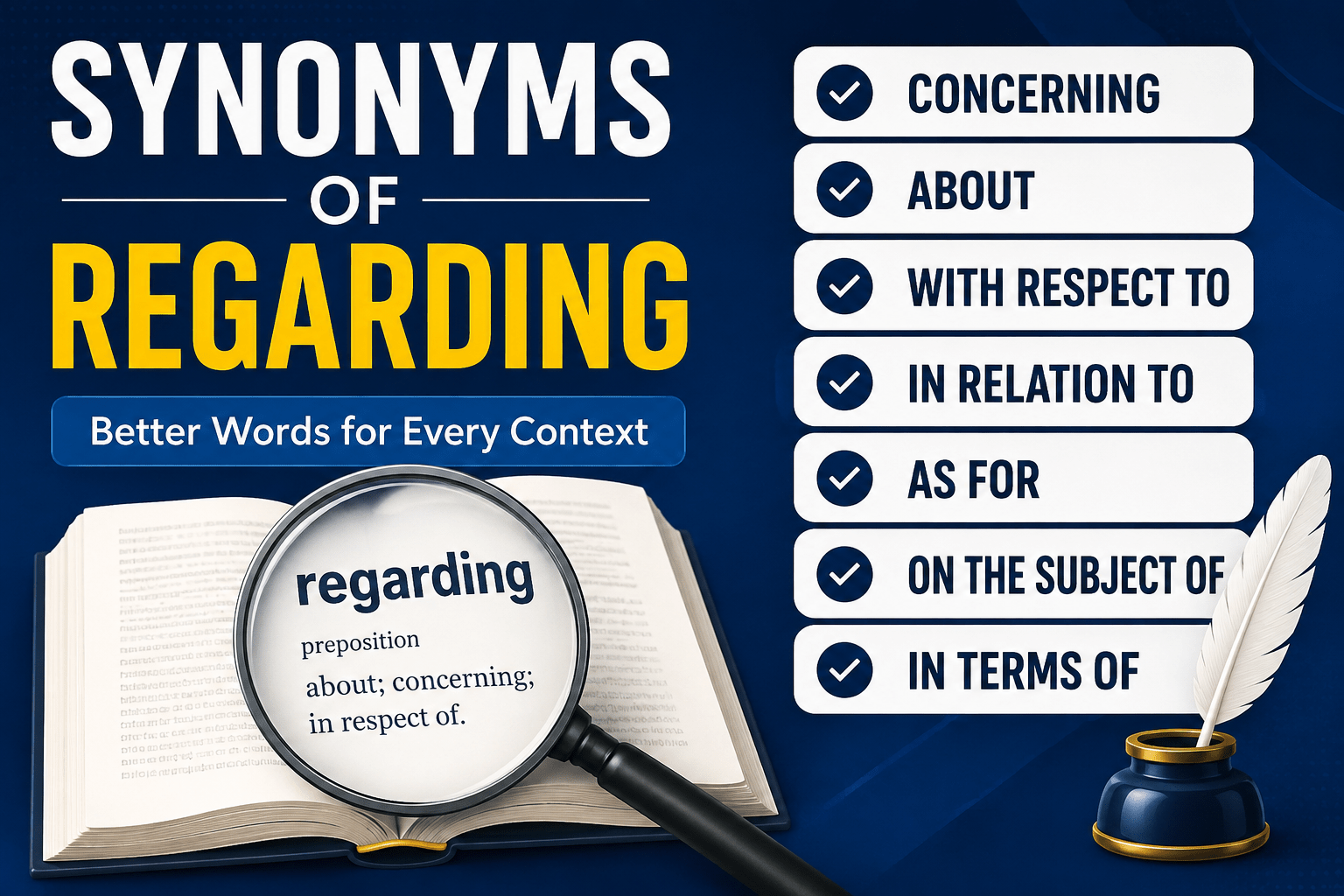
If you need a synonym for regarding, the best choice depends mainly on tone and context. Concerning is one of the closest alternatives, while about is more conversational and with respect to is more formal. Other useful alternatives include with regard to, in regard to, as regards, as to, in relation to, with reference to, and pertaining to.
The important point is that these expressions are not perfectly interchangeable in every sentence. Some are natural in everyday English, some are especially useful in professional or academic writing, and others work best when you want to introduce or narrow a particular topic.
Quick Answer: What Are the Best Synonyms of Regarding?
The closest synonyms of regarding are concerning, about, respecting, with respect to, with regard to, and as regards. For everyday English, about is usually the simplest choice. For formal or professional writing, concerning, with respect to, with regard to, and with reference to are useful alternatives. As for and on can work in particular contexts but are not universal replacements.
What Does “Regarding” Mean?
Regarding is a preposition meaning about, concerning, or relating to a particular person or subject. It is commonly used to identify the topic of a statement, question, letter, discussion, decision, or action.
For example:
I am writing regarding your recent application.
This means:
I am writing about your recent application.
Cambridge labels regarding as formal and defines it in terms of about or in relation to. Oxford similarly defines it as relating to someone or something or being about someone or something. Merriam-Webster gives concerning and with respect to among its synonyms.
Pronunciation
- US: /rɪˈɡɑːr.dɪŋ/
- UK: /rɪˈɡɑː.dɪŋ/
The pronunciation is essentially the same in both varieties, with the main difference occurring in the treatment of the r sound.
Core Synonyms of Regarding
| Word or Phrase | Relationship | Strength | Formality | Best Context |
|---|---|---|---|---|
| concerning | Direct synonym | Equal | Formal/neutral | Professional and general writing |
| about | Direct synonym | Equal | Neutral/casual | Everyday English |
| with respect to | Direct synonym | Equal | Formal | Academic, legal, professional |
| with regard to | Direct synonym | Equal | Formal | Business and formal writing |
| in regard to | Direct synonym | Equal | Formal | Professional writing |
| as regards | Near/direct synonym | Equal | Formal | Formal written English |
| as to | Near synonym | Equal | Neutral/formal | Questions and specific matters |
| in relation to | Near synonym | Similar | Formal | Relationships and broader contexts |
| with reference to | Contextual alternative | Similar | Formal | Documents, correspondence |
| pertaining to | Contextual alternative | Similar | Formal | Official, technical, legal contexts |
| on | Contextual alternative | Similar | Neutral | Topics, subjects, writing |
| as for | Contextual alternative | Similar | Neutral | Introducing or shifting topics |
| in connection with | Contextual alternative | Similar | Formal/neutral | Related matters or events |
| respecting | Near synonym | Similar | Formal/old-fashioned in some contexts | Formal statements |
| re | Contextual alternative | Topic marker | Very formal/abbreviated | Business correspondence |
The first group contains the most dependable replacements. The later expressions should be treated as contextual alternatives, because replacing regarding with them in every sentence can change the emphasis or sound unnatural.
1. Concerning
Concerning is probably the strongest one-word alternative to regarding in formal English.
Meaning: About or relating to a particular subject.
How it differs: It generally preserves the meaning of regarding without adding a major change in tone.
Best used for: Business writing, formal correspondence, reports, academic prose, and general written English.
Example:
We received several questions concerning the new policy.
Compare:
We received several questions regarding the new policy.
Both sentences are natural and essentially equivalent.
Cambridge explicitly places concerning alongside regarding and about when discussing ways of introducing a subject.
2. About
About is the simplest and most natural everyday alternative to regarding.
Meaning: On the subject of or concerning something.
How it differs: About is less formal. It often sounds more conversational and less bureaucratic than regarding.
Best used for: Everyday conversation, ordinary emails, informal writing, and accessible prose.
Example:
I have a question about your proposal.
More formal:
I have a question regarding your proposal.
If your sentence sounds unnecessarily stiff with regarding, about is often the best replacement.
3. With Respect To
With respect to is a formal phrase meaning concerning or in relation to.
Best used for: Academic, professional, legal, technical, and formal writing.
Example:
We need additional information with respect to the proposed changes.
It is particularly useful when you want to make the relationship between a statement and a specific subject explicit.
However, it can sound unnecessarily formal in casual conversation.
Natural:
I have a question about the schedule.
More formal:
I have a question with respect to the schedule.
4. With Regard To
With regard to is a very close formal alternative to regarding.
Example:
We have received your letter with regard to the contract.
It is common in professional correspondence and formal documents.
You can often substitute one for the other:
I am contacting you regarding your application.
I am contacting you with regard to your application.
The second version is somewhat more phrase-heavy, so regarding may be preferable when you want concise professional prose.
5. In Regard To
In regard to also means concerning or about.
Example:
We have several concerns in regard to the proposed agreement.
It is a formal construction and is particularly appropriate when the surrounding sentence is already formal.
Do not confuse it with in regards to when writing carefully edited formal English. In regard to and with regard to are the standard constructions to prefer in formal writing.
6. As Regards
As regards means concerning or with respect to.
Example:
As regards the final section, we recommend making several changes.
It is grammatical and established, but it is more formal and less conversational than about or regarding.
Use it when the formal tone is intentional rather than simply because a thesaurus lists it as a synonym.
7. As To
As to can mean concerning or about, but it has a narrower range of use than regarding.
Example:
There is still uncertainty as to whether the plan will succeed.
This construction is particularly natural before questions, choices, uncertainties, or specific points.
For example:
We have not yet decided as to which option is best.
However, this does not mean that as to should replace regarding mechanically in every sentence.
8. In Relation To
In relation to means in connection with or concerning something.
Example:
The report raises several questions in relation to data privacy.
It is useful when you want to emphasize a relationship between two things rather than simply identify a topic.
Compare:
She contacted me regarding the project.
She contacted me in relation to the project.
The first simply identifies the subject. The second can suggest a connection between the contact and the project.
9. With Reference To
With reference to is a formal expression meaning concerning or in relation to a particular matter.
Example:
With reference to your email of 12 August, we have reviewed the requested documents.
This expression is especially natural in formal correspondence.
It can sound excessively bureaucratic in ordinary conversation, where about would usually be better.
10. Pertaining To
Pertaining to means relating to or concerning something.
Example:
The files pertaining to the investigation were reviewed.
It is particularly common in formal, administrative, legal, and technical contexts.
However, it is not always the most natural replacement for regarding.
Compare:
I have a question regarding your application.
I have a question pertaining to your application.
The second is grammatical, but noticeably more formal and less conversational.
11. On
On can sometimes replace regarding when introducing the subject of discussion, writing, research, or a presentation.
Example:
She gave a presentation on workplace communication.
This does not mean on is a universal synonym for regarding. It works particularly well when the following noun represents a topic or subject.
Natural:
an article on climate change
a lecture on modern literature
Less natural as a mechanical replacement:
I am writing on your application.
In the second sentence, regarding or about would usually be better.
12. As For
As for can introduce a person, thing, or topic that is being considered separately or contrasted with something else.
Example:
As for the budget, we will discuss it tomorrow.
It is therefore a contextual alternative, not a direct replacement for regarding.
Compare:
We have several questions regarding the budget.
As for the budget, we will discuss it tomorrow.
The second sentence shifts attention toward the budget. That additional discourse function is not necessarily present in regarding.
13. In Connection With
In connection with means related to or associated with something.
Example:
She was contacted in connection with the investigation.
This phrase is especially useful when the relationship between two events, actions, or matters matters more than simply identifying a topic.
It is therefore best treated as a contextual alternative rather than a perfect synonym.
14. Respecting
Respecting can mean concerning or with regard to, particularly in formal English.
Example:
The rules respecting the use of the property are clearly stated.
However, modern readers may find it more formal or less familiar than regarding or concerning.
There is also a potential ambiguity: respecting can refer to showing respect. Because of that, it is usually not the first choice for contemporary general-purpose writing.
15. Re
Re is an abbreviated formal expression used to identify the subject of correspondence or documents.
For example:
Re: Application for Marketing Manager
Here re means approximately regarding, concerning, or in reference to.
It is best treated as a correspondence convention, not as a normal replacement for regarding in ordinary sentences.
Closest Synonyms vs Contextual Alternatives
One of the most important distinctions is that a thesaurus list can make several expressions look interchangeable when they are not.
Closest replacements
These usually preserve the meaning of regarding well:
- concerning
- about
- with respect to
- with regard to
- in regard to
- as regards
Near synonyms
These overlap strongly but can introduce a slightly different emphasis:
- as to
- in relation to
- respecting
Contextual alternatives
These work naturally in particular constructions:
- with reference to
- pertaining to
- on
- as for
- in connection with
- re
This distinction prevents a common vocabulary mistake: assuming that every word listed by a thesaurus can replace the original word in every sentence.
Which Synonym of “Regarding” Should You Use?
The easiest way to choose is to think about tone and function.
Use “about” when:
You want simple, natural, everyday English.
I wanted to ask about the meeting.
Use “concerning” when:
You want a close formal alternative.
We received a complaint concerning the service.
Use “with respect to” when:
You are writing formally and want to specify the subject precisely.
Several questions remain with respect to the agreement.
Use “with regard to” when:
You are writing a formal email, letter, report, or business document.
With regard to your request, we have attached the relevant documents.
Use “as to” when:
You are introducing uncertainty, a question, or a specific point.
There is some disagreement as to how the rule should be interpreted.
Use “on” when:
You are naming the subject of a book, article, lecture, course, or discussion.
She published a paper on language acquisition.
Use “as for” when:
You are shifting attention to a particular topic.
As for the final proposal, we need more time to review it.
Regarding in Professional and Academic Writing
Regarding is especially useful when you want a concise, formal way to introduce the subject of a communication.
Professional email
I am writing regarding your recent application.
This is concise and conventional.
You could also write:
I am writing concerning your recent application.
Or:
I am writing with regard to your recent application.
The first alternative remains close to the original, while the second is more formal and somewhat more elaborate.
Academic writing
In academic prose, the choice depends on the sentence.
The study examined several factors regarding student motivation.
This is possible, but concerning, related to, or a more specific construction may sometimes produce clearer prose.
For example:
The study examined several factors related to student motivation.
This illustrates an important point: the best replacement is not always the closest thesaurus synonym. Sometimes rewriting the sentence produces more natural English.
Regarding vs About
These two words have almost the same basic meaning, but their register differs.
| Word | Tone | Typical Use |
| about | Neutral/casual | Conversation and ordinary writing |
| regarding | Formal/neutral | Professional and formal writing |
Compare:
I have a question about your invoice.
I have a question regarding your invoice.
Both are correct. The second simply sounds more formal.
For most everyday communication, about is often the more natural choice. For professional correspondence, regarding can provide a concise formal tone.
Regarding vs Concerning
These are among the closest alternatives.
We received several complaints regarding the service.
We received several complaints concerning the service.
Both sentences naturally identify the subject of the complaints.
The difference is mainly stylistic and contextual rather than a major difference in core meaning. Cambridge groups regarding, about, and concerning together in its usage discussion.
One caution: concerning can have another meaning as an adjective, meaning causing worry:
The results are concerning.
That meaning is completely different from the preposition concerning in:
Information concerning the investigation was withheld.
Context makes the distinction clear.
Regarding vs With Regard To
These expressions are closely related:
I am writing regarding your request.
I am writing with regard to your request.
The first is shorter and generally more economical. The second is a longer formal phrase.
If clarity and concision are priorities, regarding is often preferable.
If you are writing a highly formal letter or document, with regard to may fit naturally with the surrounding style.
Common Mistakes
1. Treating every related phrase as an exact synonym
Words such as as for, on, and in connection with have additional meanings or functions. They should not automatically replace regarding.
2. Using “about” in every formal sentence
About is perfectly correct, but a formal document may call for regarding, concerning, or with respect to depending on the context.
3. Overusing “with respect to”
It is grammatical, but it can make simple writing unnecessarily heavy.
Instead of:
With respect to your question, we have reached a decision.
You could simply write:
Regarding your question, we have reached a decision.
Or:
We have reached a decision about your question.
4. Using “on” mechanically
On works naturally with subjects such as:
a book on history
a lecture on economics
But it is not a universal substitute for regarding.
5. Assuming “respecting” always sounds modern and natural
Although respecting can mean concerning, it is more formal and less common in many modern contexts. Regarding or concerning will usually be clearer.
Natural Collocations With “Regarding”
Some common patterns include:
- regarding your request
- regarding your application
- regarding the matter
- regarding the issue
- regarding the decision
- regarding the policy
- regarding the proposal
- regarding the contract
- regarding the situation
- questions regarding
- concerns regarding
- information regarding
- details regarding
- a statement regarding
Examples:
Please contact us if you have any questions regarding your account.
The committee raised several concerns regarding the proposal.
We need more information regarding the incident.
In many of these phrases, concerning works naturally as well.
Real-World Word Choice Examples
Everyday conversation
Do you have any questions about the plan?
Best choice: about
Professional email
I am contacting you regarding your application.
Best choice: regarding
Formal report
The report contains several recommendations concerning workplace safety.
Best choice: concerning
Legal or highly formal writing
The parties reached an agreement with respect to the disputed property.
Best choice: with respect to
Academic discussion
The researchers identified several issues in relation to the sampling method.
Best choice: in relation to
Formal correspondence
With reference to your letter dated 10 August, we have reviewed the matter.
Best choice: with reference to
Antonyms of “Regarding”
Because regarding is a preposition meaning about or concerning, it does not have a simple one-word antonym in the same way that an adjective such as similar has different.
Depending on the intended meaning, contrasting concepts may include:
- unrelated to
- irrespective of
- independent of
- separate from
- apart from
These are not strict grammatical antonyms of regarding, but they can express the opposite idea of not being connected with a particular subject.
FAQ
What is the closest synonym for “regarding”?
Concerning is one of the closest one-word synonyms. About, with respect to, and with regard to can also replace regarding in many contexts.
What is a simple synonym for “regarding”?
About is the simplest and most conversational alternative.
What is a formal synonym for “regarding”?
Good formal alternatives include concerning, with respect to, with regard to, as regards, and with reference to.
Is “about” the same as “regarding”?
Usually, yes. Both can introduce the subject of a statement. The main difference is register: about is more neutral and conversational, while regarding is more formal.
Is “concerning” a synonym for “regarding”?
Yes. When concerning functions as a preposition meaning about or relating to, it is a very close synonym of regarding.
Is “with regards to” correct?
In careful formal writing, prefer with regard to or with regard to-type constructions rather than treating with regards to as the standard form. With regard to is the conventional expression meaning concerning.
What is a professional alternative to “regarding”?
Concerning, with regard to, and with respect to are useful professional alternatives. In many business emails, however, regarding itself is already concise and professional.
Which is more formal: “about” or “regarding”?
Regarding is generally more formal than about. Cambridge specifically labels regarding as formal.
Conclusion
The best synonym for regarding depends on what you want your sentence to sound like. About is the most natural simple alternative, concerning is one of the closest formal equivalents, and with respect to or with regard to work well in more formal writing. As to, in relation to, on, as for, and with reference to are useful in particular contexts but should not be treated as universal replacements.
For most professional writing, the safest choices are regarding, concerning, about, with regard to, and with respect to. Choose the shortest expression that accurately conveys the relationship you mean.

Daniel Carter is a professional content strategist and language enthusiast. He focuses on semantic SEO, keyword research, and creating structured vocabulary content that ranks well on search engines while remaining user-friendly.